ADVERTISEMENT

Bridging the accountability gap on 'super health centers'

Published Oct 20, 2025 12:05 am  |  Updated Oct 19, 2025 03:22 pm
The controversy over the so-called “super health centers” now scattered across the country reveals the persistent failure of governance that continues to afflict the nation’s health system.
The Department of Health (DOH) reported to the Independent Commission for Infrastructure (ICI) last week that, contrary to claims attributed to the Department of Public Works and Highways (DPWH), many such centers are not yet ready for occupancy. This clash of claims exposes not just poor project coordination but a deeper malaise: the absence of clear accountability in implementing programs that are meant to deliver essential services to the people.
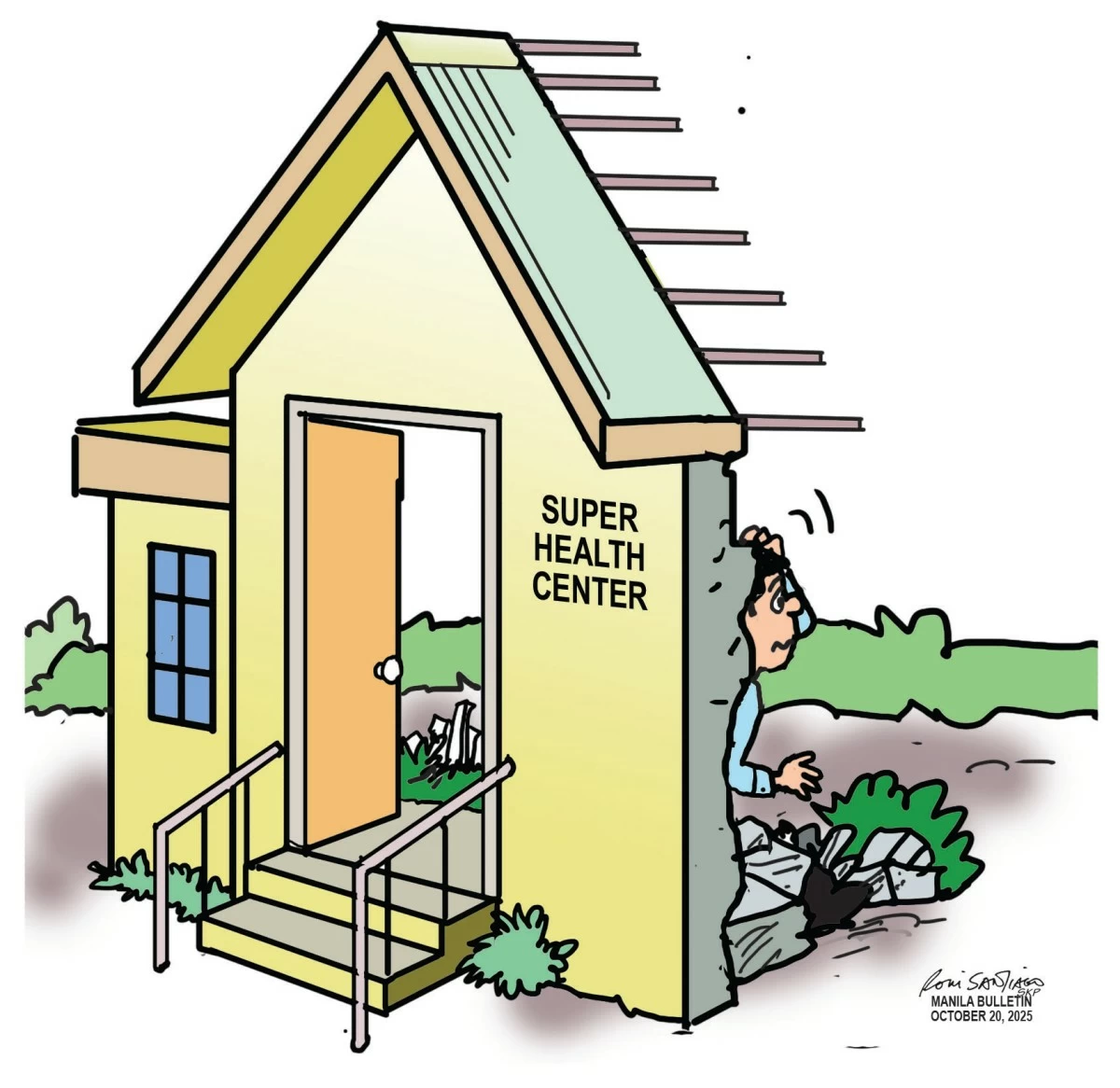
Conceived as part of the government’s effort to bring primary health care closer to the grassroots, these “super health centers” were meant to serve as intermediate facilities between rural health units and provincial hospitals—offering outpatient, diagnostic, and birthing services. Yet, as reports now show, many have turned into ghost structures: padlocked buildings without equipment, personnel, or even utilities. Built on the back of congressional allocations and executed by the DPWH, these projects have been hobbled by the familiar diseases of politicized infrastructure spending, bureaucratic turf wars, and weak oversight.
The problem is systemic. Since the 1991 Local Government Code devolved health services to local government units (LGUs), the capacity gap among them has become glaring. Wealthier cities and provinces sustain well-equipped hospitals, while poorer municipalities depend on underfunded rural health units. National agencies, instead of closing this gap, have often aggravated it through fragmented programs that blur lines of responsibility. The result: overlapping mandates, redundant spending, and uneven delivery of care.
Accountability for these failed or incomplete projects cannot be diffused among agencies. The DOH, as the policy authority on health, must assert full control over project design, quality assurance, and operational readiness. The DPWH, whose role is primarily infrastructure, should not act as a parallel implementing agency beholden to congressional sponsors, but must focus its efforts on delivering quality finished projects in a timely manner.
The Commission on Audit (COA) should step in to determine whether public funds for these centers were properly disbursed and whether contractual obligations were fulfilled. Without such scrutiny, the so-called “super health centers” risk joining the long list of white elephants that litter our local landscapes.
At the heart of this controversy lies the unfinished agenda of reforms in the devolution of local autonomy.
The Mandanas-Garcia ruling has expanded LGU fiscal space through higher tax shares, but local capacity remains uneven. The DOH must help build local competencies by guiding, training, and monitoring LGUs under a unified national health framework. National government should not abdicate its stewardship role; it must ensure that every health facility, whether built by the DPWH or managed by an LGU, meets national standards of safety, functionality, and accessibility.
Deficiencies in governance undermine the promise of the Universal Health Care (UHC) Act of 2019, which envisions an integrated and equitable health system where every Filipino has access to quality care without financial hardship. That vision depends on a strong network of functioning primary care facilities which is the very role the “super health centers” were meant to fulfill. Unless these facilities are completed, staffed, and sustainably operated, UHC will remain a legal aspiration rather than a lived reality.
The unfinished “super health centers” stand as concrete symbols of the country’s governance deficit. To rebuild public confidence, the government must finish the buildings and demonstrate its political will in instituting reforms that truly benefit the Filipino people.
ADVERTISEMENT
.most-popular .layout-ratio{ padding-bottom: 79.13%; } @media (min-width: 768px) and (max-width: 1024px) { .widget-title { font-size: 15px !important; } }

{{ articles_filter_1561_widget.title }}

.most-popular .layout-ratio{ padding-bottom: 79.13%; } @media (min-width: 768px) and (max-width: 1024px) { .widget-title { font-size: 15px !important; } }

{{ articles_filter_1562_widget.title }}

.most-popular .layout-ratio{ padding-bottom: 79.13%; } @media (min-width: 768px) and (max-width: 1024px) { .widget-title { font-size: 15px !important; } }

{{ articles_filter_1563_widget.title }}

{{ articles_filter_1564_widget.title }}

.mb-article-details { position: relative; } .mb-article-details .article-body-preview, .mb-article-details .article-body-summary{ font-size: 17px; line-height: 30px; font-family: "Libre Caslon Text", serif; color: #000; } .mb-article-details .article-body-preview iframe , .mb-article-details .article-body-summary iframe{ width: 100%; margin: auto; } .read-more-background { background: linear-gradient(180deg, color(display-p3 1.000 1.000 1.000 / 0) 13.75%, color(display-p3 1.000 1.000 1.000 / 0.8) 30.79%, color(display-p3 1.000 1.000 1.000) 72.5%); position: absolute; height: 200px; width: 100%; bottom: 0; display: flex; justify-content: center; align-items: center; padding: 0; } .read-more-background a{ color: #000; } .read-more-btn { padding: 17px 45px; font-family: Inter; font-weight: 700; font-size: 18px; line-height: 16px; text-align: center; vertical-align: middle; border: 1px solid black; background-color: white; } .hidden { display: none; }
function initializeAllSwipers() { // Get all hidden inputs with cms_article_id document.querySelectorAll('[id^="cms_article_id_"]').forEach(function (input) { const cmsArticleId = input.value; const articleSelector = '#article-' + cmsArticleId + ' .body_images'; const swiperElement = document.querySelector(articleSelector); if (swiperElement && !swiperElement.classList.contains('swiper-initialized')) { new Swiper(articleSelector, { loop: true, pagination: false, navigation: { nextEl: '#article-' + cmsArticleId + ' .swiper-button-next', prevEl: '#article-' + cmsArticleId + ' .swiper-button-prev', }, }); } }); } setTimeout(initializeAllSwipers, 3000); const intersectionObserver = new IntersectionObserver( (entries) => { entries.forEach((entry) => { if (entry.isIntersecting) { const newUrl = entry.target.getAttribute("data-url"); if (newUrl) { history.pushState(null, null, newUrl); let article = entry.target; // Extract metadata const author = article.querySelector('.author-section').textContent.replace('By', '').trim(); const section = article.querySelector('.section-info ').textContent.replace(' ', ' '); const title = article.querySelector('.article-title h1').textContent; // Parse URL for Chartbeat path format const parsedUrl = new URL(newUrl, window.location.origin); const cleanUrl = parsedUrl.host + parsedUrl.pathname; // Update Chartbeat configuration if (typeof window._sf_async_config !== 'undefined') { window._sf_async_config.path = cleanUrl; window._sf_async_config.sections = section; window._sf_async_config.authors = author; } // Track virtual page view with Chartbeat if (typeof pSUPERFLY !== 'undefined' && typeof pSUPERFLY.virtualPage === 'function') { try { pSUPERFLY.virtualPage({ path: cleanUrl, title: title, sections: section, authors: author }); } catch (error) { console.error('ping error', error); } } // Optional: Update document title if (title && title !== document.title) { document.title = title; } } } }); }, { threshold: 0.1 } ); function showArticleBody(button) { const article = button.closest("article"); const summary = article.querySelector(".article-body-summary"); const body = article.querySelector(".article-body-preview"); const readMoreSection = article.querySelector(".read-more-background"); // Hide summary and read-more section summary.style.display = "none"; readMoreSection.style.display = "none"; // Show the full article body body.classList.remove("hidden"); } document.addEventListener("DOMContentLoaded", () => { let loadCount = 0; // Track how many times articles are loaded const offset = [1, 2, 3, 4, 5, 6, 7, 8, 9, 10]; // Offset values const currentUrl = window.location.pathname.substring(1); let isLoading = false; // Prevent multiple calls if (!currentUrl) { console.log("Current URL is invalid."); return; } const sentinel = document.getElementById("load-more-sentinel"); if (!sentinel) { console.log("Sentinel element not found."); return; } function isSentinelVisible() { const rect = sentinel.getBoundingClientRect(); return ( rect.top < window.innerHeight && rect.bottom >= 0 ); } function onScroll() { if (isLoading) return; if (isSentinelVisible()) { if (loadCount >= offset.length) { console.log("Maximum load attempts reached."); window.removeEventListener("scroll", onScroll); return; } isLoading = true; const currentOffset = offset[loadCount]; window.loadMoreItems().then(() => { let article = document.querySelector('#widget_1690 > div:nth-last-of-type(2) article'); intersectionObserver.observe(article) loadCount++; }).catch(error => { console.error("Error loading more items:", error); }).finally(() => { isLoading = false; }); } } window.addEventListener("scroll", onScroll); });

Sign up by email to receive news.