






Manila Bulletin
 Philippines
National
'Preparedness is love in action': Advocate calls on Filipinos to strengthen disaster readiness at home
Philippines
National
'Preparedness is love in action': Advocate calls on Filipinos to strengthen disaster readiness at home
Philippines
National
'Preparedness is love in action': Advocate calls on Filipinos to strengthen disaster readiness at home
'Preparedness is love in action': Advocate calls on Filipinos to strengthen disaster readiness at home
Published Oct 19, 2025 12:31 pm


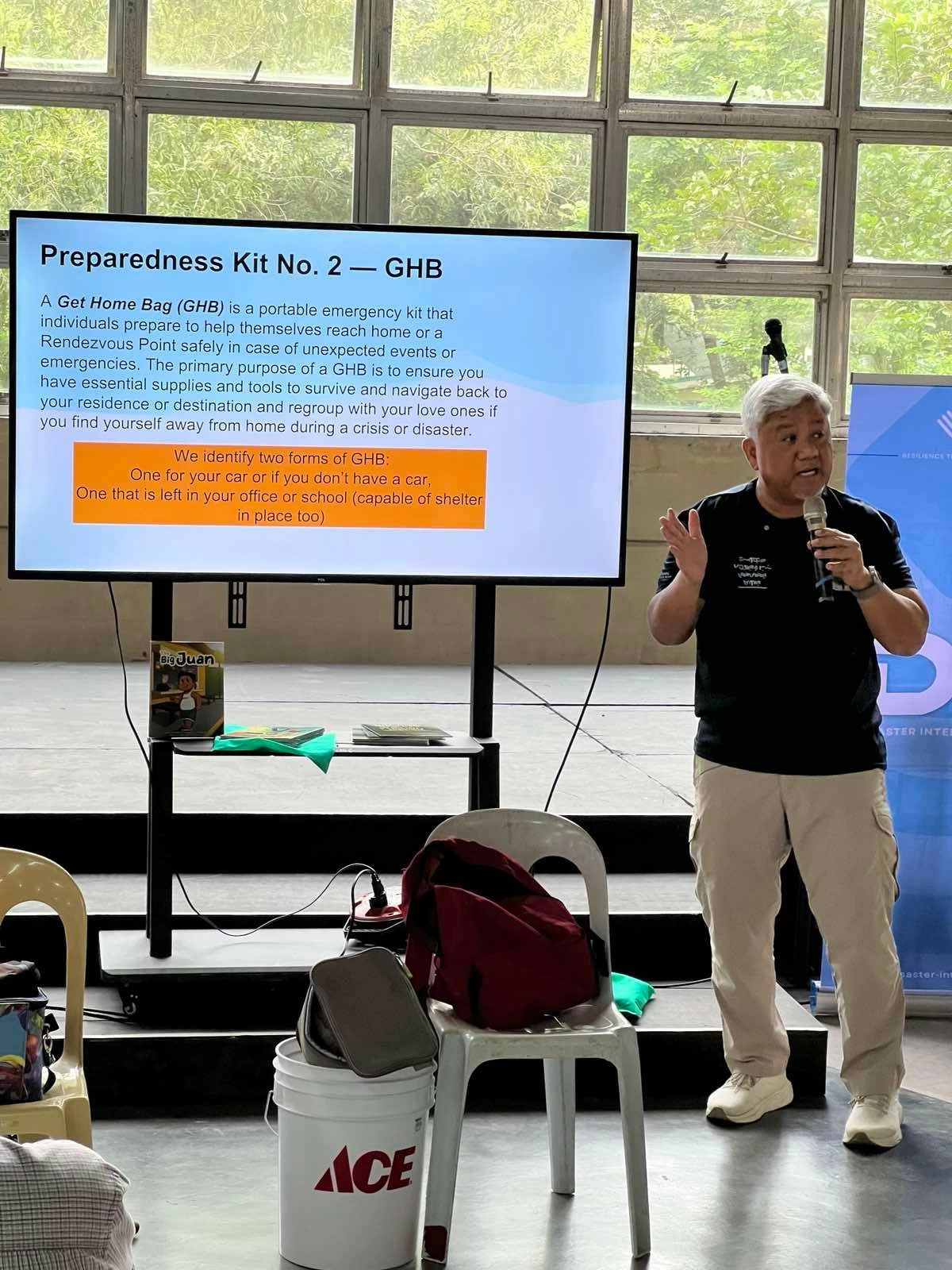
Mr. Jerry Vicente S. Catabijan, head of Nuvali Preppers, discusses essential disaster preparedness kits during the “Shake, Grab, Go!”, a public event on disaster preparedness held on Oct. 18, 2025 at the UP College of Architecture, University of the Philippines Diliman in Quezon City. (Contributed photo)
“Preparedness is love in action. Protect your family with a disaster kit.”
This was the core message of survival expert Jerry Vicente S. Catabijan, head of Nuvali Preppers, as he spoke about how every family can protect themselves by preparing a disaster kit especially amid recent powerful earthquakes that struck Davao Oriental, Cebu and other parts of the country.
Catabijan led the session “The Essentials of Survival: Building the Right Disaster Kits for Every Situation” during the “Shake, Grab, Go!”, a public event on disaster preparedness held on Saturday, Oct. 18, at the UP College of Architecture, University of the Philippines Diliman in Quezon City.
Organized in partnership with Pinoy Prepper Bazaar, PrepperED, Disaster Intelligence Inc., UP Resilience Institute, UP Vanguard–Makati Chapter, Nuvali Preppers, Sgt. Prepper, and Preppers of the Philippines, the event gathered survival enthusiasts for a full-day learning experience on disaster readiness and community resilience.
Catabijan, who holds an Executive Master’s in Disaster, Risk, and Crisis Management from the Asian Institute of Management and served as an auxiliary volunteer with the Philippine Air Force’s 505th Search and Rescue Group, emphasized that preparedness begins with a mindset of anticipation.
“When you build a disaster kit, apply the anticipatory mindset. Always ask, ‘What if?’ By thinking ahead, you anticipate hazards before they strike,” he said.
He explained that hazards can be natural like earthquakes, floods, typhoons, or pandemics, or human-induced such as industrial accidents, war, or cyberattacks.
He said that what turns a hazard into a disaster is vulnerability, or one’s exposure and lack of capacity to respond. “High vulnerability plus low capacity equals disaster,” he said.
Catabijan underscored a simple truth: “During and after a disaster, remember Y.O.Y.O. — You’re On Your Own.”
4 essential preparedness kits
To help families translate preparedness into action, Catabijan outlined four types of survival kits – Everyday Carry (EDC) Kit, Get Home Bag (GHB), Shelter-In-Place (S.I.P.) Kit, and Bug-Out Bag (B.O.B.) – each tailored to different situations. He described them as practical tools that could mean the difference between panic and protection.
The Everyday Carry Kit (EDC) is a compact set of essentials kept on one’s person daily for minor emergencies or sudden crises. Typical items include: multitool or utility knife, LED flashlight, whistle, pen, and notebook, energy snacks (bars or nuts), space blanket, small first-aid items and triangular bandage, and personal safety tools such as pepper spray or tactical pen.
“Your EDC is your first line of defense,” Catabijan said. “Small, simple, but lifesaving.”
Meanwhile, the Get Home Bag (GHB) is a portable kit for those stranded away from home when disaster strikes, which is designed to help one return safely. Contents may include bottled or filtered water, non-perishable food, extra clothes, rain gear, gloves, and mask, flashlight, batteries, multi-tool, compass, first-aid kit with antiseptics and tourniquet, whistle, transistor radio, tarpaulin or blanket, cash in small bills, ID, and contact list.
“Keep one in your car or workplace,” he advised. “If an earthquake hits and you can’t drive, your GHB will help you get home safely.”
The third one is the Shelter-In-Place (S.I.P.) Kit which is prepared for scenarios where it’s safer to stay indoors such as during pandemics, ashfall, or toxic leaks. The core components include water supply for at least three weeks (one gallon per person daily), three weeks to three months of non-perishable food, prescription medicines and first-aid kit, masks, gloves, and sanitation supplies, battery or hand-crank radio, flashlights, power banks, plastic sheeting, duct tape, tools, and blankets, important documents in waterproof storage, pet food, baby formula, and small games for morale.
“Your S.I.P. kit lets you safely ride out long emergencies at home. It’s your lifeline when going outside is too dangerous,” he said.
Lastly, the Bug-Out Bag (B.O.B.) is a classic 72-hour evacuation kit designed for mobility during sudden, large-scale disasters. Essential contents include a durable backpack, water and purification tablets, MREs (meals, ready-to-eat) or lightweight meals, compact tent or tarpaulin, sleeping bag, mosquito net, first-aid kit, flashlight, multi-tool, paracord, power bank, radio, maps, and ID copies, self-defense items and spare keys, cash, and important documents.
Catabijan reminded the crowd that they don’t need to buy expensive gear. He said it’s best to “reuse what you have” since “what matters is readiness, not brand names.”
Preparedness as love and responsibility
For Catabijan, disaster readiness is not about fear, it’s about love and foresight. He said people should prepare “because we love our family.” “Preparedness is love in action. It protects not only your home but your neighbors, too.”
He urged participants to stock a little extra to help others as he explained that community preparedness prevents panic and violence.
“A hungry neighbor can become a desperate one,” he warned. “Preparedness means caring for your community. Sharing builds safety.”
He also advised families to maintain discretion and composure during crises.
Building a culture of readiness
“Shake, Grab, Go!” drew a diverse crowd of learners and practitioners in disaster risk reduction, urban resilience, and emergency management.
Booths showcased go-bag essentials, survival gear, and practical demonstrations on fire safety, pet evacuation, and home hazard mapping.
Organizers said the event underscored a shared vision among them and their partners: a disaster-resilient Philippines where preparedness begins in every household.
Other key speakers were Dr. Mahar Lagmay, executive director of UP Resilience Institute; Mr. Martin Aguda Jr., managing director of Disaster Intelligence Inc.; Ms. Elah Tendero, president of UPMV K9, an advocate group for household and community readiness; Mr. Dino Juan, founder of Sgt. Pepper, a preparedness educator in survival gear and emergency communication; and Mr. GM Lanozo, administrator of Prepper of the Philippines which offers practical survival skills for real-world emergencies.
“Disaster preparedness isn’t fear, it’s love. It’s the greatest act of protection you can give your family. Because when disaster strikes, chance always favors the prepared mind,” Catabijan concluded.