







Former executive secretary and peacemaker Eduardo Ermita dies
Published Oct 18, 2025 12:26 pm
|
Updated Oct 18, 2025 01:25 pm


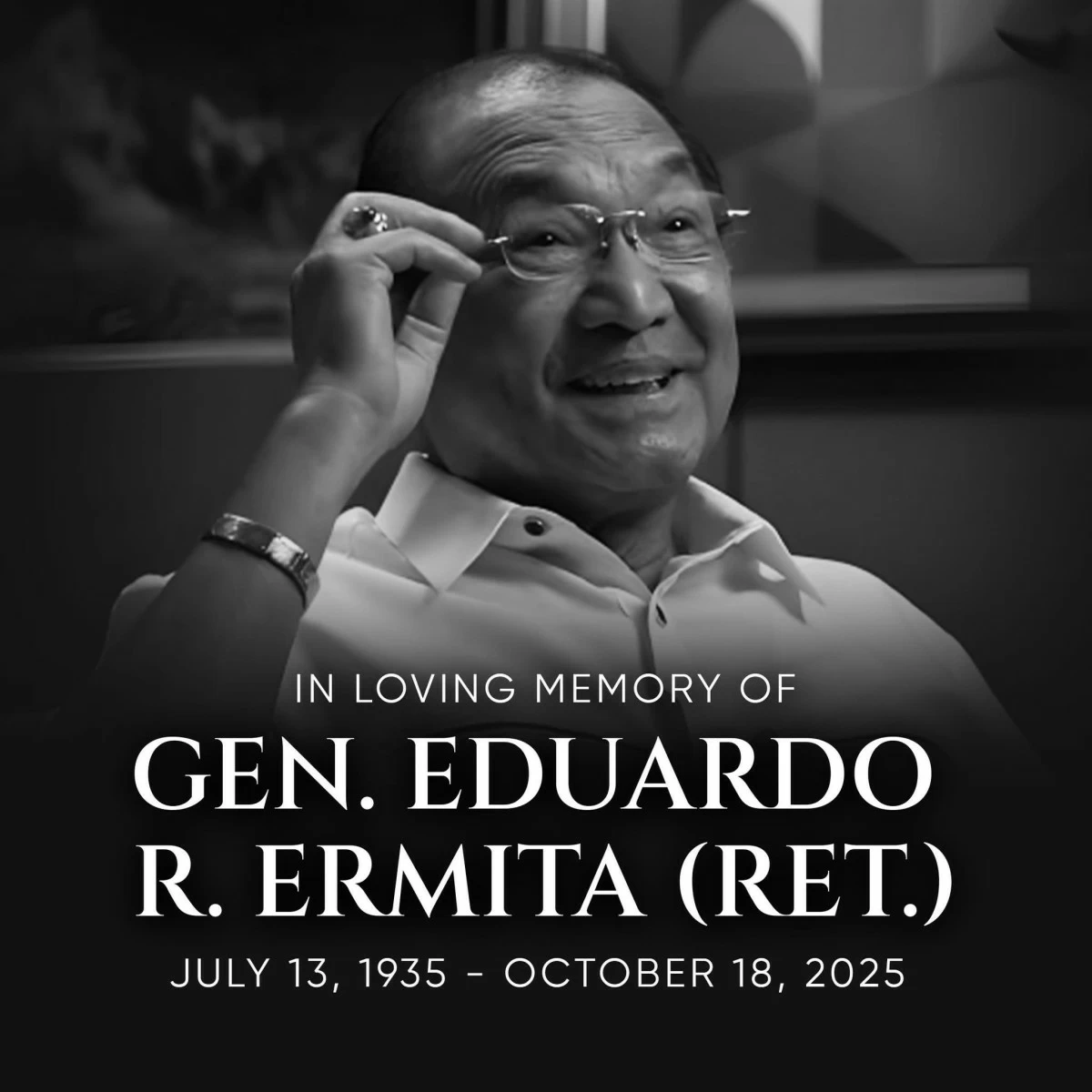
Former Executive Secretary and peacemaker Eduardo R. Ermita
Former executive secretary, congressman, and Armed Forces of the Philippines Vice Chief of Staff and peace advocate (Ret.) Gen. Eduardo R. Ermita has died. He was 90 years old.
His daughter, Balayan Mayor Lisa Ermita Abad, announced his passing.
“It is with profound sadness and heavy hearts that we, the Ermita family, announce the passing of our beloved father, General Eduardo Ramos Ermita (Retired), a dedicated public servant and our guiding light,” Ermita-Abad said.
She added “he passed away peacefully today, October 18, 2025, at 8:00am, surrounded by his loving family.”
Ermita-Abad said her father lived a full life in steadfast service to the Filipino people.
“As a soldier, he served with honor and dedication during some of the nation's most challenging times,” she added.
Peacemaker
During his career in government, Ermita exemplified what it is to be a soldier, statesman, and peacemaker. He was instrumental in laying and solidifying the foundations of peace in our country. Having witnessed the horrors of war as a soldier, he had developed a profound yearning for peace. This propelled him to carve out a unique niche within the military establishment as a peacemaker and make it the central focus of his service in the government and for the people.
In February 1984, he displayed extraordinary courage by venturing into the deep jungles of Basilan to get to one of the camps of the Moro National Liberation Front (MNLF). His mission was to talk peace with one of the MNLF’s fiercest warriors, Gerry Salappudin, who, at that time also served as the Chair of the group’s Basilan Revolutionary Committee. Ermita informed the MNLF leadership of the national government’s programs, which aimed to address the roots of the decades-long armed conflict in the region and help push forward the peace negotiations between the Government of the Philippines and the MNLF. Ermita’s visit to the MNLF camp became a turning point, as it enabled the government to talk peace with the revolutionary group’s top commanders who also included MNLF Reformist Group Chair Dimas Puntado; MNLF Deputy Chief Abu Khayr Alonto; Commander Talib Congo; and Commander Ronnie Malaguiok.
Ermita was not only dealing with former rebels on the ground, he was also part of the Philippine delegation who worked tirelessly to achieve recognition from the Organization of Islamic Committee or OIC. He joined the Philippine government team in monitoring the ministerial meetings of the OIC that were held in West Africa, Iran, Morocco, Sudan, Tripoli, Karachi, and other capital cities of OIC member-states. This effort affirmed the Philippine government’s genuine interest in reaching a peaceful settlement with the MNLF and effectively unlocked the doors for peace negotiations with the group. Ermita along with Foreign Affairs Undersecretary Ambassador Joey Syjuco was the other half of the lean and mean secretariat of the government panel who headed the negotiations, leading to the signing of the 1976 Tripoli Agreement with the MNLF. Ermita’s experiences in dealing directly with rebels provided him with valuable insights and perspectives coming from individuals and groups on the ground while recognizing the history and culture of the Moro people in the Southern Philippines.
He became part of the National Unification Commission (NUC) the office that was mandated to hold nationwide consultations with all concerned stakeholders, including rebel groups such as the MNLF, the communist group, as well as the Philippine military and police – and craft the country’s comprehensive peace policy based on inputs gathered from these forums. Ermita was sent on a critical mission by President Fidel V. Ramos in October 1992. Leading a three-member delegation, he conducted preparatory talks with Misuari under the auspices of the Libyan government. He successfully convinced the MNLF leader to resume negotiations with the Philippine government. Not only was he able to convince the MNLF chief to join the new formal rounds of negotiation, Misuari confided in him how he had founded the MNLF as well as shared the group’s struggles, as well as aspirations for their people. These efforts eventually paved the way for the signing of the 1996 Final Peace Agreement, a major milestone in the Bangsamoro peace process.
Ermita’s efforts were marked by a commitment to preserving national security while striving to meet the demands of peace agreements. Despite facing challenges, including opposition and setbacks, his involvement in peace processes demonstrated his belief in negotiation as a crucial tool for resolving conflicts. Ultimately, Ermita’s contributions underscore the importance of sustained dialogue and cooperation in the pursuit of lasting peace.
Papa, Lolo Ed
“To us, his family, he was simply "Papa" or "Lolo Ed"—our source of wisdom, strength, and unconditional love. The lessons he imparted and the values he lived by are the greatest legacy he leaves behind,” Ermita Abad said.
“He was a true patriarch, not only of our family but also of the entire First District of Batangas, whose welfare remained his foremost concern until the very end.”
“We take solace in knowing that his life's work has touched countless others and that his legacy will live on through us and through all who were inspired by his example.”
Interment will be at the Libingan ng mga Bayani on Oct. 18-19 and at the Heritage Memorial Park from Oct. 20-22.
She extended her family’s deepest gratitude for the prayers and overwhelming expressions of love and support given to the late statesman and decorated soldier. (With excerpts from the OPAPRU website)