







Music, memory, and mothers
Published Oct 16, 2025 08:08 am


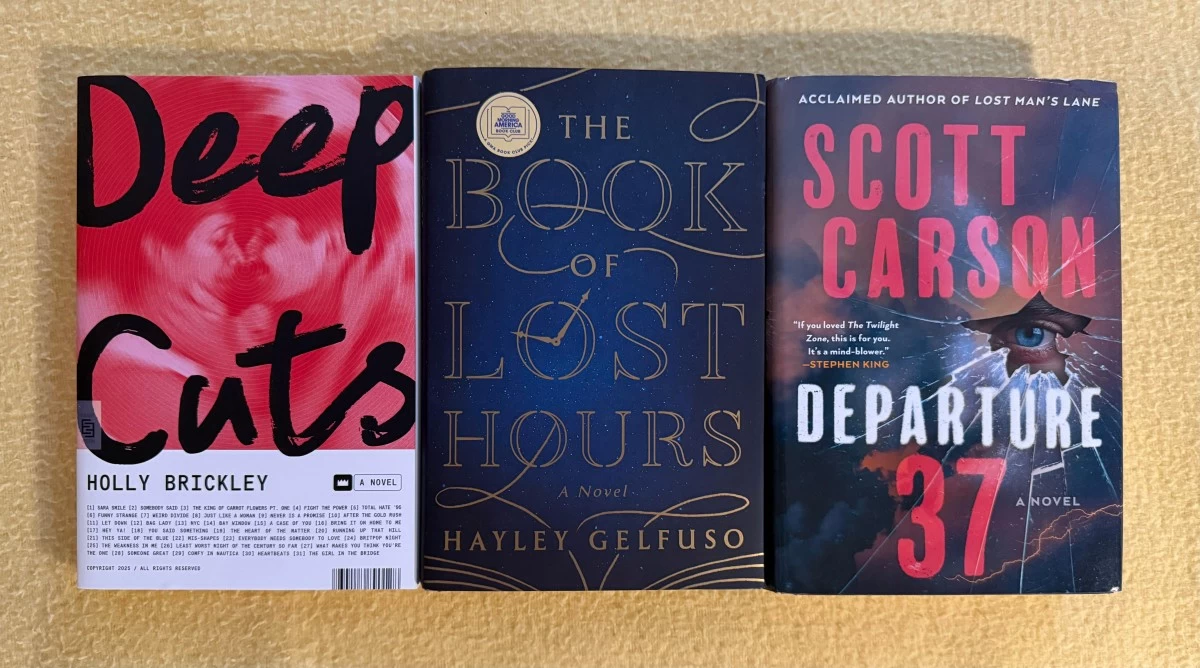
Three well-written novels with strong narratives are on for today. Brickley explores the soundtrack of our lives in the early 2000s. Gelfuso mixes SciFi and the Cold War, while Carson pays tribute to "The Twilight Zone."
"Deep Cuts" by Holly Brickley
It’s Berkeley, year 2000, as this novel opens in a campus bar where Percy Marks is having a planning session with her roommate, Megan, about some off-campus party they’ll be hosting. She has this tendency to pontificate obsessively about music, and it soon catches the ear of her fellow student, Joe Morrow, who’s a budding songwriter. He sidles up to her and asks for her opinion on a number of songs, and then requests that she critique a song he has written. It’s not long before there’s a relationship of creative dependency established, and Percy enters the inner circle of Joe and Zoe, his would-be girlfriend and roommate. Would-be because deep down Zoe bats for the other side, and it’s with Zoe that Percy stumbles into an affair. The novel is a nostalgic romp to the indie sleaze era of the early 2000s.
Spanning more than a decade, it’s a novel about friendship, relationships, and growing up, all with a soundtrack to our lives - each chapter is the title of a song that’s relevant to the main characters, especially to Percy. There’s a wonderful sense of time and place as Percy moves to New York City, and Joe takes his band, Caroline, to Europe. In terms of temporal parameters, the novel starts off right before 9/11 and takes us to the first term of President Barack Obama. There’s a chapter devoted to catching Joe’s band at the Troubadour in Los Angeles, and it vividly recreates that moment when a band is about to break through and finally make it big. Then there’s the potent reminder of how fickle the public can be, and how it builds you up just to tear you down. Examining the nature of talent, the obsession with music, the need for belonging and being heard, this is the novel that examines the difference between the perfect song and the perfect recording.
"The Book of Lost Hours" by Hayley Gelfuso
A novel about the power of memory, about the fragile nature of truth, and what the human heart is capable of enduring; this book is a curious and enthralling blend of espionage and spies on one side, and of violating the time/space continuum on the other. It’s both a Cold War mystery thriller and a quasi-time travel adventure. And at the center of the narrative is a library of memories, located in that slip of a moment between reality and dreams - and it’s called Time Space. We first meet 11-year-old Lisavet Levy in 1938, daughter of a Jewish watchmaker living in Nuremberg, and her father is one of those in possession of the special watches that gain access to Time Space. Right before the shop is ransacked by Nazis, her father brings her to Time Space, where she’s left to fend for herself, as the Nazis take control of her father’s watch.
We then shift to 1965, and teenager Amelia Duquesne is mourning the disappearance of her uncle Ernest. Ernest works for an agency tasked to help control and filter the memories that are stored in Time Space. There’s a Moira Donnelly that he directly works under, and heading the CIA is a Jack Dillinger. That this same Ernest, in 1949, appeared in Time Space and encountered Lisavet is just one of the many coincidences that propel the narrative, and have us wanting to turn the page and discover what happens next. The novel as a whole is a meditation on time, on memory, and on history. Issues such as the notion that it’s the victor who writes history and can select which memory to preserve are taken up; and what makes this novel truly succeed is how family, and calibrating what one can and will do in the name of family and Love are never far from the plot developments. Enthralling read!
"Departure 37" by Scott Carson
There’s a very good reason why Rod Serling is one of three names that this novel is dedicated to. Carson has written a book that comes straight out of "The Twilight Zone," and that’s a good thing for us. It has espionage, has history, and has horror, and the story flits from the coast of Maine today to a secret nuclear laboratory in Indiana in the year 1962, during the Cuban Missile Crisis. The narrative opens on a clear October night sky when more than a hundred commercial pilots receive a call in the middle of the night, and it’s their mothers, imploring them not to fly the coming morning, because they’ll crash and die. If that wasn’t creepy enough, some of the mothers have been dead for years. Then we are introduced to a 17-year-old girl named Charlie, who lives on a remote peninsula in Maine that has an abandoned airfield, and watches a strange silver weather balloon suddenly appear.
It’s when a B-52 bomber that mysteriously disappeared back in 1962 as part of a secret military operation suddenly shows up in 2025, and is about to land on that derelict airfield, that things get very creepy. The Pentagon and AI experts are all trying to figure out what will happen, and who will descend from the aircraft - plus, is it still carrying the nuclear payload it vanished with 60 years ago? Carson is the pseudonym for Michael Koryta, a multi-award-winning writer known for his contemporary crime and supernatural fiction. This novel does ask you to suspend disbelief, but rewards you with a smart, inventive, and well-paced double-strand narrative. One narrative takes us back to 1962 and the scientist behind these ‘vanishings, ’ and the second narrative is set in the now and has Charlie in the center of bizarre circumstances. As the little town of Ash Coast becomes ground zero for extraordinary events, we’re treated to a story that’s creepy, but always humane.