ADVERTISEMENT

Pulse Asia: 90% of Filipinos see collusion in flood control projects

Public shows 'neutral' trust in ICI

Published Oct 15, 2025 10:41 am
PULSE ASIA
PULSE ASIA
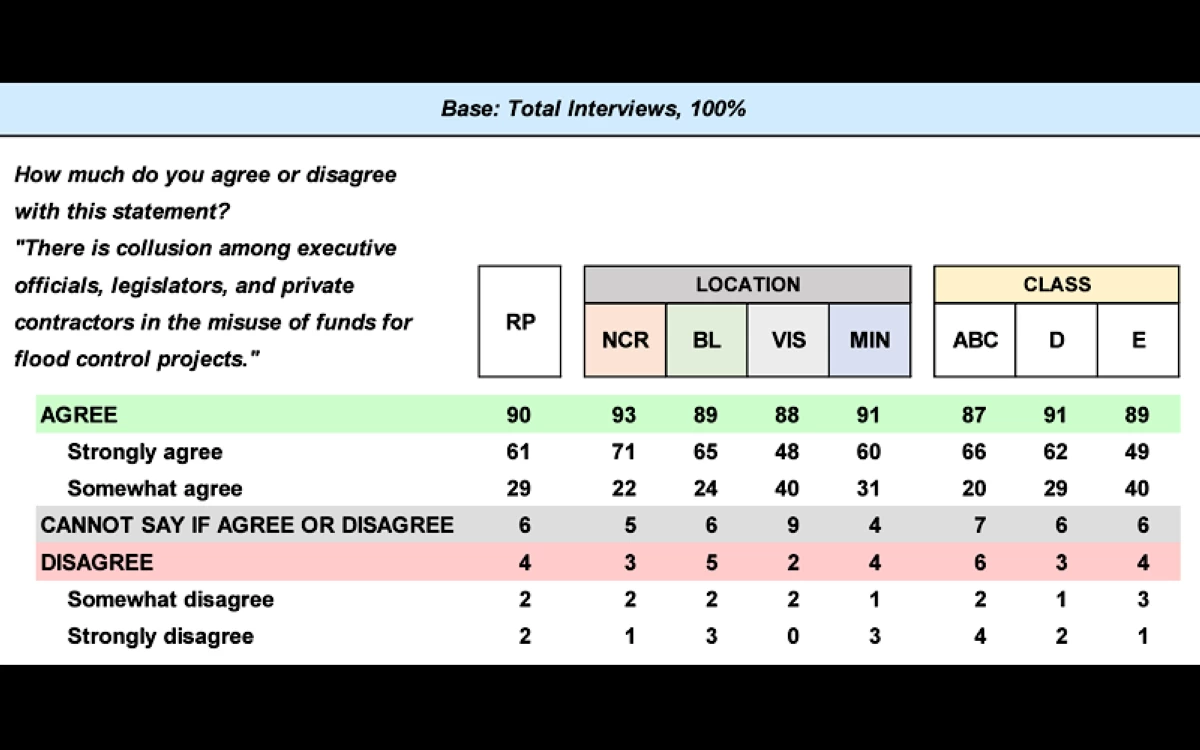
The majority of Filipinos believe there is collusion among government officials and private contractors in the misuse of funds for flood control projects, Pulse Asia said in a survey released on Wednesday, Oct. 15.
The latest “Ulat ng Bayan” national survey was conducted from Sept. 27 to 30 through face-to-face interviews with 1,200 adults nationwide.
“The prevailing opinion among adults in the country is one of agreement with the view that there is collusion among executive and legislative officials as well as private contractors in various ghost and substandard flood control projects,” Pulse Asia said.
This view was shared by 90 percent of respondents nationwide, with nearly the same levels of agreement across regions (88 to 93 percent) and socio-economic classes (87 to 91 percent).
Strong agreement was highest in Metro Manila (71 percent), followed by the rest of Luzon (65 percent), Mindanao (60 percent), Class ABC (66 percent), and Class D (62 percent).
Trust in ICI ‘neutral’
Given the perception of widespread collusion, the survey explored how much Filipinos trust the institutions tasked with investigating these allegations.
The Department of Public Works and Highways (DPWH) emerged as the least trusted, with 81 percent expressing distrust, Pulse Asia said.
Trust was higher for civil society organizations (50 percent trust, 30 percent distrust, 20 percent undecided) and the media (51 percent trust, 29 percent distrust, 20 percent undecided), it added.
The Independent Commission on Infrastructure (ICI), created to investigate alleged irregularities in flood control projects, received a neutral assessment, with 56 percent of Filipinos undecided, 24 percent expressing distrust, and 20 percent expressing trust, Pulse Asia said.
Other government bodies measured included: the Senate, with 37 percent expressing trust, 27 percent distrust, and 36 percent undecided; the House of Representatives, with 36 percent expressing distrust, 24 percent trust, and 40 percent undecided; the Office of the Ombudsman, with 39 percent trust, 18 percent distrust, and 43 percent undecided; and the President, who received a plurality of distrust at 45 percent, with the remainder expressing trust (31 percent) or unable to say (24 percent), it added.
Optimism on accountability
Despite the mixed trust levels, Filipinos remain relatively confident that officials involved in anomalous flood control projects will be held accountable.
Seventy-one percent believe government officials involved in anomalous flood control projects will still be punished.
About 21 percent were ambivalent, while 8 percent said the officials would likely escape accountability, Pulse Asia said.
It added that optimism about accountability was consistent across all regions (66 to 78 percent) and social classes (69 to 79 percent).
The sense of accountability also extends to public action, with many seeing protests as a means to enforce it.
Nearly half of Filipinos (46 percent) believe that protest actions are an effective way to ensure government officials involved in corruption are held accountable, Pulse Asia said.
Agreement with this view was highest in Mindanao (56 percent) and among Class E respondents (61 percent).
In Metro Manila and the Visayas, 50 percent share this belief, while in the rest of Luzon, respondents were almost evenly divided (39 percent agree, 35 percent disagree).
At the national level, 31 percent do not consider protests effective, while 23 percent were undecided.
Pulse Asia noted a “three-way split” among Class ABC respondents: 41 percent agreed, 31 percent were undecided, and 28 percent disagreed.
The survey period coincided with large public demonstrations such as the “Black Friday” protests on Sept. 12 and the “Trillion Peso March” on Sept. 21, which marked the anniversary of the declaration of martial law.

Related Tags

PULSE ASIA CORRUPTION ICI
ADVERTISEMENT
.most-popular .layout-ratio{ padding-bottom: 79.13%; } @media (min-width: 768px) and (max-width: 1024px) { .widget-title { font-size: 15px !important; } }

{{ articles_filter_1561_widget.title }}

.most-popular .layout-ratio{ padding-bottom: 79.13%; } @media (min-width: 768px) and (max-width: 1024px) { .widget-title { font-size: 15px !important; } }

{{ articles_filter_1562_widget.title }}

.most-popular .layout-ratio{ padding-bottom: 79.13%; } @media (min-width: 768px) and (max-width: 1024px) { .widget-title { font-size: 15px !important; } }

{{ articles_filter_1563_widget.title }}

{{ articles_filter_1564_widget.title }}

.mb-article-details { position: relative; } .mb-article-details .article-body-preview, .mb-article-details .article-body-summary{ font-size: 17px; line-height: 30px; font-family: "Libre Caslon Text", serif; color: #000; } .mb-article-details .article-body-preview iframe , .mb-article-details .article-body-summary iframe{ width: 100%; margin: auto; } .read-more-background { background: linear-gradient(180deg, color(display-p3 1.000 1.000 1.000 / 0) 13.75%, color(display-p3 1.000 1.000 1.000 / 0.8) 30.79%, color(display-p3 1.000 1.000 1.000) 72.5%); position: absolute; height: 200px; width: 100%; bottom: 0; display: flex; justify-content: center; align-items: center; padding: 0; } .read-more-background a{ color: #000; } .read-more-btn { padding: 17px 45px; font-family: Inter; font-weight: 700; font-size: 18px; line-height: 16px; text-align: center; vertical-align: middle; border: 1px solid black; background-color: white; } .hidden { display: none; }
function initializeAllSwipers() { // Get all hidden inputs with cms_article_id document.querySelectorAll('[id^="cms_article_id_"]').forEach(function (input) { const cmsArticleId = input.value; const articleSelector = '#article-' + cmsArticleId + ' .body_images'; const swiperElement = document.querySelector(articleSelector); if (swiperElement && !swiperElement.classList.contains('swiper-initialized')) { new Swiper(articleSelector, { loop: true, pagination: false, navigation: { nextEl: '#article-' + cmsArticleId + ' .swiper-button-next', prevEl: '#article-' + cmsArticleId + ' .swiper-button-prev', }, }); } }); } setTimeout(initializeAllSwipers, 3000); const intersectionObserver = new IntersectionObserver( (entries) => { entries.forEach((entry) => { if (entry.isIntersecting) { const newUrl = entry.target.getAttribute("data-url"); if (newUrl) { history.pushState(null, null, newUrl); let article = entry.target; // Extract metadata const author = article.querySelector('.author-section').textContent.replace('By', '').trim(); const section = article.querySelector('.section-info ').textContent.replace(' ', ' '); const title = article.querySelector('.article-title h1').textContent; // Parse URL for Chartbeat path format const parsedUrl = new URL(newUrl, window.location.origin); const cleanUrl = parsedUrl.host + parsedUrl.pathname; // Update Chartbeat configuration if (typeof window._sf_async_config !== 'undefined') { window._sf_async_config.path = cleanUrl; window._sf_async_config.sections = section; window._sf_async_config.authors = author; } // Track virtual page view with Chartbeat if (typeof pSUPERFLY !== 'undefined' && typeof pSUPERFLY.virtualPage === 'function') { try { pSUPERFLY.virtualPage({ path: cleanUrl, title: title, sections: section, authors: author }); } catch (error) { console.error('ping error', error); } } // Optional: Update document title if (title && title !== document.title) { document.title = title; } } } }); }, { threshold: 0.1 } ); function showArticleBody(button) { const article = button.closest("article"); const summary = article.querySelector(".article-body-summary"); const body = article.querySelector(".article-body-preview"); const readMoreSection = article.querySelector(".read-more-background"); // Hide summary and read-more section summary.style.display = "none"; readMoreSection.style.display = "none"; // Show the full article body body.classList.remove("hidden"); } document.addEventListener("DOMContentLoaded", () => { let loadCount = 0; // Track how many times articles are loaded const offset = [1, 2, 3, 4, 5, 6, 7, 8, 9, 10]; // Offset values const currentUrl = window.location.pathname.substring(1); let isLoading = false; // Prevent multiple calls if (!currentUrl) { console.log("Current URL is invalid."); return; } const sentinel = document.getElementById("load-more-sentinel"); if (!sentinel) { console.log("Sentinel element not found."); return; } function isSentinelVisible() { const rect = sentinel.getBoundingClientRect(); return ( rect.top < window.innerHeight && rect.bottom >= 0 ); } function onScroll() { if (isLoading) return; if (isSentinelVisible()) { if (loadCount >= offset.length) { console.log("Maximum load attempts reached."); window.removeEventListener("scroll", onScroll); return; } isLoading = true; const currentOffset = offset[loadCount]; window.loadMoreItems().then(() => { let article = document.querySelector('#widget_1690 > div:nth-last-of-type(2) article'); intersectionObserver.observe(article) loadCount++; }).catch(error => { console.error("Error loading more items:", error); }).finally(() => { isLoading = false; }); } } window.addEventListener("scroll", onScroll); });

Sign up by email to receive news.