






The United States reaffirmed its defense pact with the Philippines after China Coast Guard (CCG) and Chinese militia vessels rammed and water cannoned a Philippine Bureau of Fisheries and Aquatic Resources (BFAR) vessel near the Pag-asa Island over the weekend.
Manila Bulletin
 Philippines
National
US reaffirms defense support for PH after sea clash with China near Pag-asa
Philippines
National
US reaffirms defense support for PH after sea clash with China near Pag-asa
Philippines
National
US reaffirms defense support for PH after sea clash with China near Pag-asa
US reaffirms defense support for PH after sea clash with China near Pag-asa
Published Oct 14, 2025 12:01 pm


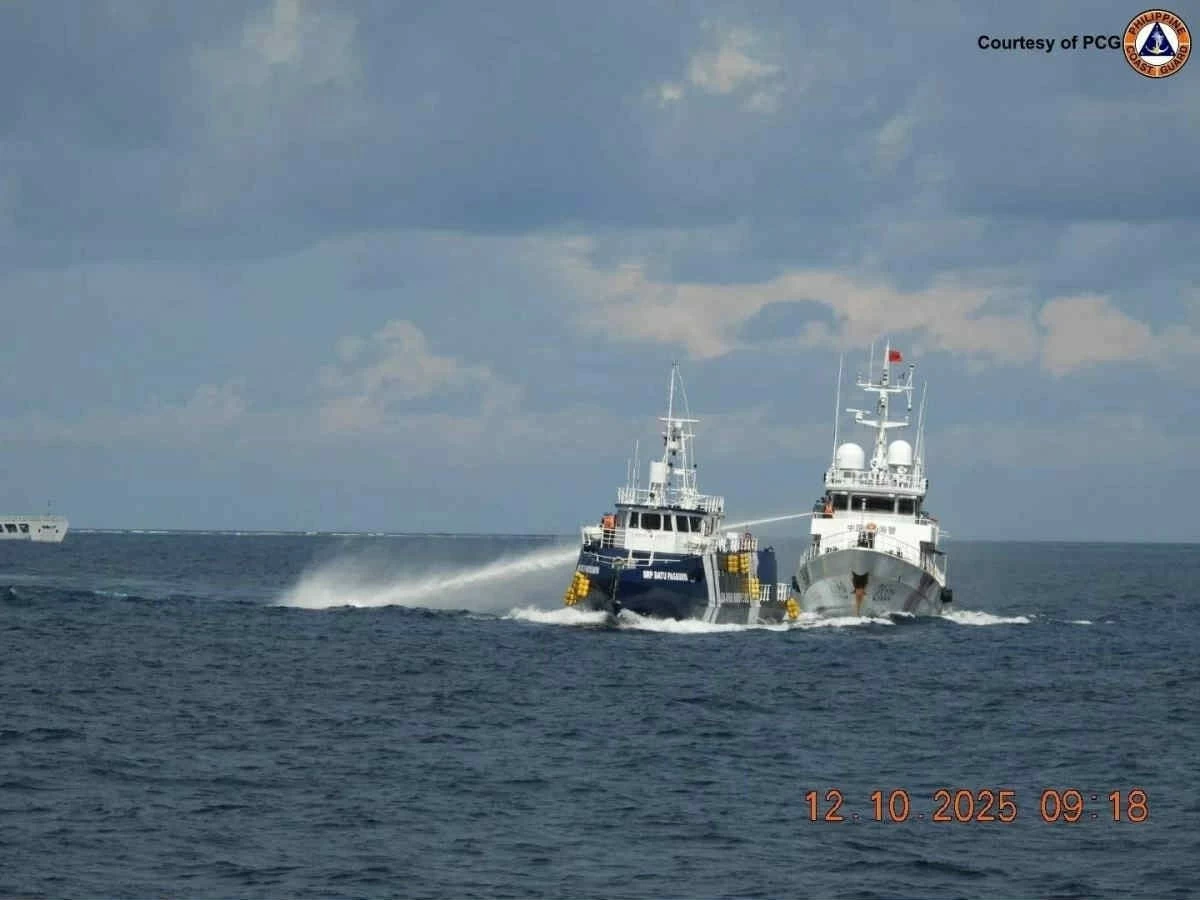
A China Coast Guard ship fires a water cannon at BRP Datu Pagbuaya while the latter is in Pag-asa Island, West Philippine Sea on Oct. 12, 2025 during a humanitarian mission. (PCG Photo)
“The United States reaffirms Article IV of the 1951 United States-Philippines Mutual Defense Treaty (MDT) extends to armed attacks on Philippine armed forces, public vessels, or aircraft – including those of its Coast Guard – anywhere in the South China Sea,” Thomas Pigott, US State Department Principal Deputy Spokesperson, said in a statement on Tuesday, Oct. 14.
Signed in 1951, the MDT is a defense agreement that states the activation of US’ defense in case of an armed attack on Philippine territory and waters.
Condemning China’s recent actions, Pigott said the US stands with the Philippines “as they confront China’s dangerous actions which undermine regional stability.”
“China’s sweeping territorial and maritime claims in the South China Sea and its increasingly coercive actions to advance them at the expense of its neighbors continue to undermine regional stability and fly in the face of its prior commitments to resolve disputes peacefully,” he added.
During a joint press conference with Department of Foreign Affairs (DFA) Secretary Ma. Theresa Lazaro on Monday, Oct. 13, Croatian Foreign Minister Gordan Grlić Radman acknowledged that resolving maritime territorial disputes “is never easy.”
“The situation is particularly complex in the South China Sea, where there are several claimed states. The willingness of all parties to resolve it, as well as the timing for finding a solution are crucial,” he said.
“We call for de-escalation and remain committed to supporting our partners in seeking to exercise their legitimate rights in the region and beyond,” the official added.
He stressed the importance of sticking to the rules as members of the United Nations.
Earlier, the embassies of the European Union, Japan, Australia, United Kingdom, and New Zealand condemned China’s aggressive actions in the highly disputed region.
These remarks came after CCG and Chinese militia vessels “approached and conducted dangerous maneuvers and activated their water cannons” against three BFAR vessels anchored near Pag-asa Island to assist Filipino fisherfolk, the National Maritime Council (NMC) said.
The South China Sea is a heavily contested area claimed in part by the Philippines, Vietnam, Malaysia, Taiwan, and Brunei Darussalam, and almost in its entirety by China.
A potential flashpoint for military conflict, the international community has put emphasis on maintaining freedom of navigation in the region, where an estimated one-third of the global maritime trade—about $3.4 to $5.3 trillion annually—passes through it.