






Manila Bulletin
 Philippines
National
One new fatality brings Davao Oriental quakes death toll to 9 – OCD
Philippines
National
One new fatality brings Davao Oriental quakes death toll to 9 – OCD
Philippines
National
One new fatality brings Davao Oriental quakes death toll to 9 – OCD
One new fatality brings Davao Oriental quakes death toll to 9 – OCD
Published Oct 14, 2025 03:27 pm


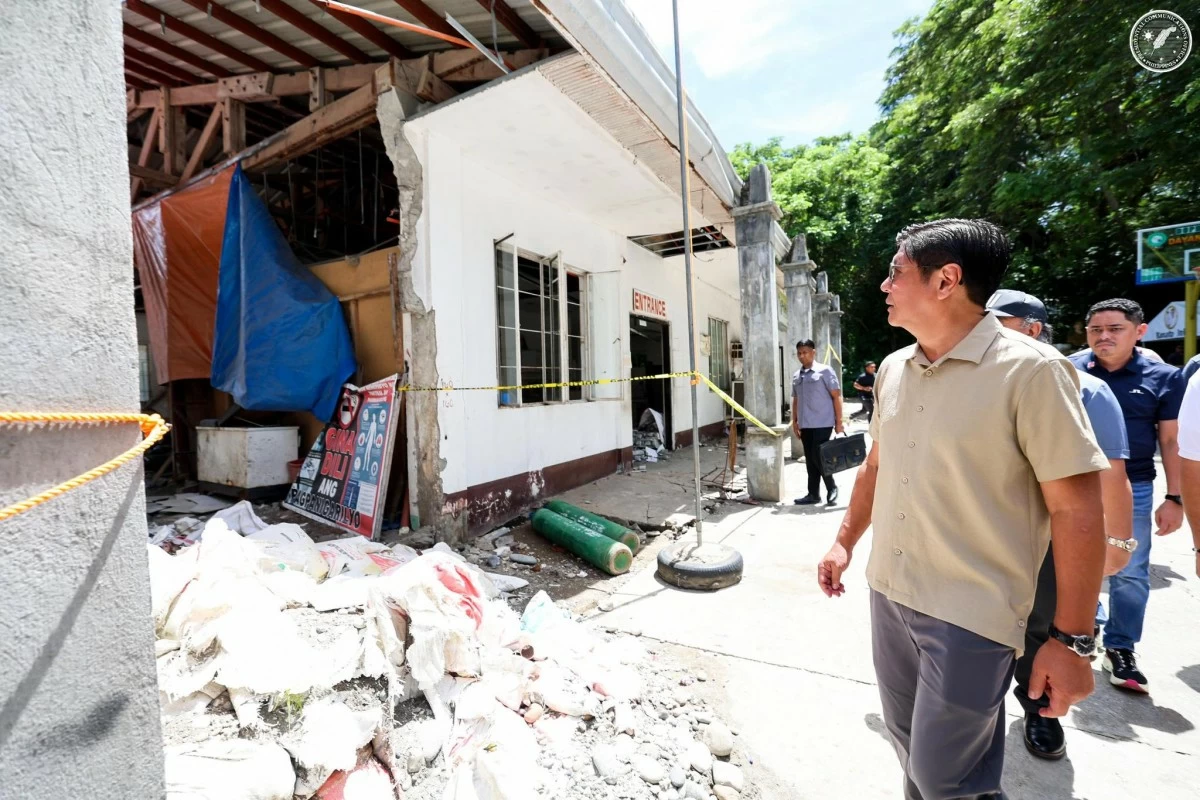
President Ferdinand Marcos Jr. inspects facilities that were damaged due to the recent doublet earthquakes that hit Davao Oriental on Oct. 13, 2024. (Photo: Presidential Communication Office)
The Office of Civil Defense (OCD) reported that the death toll from the doublet earthquakes that struck Davao Oriental last week has risen to nine after one additional fatality was logged on Tuesday, Oct. 14.
The magnitude 7.4 and 6.8 twin earthquakes that struck Manay, Davao Oriental on Oct. 10 has affected 200,914 families comprised of 845,001 individuals in Davao (Region 11) and Caraga (Region 13), according to a situational report from the National Disaster Risk Reduction and Management Council (NDRRMC).
“Last night, we had eight reported fatalities in Davao Region but early this morning, one additional death was recorded so as of noontime, the number of deaths that are still subject for validation has already reached nine,” OCD spokesperson Junie Castillo said.
There were 403 others injured from the impact of the tremors while no one was reported missing.
Meanwhile, around 12,700 individuals were displaced and staying in eight evacuation centers while close to 200 persons were staying in open spaces or at their friends' or relatives’ homes due to fear of aftershocks.
The OCD also reported that 2,575 houses were damaged by the quakes, including 2,231 partially damaged and 344 totally destroyed homes. The initial estimated cost of damage to infrastructure has reached over ₱1.258 million although the number is expected to further rise as assessments are still ongoing.
Contingency plans, earthquake drills
In response to the series of strong earthquakes, NDRRMC Chairperson and Defense Secretary Gilberto Teodoro Jr. has urged all local government units (LGUs) and national government agencies (NGAs) nationwide to review and update their contingency plans and intensify earthquake preparedness drills.
According to Castillo, Teodoro called for the review of local contingency plans of LGUs and NGAs to ensure all of their established plans and disaster protocols within their Area of Responsibility (AOR) are reviewed, validated, and up-to-date.
In addition to the review of plans, they were also encouraged to conduct wide-scale earthquake drills, particularly in public areas such as schools, government offices, and other facilities, to strengthen readiness.
“It is important for every local government unit and agency to review their contingency plan to determine our capacity in terms of response mechanisms, what resources are available, and what gaps need to be addressed,” Castillo said.
This should be on top of the nationwide simultaneous earthquake drills regularly held four times a year by the OCD.
“Everyone must take part. It can’t be that only a few are trained. Everyone should know what to do in case an earthquake occurs,” Castillo noted.