







DOF: Flood control scandal drags down growth outlook
Target revision 'not yet' on the table
By Derco Rosal
Published Oct 14, 2025 03:35 pm


At A Glance
- President Marcos' chief economic manager said the Philippine economy might have slowed in the third quarter of the year, which he sees stretching through early 2026, due to the moderation in flood control infrastructure fund spending.
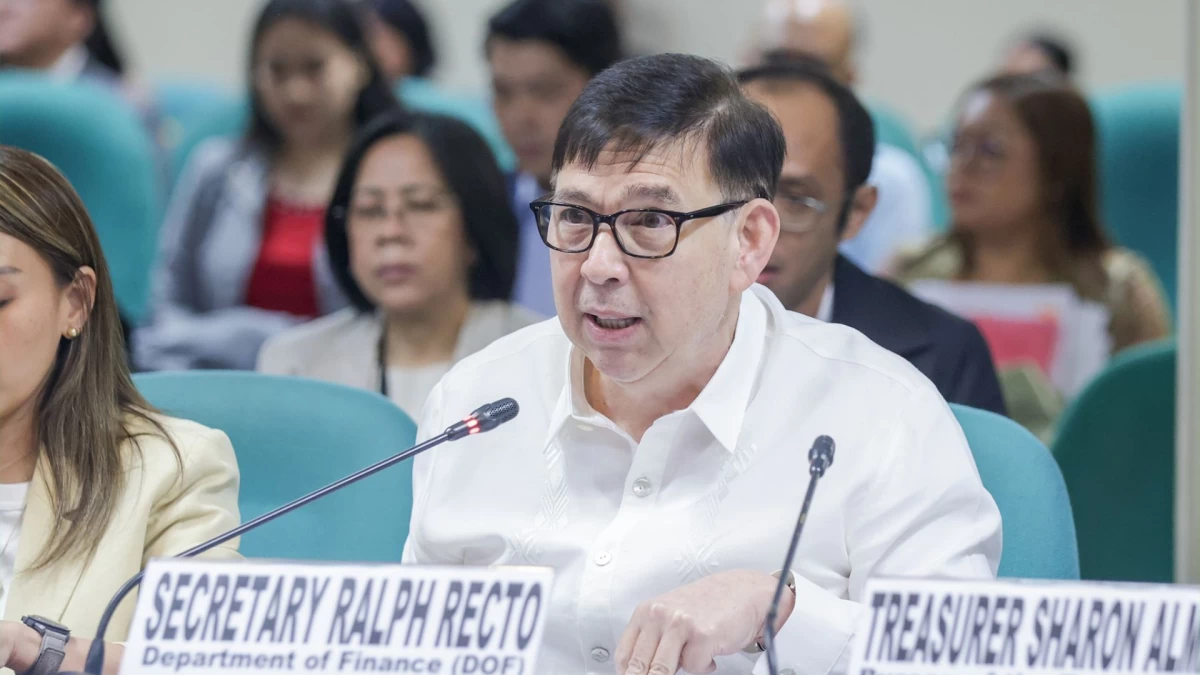
Finance Secretary Ralph G. Recto
President Ferdinand R. Marcos Jr.’s chief economic manager said Philippine growth might have slowed in the third quarter of the year, which he sees stretching through early 2026, due to the moderation in flood control infrastructure spending.
Department of Finance (DOF) Secretary Ralph G. Recto told senators during the Senate finance subcommittee’s briefing on the agency’s 2026 budget proposal that the country’s gross domestic product (GDP) could have moved at a sluggish pace.
“There’s a possible slowdown in growth in the third quarter because of all the reforms being initiated by our President to ensure that taxpayers’ money is spent properly in executing the budget as well,” Recto said on Tuesday, Oct. 14.
If government spending moderates, Recto said there could be a slowdown in local output expansion.
For the full-year 2025 growth target, Recto conceded the Philippines may miss even the lower end of 5.5 percent. “We could miss it, we could hit 5.4 percent.”
He added that another interest rate cut by the Bangko Sentral ng Pilipinas (BSP), which could help accelerate growth, stands as a possibility after the latest reduction in the policy rate to 4.75 percent.
While Recto believes this economic slowdown could pan out until early next year, growth is expected to accelerate beginning the second quarter of 2026. He is upbeat that the government will “fix the problem” tied to corruption in government spending.
“Moving forward, we will realize the full potential of growth. Based on our demographic data and stable macroeconomic environment, the economy could easily grow anywhere from six to seven percent,” Recto said.
“We just need to make sure that we execute the budget properly and spend the people’s money correctly,” he added.
Last month, Recto lamented that the Philippine economy could be growing by six percent if flood control projects had not been hijacked by corruption, resulting in a loss of as much as ₱119 billion in economic output.
Meanwhile, Recto’s colleagues in the economic team said the existing growth goals will be revisited after GDP data for the third quarter comes out early next month.
Department of Budget and Management (DBM) Secretary Amenah F. Pangandaman told Manila Bulletin that the DBM’s technical team is now working with the Department of Economy, Planning, and Development (DEPDev) to revisit the existing growth targets of 5.5 to 6.5 percent for this year and six to seven percent annually from 2026 through the end of the Marcos Jr. administration in 2028.
For his part, DEPDev Secretary and National Socioeconomic Planner Arsenio M. Balisacan told Manila Bulletin that a target adjustment is “not yet” on the table. “We will wait until we see the third-quarter growth, which will come out in the first week of November.”
They were asked what third-quarter growth figure would warrant a downward adjustment, but both Pangandaman and Balisacan have yet to respond.
It can be recalled that the BSP has lowered its GDP growth forecasts for 2025 and 2026, citing output drag from the misuse of flood control infrastructure funds. The central bank’s forecast for both 2025 and 2026 falls below the government’s goals.
To recall, infrastructure and other capital outlays dropped by 25.3 percent to ₱93.3 billion in July from ₱124.9 billion in the same month last year. According to the DBM, this could be blamed on slower spending by the Department of Public Works and Highways (DPWH).
Infrastructure spending last July also declined by 37.3 percent from ₱148.8 billion in June.
Looking ahead, the national government is projected to breach the ₱2-trillion mark in infrastructure spending by 2029—hitting a fresh high—but its share to GDP is seen at just 5.2 percent—lower than last year’s 5.8 percent and the planned 5.3 percent for 2025.
In a statement, Recto assured the public that the Marcos Jr. administration’s swift response to the recent flood control controversy signals the start of a major government cleanup aimed at restoring integrity, strengthening institutions, and sustaining economic growth.
“The President himself is the whistleblower of this controversy. At malinaw ang kanyang mensahe [And his message is clear]: We will never turn a blind eye to corruption,” Recto said.
He emphasized that the administration is “[laying down] the foundations for long-term growth,” noting that reforms now being implemented will lead to stronger governance and accountability.
Recto said the government is taking decisive steps to restore public trust, including the creation of the Independent Commission for Infrastructure (ICI), the digitalization of procurement systems, and stricter transparency measures across all levels of government. “Things will only get better from here,” he added.
“These efforts will build stronger institutions, which are the very backbone of a stable and growing economy in the long term,” the DOF statement quoted Recto as saying, adding that justice will be served as those responsible for corruption “will be held fully accountable and brought to jail in the coming months ahead.”
Recto also said the administration is working closely with local government units (LGUs) and the private sector to address Metro Manila’s flooding problem through better coordination and planning.
He noted that the controversy revealed inefficiencies in capital expenditures, which the government is now addressing. “The controversy has revealed that not all capital expenditures were translating into growth. And now that we’re plugging those leaks and reallocating funds to high-impact investments—such as education, healthcare, agriculture, and digitalization—we will only grow faster,” Recto said.
Under the Marcos Jr. administration, the economy has grown at an average rate of 5.9 percent—one of the highest in the region—driven by easing inflation, robust consumer spending, and a strong labor market, the Finance chief noted. As of August 2025, employment stood at 50.1 million, with wage and salary workers making up 64.4 percent of total employment, or about 32.3 million Filipinos, most of them in private establishments, he added.
Recto reaffirmed the DOF’s commitment to fiscal integrity by “[protecting] every peso of the taxpayers’ money by ensuring that their taxes are spent on the right things, at the right price, by the right agency, and at the right time.”