






Manila Bulletin
 Philippines
National
Filipino fishing boats harmful to 'nature reserve'? PCG rejects new Chinese narrative in WPS
Philippines
National
Filipino fishing boats harmful to 'nature reserve'? PCG rejects new Chinese narrative in WPS
Philippines
National
Filipino fishing boats harmful to 'nature reserve'? PCG rejects new Chinese narrative in WPS
Filipino fishing boats harmful to 'nature reserve'? PCG rejects new Chinese narrative in WPS
Published Oct 14, 2025 12:51 pm
|
Updated Oct 14, 2025 01:31 pm


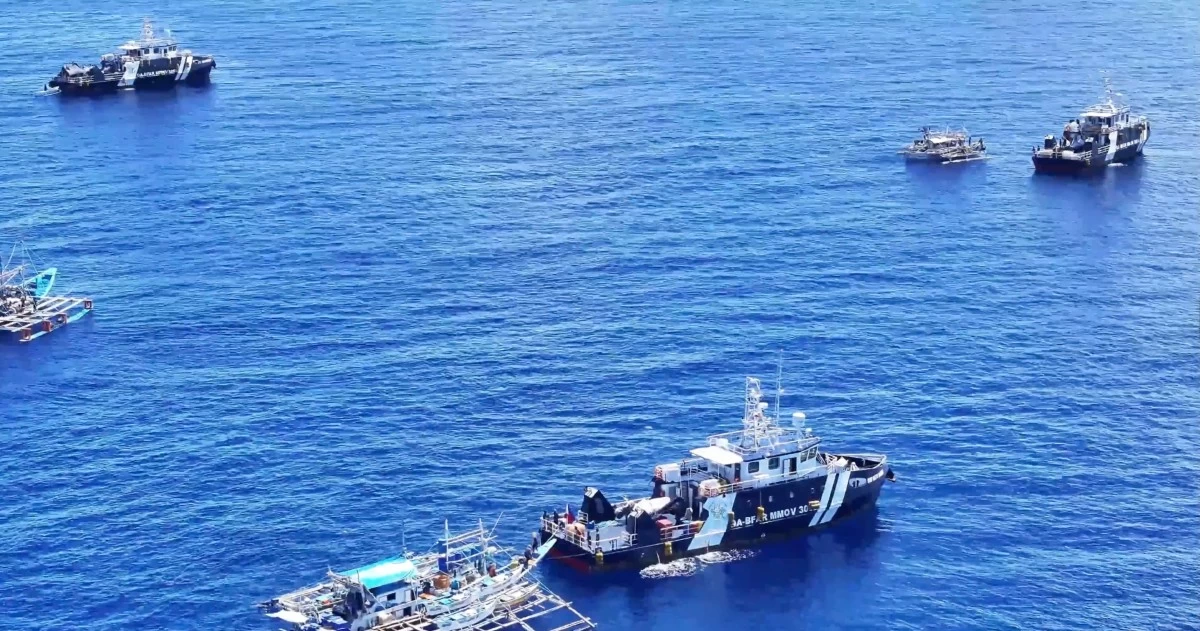
Bureau of Fisheries and Aquatic Resources (BFAR) vessels hand out fuel, grocery packs, and crushed ice to Filipino fishermen in Bajo de Masinloc and Escoda Shoal, West Philippine Sea on Oct. 13, 2025 as part of the “Kadiwa para sa Bagong Bayaning Mangingisda” (KBBM) humanitarian mission. The Philippine Coast Guard says a radio challenge is issued by the China Coast Guard (CCG), claiming that the presence of Filipino fishing boats in Bajo de Masinloc could harm their so-called "nature reserve." (Courtesy of Philippine Coast Guard)
The Philippine Coast Guard (PCG) has revealed that, for the first time, China Coast Guard (CCG) personnel issued a radio challenge claiming that the presence of Filipino fishing boats in Bajo de Masinloc (Scarborough or Panatag Shoal) could damage what they called an “environmental reserve,” its latest narrative to assert claims in the said feature in the West Philippine Sea (WPS).
The radio challenge was documented during a “Kadiwa para sa Bagong Bayaning Mangingisda” (KBBM) humanitarian mission of the PCG and Bureau of Fisheries and Aquatic Resources (BFAR) in the WPS on Monday, Oct. 13, where they distributed fuel subsidies, food packs, and crushed ice to Filipino fishermen operating in the area.
PCG spokesperson for WPS Commodore Jay Tarriela said coast guard vessels BRP Teresa Magbanua and BRP Cape San Agustin, together with M/V Mamalakaya and six BFAR patrol boats, were in Bajo de Masinloc, located 124 nautical miles off Masinloc, Zambales, when they received the radio challenge.
“For the first time, the PCG documented a CCG radio challenge claiming that the presence of Philippine fishing boats could damage their so-called ‘environmental reserve,’” Tarriela said.
The PCG immediately rejected the claim as false and baseless as Tarriela stressed that Bajo de Masinloc is an integral part of Philippine territory, and only the Philippine government holds the authority to designate or manage environmental protection areas within its 200-nautical mile exclusive economic zone (EEZ).
New narrative
According to the PCG, the Chinese radio transmission was part of a broader pattern of harassment and intimidation tactics employed by Beijing’s maritime forces in the WPS.
The issuance of the radio challenge featuring China’s new narrative coincided with the discovery of suspected man-made structures in Bajo de Masinloc during a maritime domain awareness (MDA) flight of the PCG on Monday.
The establishment of a “national nature reserve” in Bajo de Masinloc was announced by Beijing on Sept. 10, earning the ire of Philippine defense and security officials who stressed that China is notorious for reclaiming features in the WPS and turning them into militarized islands, as well as crushing coral reefs and destroying marine life.
In 1995, China built structures in Panganiban (Mischief) Reef, located 129 nautical miles west of Palawan, which they initially claimed to be a fisherman’s haven that could be used as shelter by anybody during bad weather. Years later, China turned the reef into a militarized artificial island equipped with missile and radar systems, and an airfield that can accommodate jet fighters and other big aircraft.
A 2016 Hague ruling affirmed that China’s sweeping “nine-dash line” claims in the South China Sea have no legal basis, and that Bajo de Masinloc is a traditional fishing area where both Filipino and foreign fishermen may operate, subject to Philippine jurisdiction.
Despite the ruling, CCG and Chinese maritime militia vessels have repeatedly deployed floating barriers, and conducted blocking maneuvers and water cannon attacks to drive Filipino fishermen away from traditional fishing grounds.
Braving Chinese harassment
Amid the Chinese obstruction and harassment, the PCG and BFAR said the humanitarian mission was completed.
An estimated 120,000 liters of fuel, over 600 grocery packs, and crushed ice were handed out to nearly 100 Filipino fishing boats that operated in Bajo de Masinloc and Escoda (Sabina) Shoal amid the blocking and shadowing of 11 CCG ships, 11 Chinese maritime militia vessels, a People’s Liberation Army-Navy (PLA-N) helicopter, and three PLA-N warships.
The PCG and BFAR also facilitated the sale of 30 tons of fresh fish catch to the government. Tarriela said this ensured the continued livelihood for local fishermen in the country’s traditional fishing grounds in the WPS.
In Escoda Shoal, tensions also ran high as the CCG deployed 10 vessels, 10 Chinese militia boats, one PLA-N helicopter, two PLA-N vessels, and one high-speed response boat to obstruct the humanitarian mission.
Chinese ships activated water cannons in an attempt to intimidate Filipino fishermen but PCG vessels BRP Melchora Aquino and BRP Cabra, supported by five BFAR patrol boats, managed to complete the distribution through skilled seamanship and disciplined coordination.
The mission was completed successfully by 7 p.m. when all supplies were delivered and fishermen were safely assisted.
“The PCG and BFAR remain steadfast in our duty to protect the safety and security of every Filipino fisherman,” PCG Commandant Adm. Ronniel Gil Gavan said.
“My top priority is to safeguard their livelihoods from any interference by the China Coast Guard and to ensure their rights as Filipinos are never suppressed by external bullying. We stand firmly with President Ferdinand Marcos Jr. in defending every square inch of our sovereign territory against any foreign power,” he added.