






Manila Bulletin
 Philippines
National
DepEd eyes specialized training, Command Center with Phivolcs for earthquake readiness
Philippines
National
DepEd eyes specialized training, Command Center with Phivolcs for earthquake readiness
Philippines
National
DepEd eyes specialized training, Command Center with Phivolcs for earthquake readiness
DepEd eyes specialized training, Command Center with Phivolcs for earthquake readiness
Published Oct 14, 2025 05:21 pm


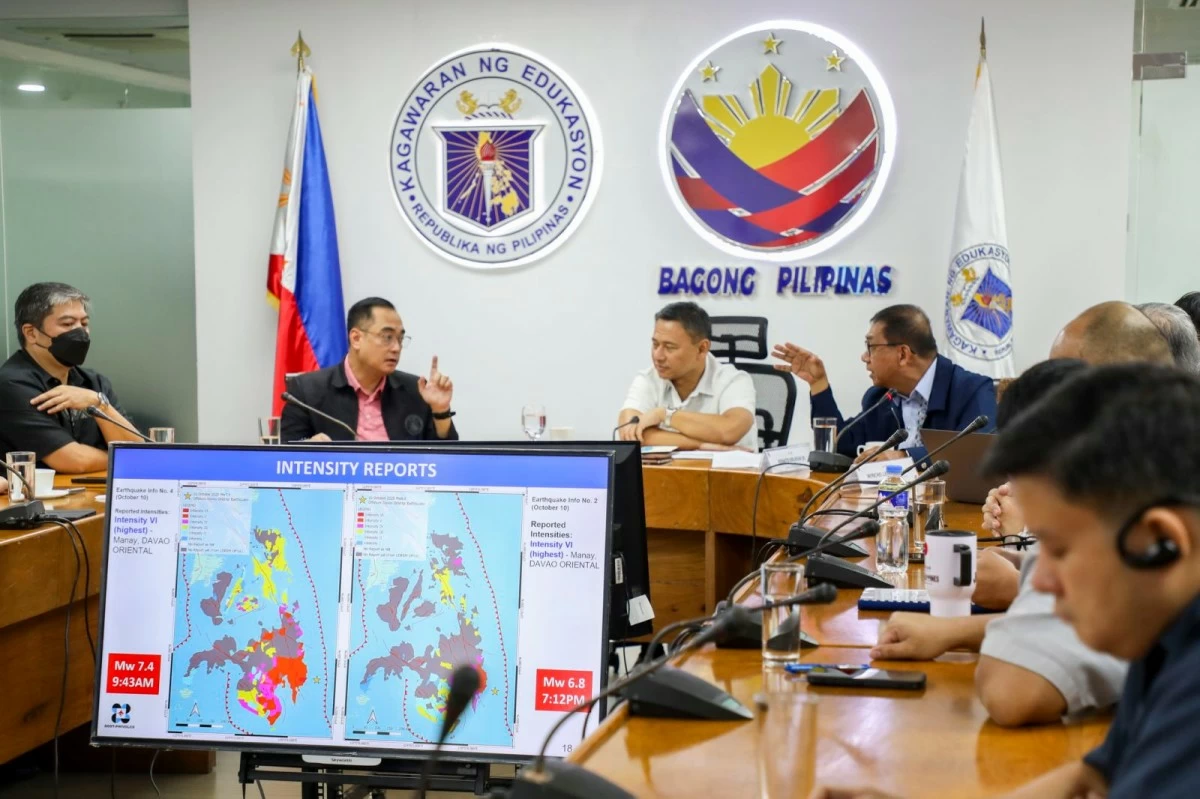
DepEd and Phivolcs strengthen partnership for science-based disaster preparedness and accurate crisis response, ensuring data-driven class suspension decisions and safer schools amid earthquakes. (Photo from DepEd)
The Department of Education (DepEd) is ramping up its earthquake preparedness efforts through specialized training programs and the proposed establishment of a DepEd Command Center, in partnership with the Philippine Institute of Volcanology and Seismology (Phivolcs).
In the wake of recent earthquakes that struck Cebu and Davao Oriental, DepEd on Tuesday, October 14, strengthened its coordination with Phivolcs to ensure that decisions on class suspensions and school safety measures are based on scientific data and localized risk assessments.
The initiative, directed by President Ferdinand R. Marcos Jr., seeks to promote science-based disaster preparedness while sustaining learning continuity during emergencies.
“Sa usapin ng kalamidad, bukod sa maagap, dapat eksakto rin ang kilos (In matters of disaster response, action must not only be swift but also precise),” said DepEd Secretary Sonny Angara.
“Kaya mahalaga ang pakikipag-ugnayan sa Phivolcs para ang bawat desisyon, mula sa pagsuspinde ng klase hanggang sa pagpapatuloy ng pag-aaral, ay nakabatay sa siyensya at hindi sa pangamba (That’s why coordination with Phivolcs is crucial—so that every decision, from class suspensions to the resumption of learning, is grounded in science, not fear),” he added.
Angara, who recently visited earthquake-affected areas in Cebu and Davao Oriental, emphasized the importance of accurate data and strong inter-agency coordination.
“Nang makita ko mismo ang pinsala ng lindol sa Cebu at Davao Oriental, mas nauunawaan natin kung gaano kahalaga ang tamang datos at koordinasyon (When I personally witnessed the damage caused by the earthquake in Cebu and Davao Oriental, it deepened our understanding of how vital accurate data and coordination are),” Angara said.
“Sa tulong ng Phivolcs, masisiguro nating ang bawat hakbang ng DepEd ay mabilis, ligtas, at may batayang siyentipiko (With Phivolcs’ support, we can ensure that every step taken by DepEd is swift, safe, and grounded in scientific evidence),” he added.
Command Center and specialized training
During the meeting, DepEd and Phivolcs, led by Department of Science and Technology (DOST) Secretary Renato Solidum Jr., discussed the importance of ensuring that schools located near fault lines are “over-engineered” to withstand strong earthquakes.
The Command Center will facilitate real-time coordination with Phivolcs, manage early warning systems, and provide science-based updates to regional offices, ensuring that school responses are both timely and accurate.
DepEd likewise plans to conduct specialized training programs for regional and field offices focused on building integrity assessment, emergency response coordination, and checklist-based alert systems for faster decision-making.
These capacity-building efforts aim to help schools and division offices assess infrastructure safety and act swiftly once danger thresholds are reached.
Science-based decisions and learning continuity
Both agencies are also committed to strengthening collaboration in public information campaigns, particularly to counter misinformation and build public trust during disasters.
Under DepEd Order No. 22, s. 2024, local chief executives, Schools Division Superintendents, and school heads have the authority to suspend classes, guided by Phivolcs advisories and on-ground conditions.
Preventive suspensions, DepEd said, must be accompanied by alternative learning modalities—modular, online, or take-home—while schools undergo safety inspections.
READ:
https://mb.com.ph/2025/10/14/deped-to-lgus-balance-safety-and-learning-in-class-suspension-decisions
DepEd also reaffirmed DepEd Order No. 21, s. 2015, which tasks regional offices with monitoring disaster preparedness measures to ensure the continuity of education even during emergencies.
Building a culture of resilience in schools
Through its strengthened partnership with Phivolcs, DepEd seeks to cultivate a culture of readiness and resilience in all schools—prioritizing safety, data-driven decision-making, and learning continuity amid natural hazards.
RELATED STORY: