






Manila Bulletin
 Business
The Stock Market
Davao Light prepares for 250,000 new customers with ₱2-billion investment
Business
The Stock Market
Davao Light prepares for 250,000 new customers with ₱2-billion investment
Business
The Stock Market
Davao Light prepares for 250,000 new customers with ₱2-billion investment
Davao Light prepares for 250,000 new customers with ₱2-billion investment
Published Oct 14, 2025 03:30 pm


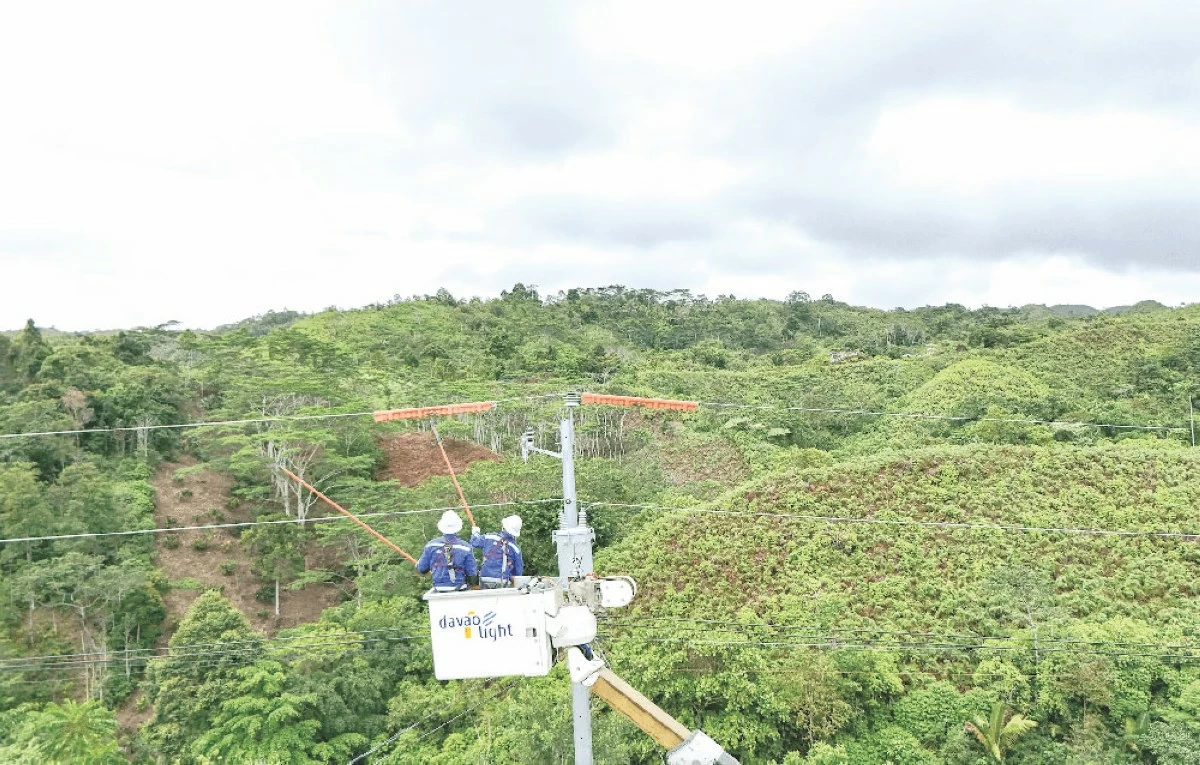
SITIO ELECTRIFICATION The improved peace and order situation in Davao City allowed Davao Light to erect and install power lines and other infrastructure to finally energize Barangay Malabog and other underserved areas.
Aboitiz-led Davao Light and Power Company (DLPC) is planning a ₱1 billion capital expenditure (CAPEX) budget for next year, a figure that could double to ₱2 billion once its franchise area expands across the Davao Region.
Enriczar Tia, DavaoLight president and chief operating officer, said the distribution utility (DU) is looking to raise its capital outlay to accommodate its growing customer base in Davao City, Panabo City, and the areas of Carmen, Dujali, and Santo Tomas.
“It’s still being deliberated right now. For DavaoLight, [it’s] more than ₱1 billion in CAPEX for the existing franchise,” Tia told reporters. “The expanded franchise would require additional CAPEX, so higher than that, maybe ₱2 billion.”
As of August 2025, the utility serves more than 500,000 customers. This number is expected to increase by 250,000 next year as it begins operations in Davao del Norte and Davao de Oro.
DavaoLight’s most recent peak demand reached 569 megawatts (MW), with the possibility of increasing by another 120 MW.
Tia noted that 52 percent of its supply comes from non-renewable sources and 48 percent from renewable energy (RE).
Apart from the planned franchise expansion, DLPC is focused on underground cabling to remove “spaghetti wires” across Davao streets. This effort follows the completion of its underground project along C.M. Recto street in 2023.
“Ongoing right now is the Ramon Magsaysay street, so we’re able to energize that by December of this year,” Tia explained. “After that, Ponciano street (now C. Bangoy street), and then after that is Quirino. There are two or three that we need to [work] underground.”
To minimize disruption, construction of the underground facilities is done during off-peak hours. “We don’t want to disrupt traffic, so what we do is we construct the underground facilities during the night… [Around] 9 p.m. to 5 a.m.”
DavaoLight also expressed support for the net metering program, which allows consumers to generate their own power and sell the excess back to the grid.
“I think close to 600 customers have already shifted to net metering,” the executive shared. “We accept it here, and we process that together with the city for the necessary permits… We’re helping our customers be able to energize as much as possible.” Currently, about 500 customers with a collective 4 MW are part of the program.