







The Philippines will file a diplomatic protest after China Coast Guard (CCG) and Chinese militia vessels rammed and water cannoned Philippine vessels near the highly contested Pag-asa Island this week.
PH to file diplomatic protest vs China over WPS attack
Published Oct 13, 2025 08:47 am
|
Updated Oct 13, 2025 01:34 pm


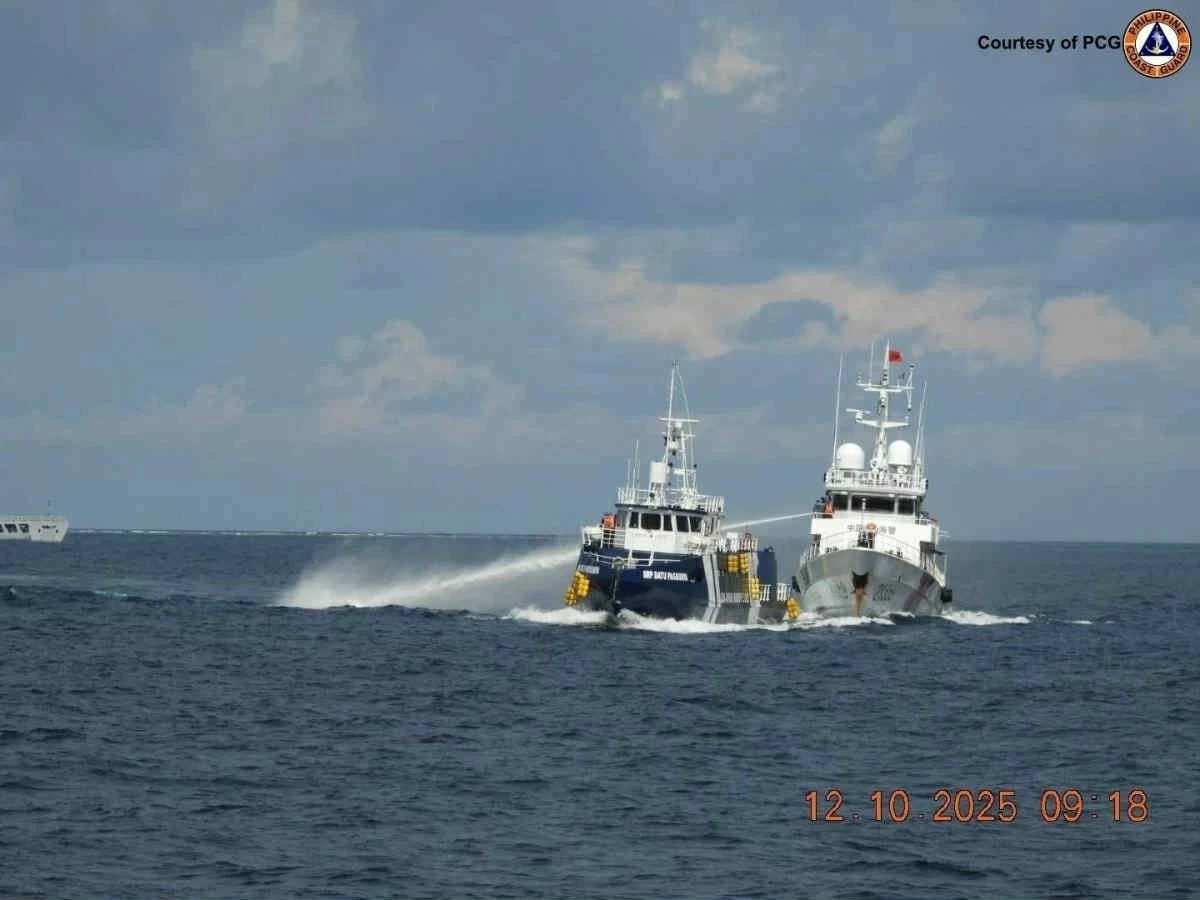
A China Coast Guard ship fires a water cannon at BRP Datu Pagbuaya while the latter is in Pag-asa Island, West Philippine Sea on Oct. 12, 2025 during a humanitarian mission. (PCG Photo)
“Yes, a diplomatic protest will be filed,” Department of Foreign Affairs (DFA) spokesperson Angelica Escalona said when asked by the media on Sunday, Oct. 12.
The National Maritime Council (NMC) also strongly condemned the attack in a statement, adding that the “proximity of CCG’s illegal and reckless actions to Pag-asa Island is of grave concern to the Philippines.”
Foreign diplomats joined in raising concerns about China’s latest actions, with Japanese Ambassador Endo Kazuya stressing Japan’s adherence to the rule of law.
“Seriously concerned about the repeated dangerous actions by CCG, including collision and use of water cannon against the (Philippine) BFAR vessel. (Japan) upholds the rule of law and opposes any actions which increase tensions. #FOIP,” he wrote on X (formerly Twitter), using the hashtag for “free and open Indo-Pacific.”
The Embassy of the United Kingdom also took to X, urging parties to end “dangerous tactics” in the region.
“UK is concerned by the latest act of ramming and water cannon used by the Chinese Coast Guard against Philippine civilian BFAR vessels,” its embassy wrote on X.
“We call for an end to dangerous tactics in the South China Sea and urge respect for international law and the peaceful resolution of disputes,” it added.
Australian Ambassador Marc Innes-Brown and the Embassy of New Zealand in Manila likewise expressed deep concerns about the latest actions of the CCG.
“Deeply concerned by dangerous actions of the China Coast Guard, which again rammed and water cannoned Philippine Fisheries Bureau vessels in the South China Sea. Disputes must be resolved peacefully in accordance with international law,” he said on X.
“(New Zealand) is concerned about dangerous actions by the Chinese Coast Guard against (Philippines) BFAR vessels. Contact between vessels & the use of water cannons endangers lives at sea and risks increasing tensions. (New Zealand) firmly calls for peaceful resolution of disputes in accordance with UNCLOS,” the embassy said.
US Ambassador MaryKay Carlson and the European Union’s Delegation in the Philippines earlier took to X to raise alarm over the latest incident.
According to the NMC, the three Bureau of Fisheries and Aquatic Resources (BFAR) vessels were anchored near Pag-asa Island to assist Filipino fisherfolk when the CCG and Chinese Maritime Militia (CMM) vessels “approached and conducted dangerous maneuvers and activated their water cannons.”
“It must be emphasized that Pag-asa Island forms part of the Kalayaan Island Group (KIG), which is an integral part of the Philippines over which it has longstanding sovereignty and jurisdiction,” the NMC said.
“The Philippines is clearly within its rights to conduct routine maritime operations in and around Pag-asa Island, and will continue to do so,” it added.
It called on China to stop the aggressive actions and adhere to international law, specifically the 1982 United Nations Convention on the Law of the Sea (UNCLOS) and the 2016 Arbitral Award.
“China must be sincere and hold true to its call for dialogue and consultation by demonstrating constructive actions and desisting from all provocative actions,” the NMC said.
The South China Sea is a heavily contested area claimed in part by the Philippines, Vietnam, Malaysia, Taiwan, and Brunei Darussalam, and almost in its entirety by China.
A potential flashpoint for military conflict, the international community has put emphasis on maintaining freedom of navigation in the region, where an estimated one-third of the global maritime trade—about $3.4 to $5.3 trillion annually—passes through it.