






Manila Bulletin
 Philippines
National
Three BFAR vessels, not one, struck by Chinese water cannon – PCG
Philippines
National
Three BFAR vessels, not one, struck by Chinese water cannon – PCG
Philippines
National
Three BFAR vessels, not one, struck by Chinese water cannon – PCG
Three BFAR vessels, not one, struck by Chinese water cannon – PCG
Published Oct 13, 2025 02:33 pm


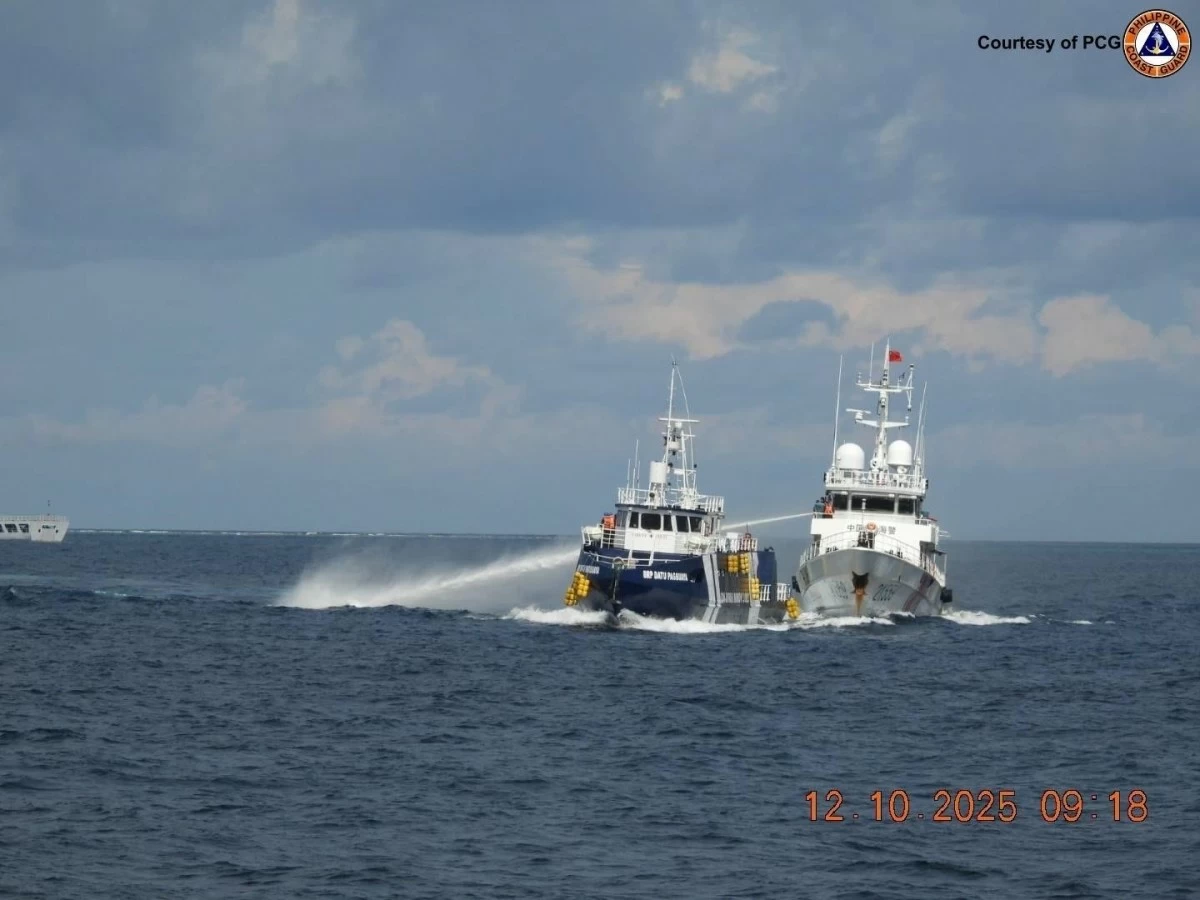
A China Coast Guard ship fires a water cannon at BRP Datu Pagbuaya while the latter is in Pag-asa Island, West Philippine Sea on Oct. 12, 2025 during a humanitarian mission. (Photo: Philippine Coast Guard)
Two more civilian vessels of the Bureau of Fisheries and Aquatic Resources (BFAR) were apparently hit by a water cannon by the China Coast Guard (CCG) near Pag-asa (Thitu) Island in the West Philippine Sea (WPS), the Philippine Coast Guard (PCG) revealed on Monday, Oct. 13.
Aside from BRP Datu Pagbuaya, a CCG ship with bow number “21559” also shot jets of water at BRP Datu Bankaw and BRP Datu Sanday approximately one to two nautical miles off the coast of Pag-asa Island around 8:50 a.m. on Oct. 12, according to PCG spokesperson for WPS Commodore Jay Tarriela.
The three BFAR vessels were in the area for a “Kadiwa para sa Bagong Bayaning Mangingisda” (KBBM) initiative, where government troops give fuel, food packs, and other supplies to Filipino fishermen in WPS.
“Yesterday, we only thought it was only BRP Datu Pagbuaya that was directly hit by the water cannon of CCG-21559. But we just received this report from the Commanding Officer of BRP Datu Bankaw that they were also hit by CCG-21559 but it’s not as significant or impactful compared to BRP Datu Pagbuaya,” Tarriela said in a press conference in Manila.
“And CCG-21559 again conducted dangerous maneuvers and used its water cannon against BRP Datu Sanday. So all in all, there were three BFAR vessels that were subjected to water cannon by China Coast Guard 21559, but it was only BRP Datu Pagbuaya that was directly hit and had significant impacts,” he added.
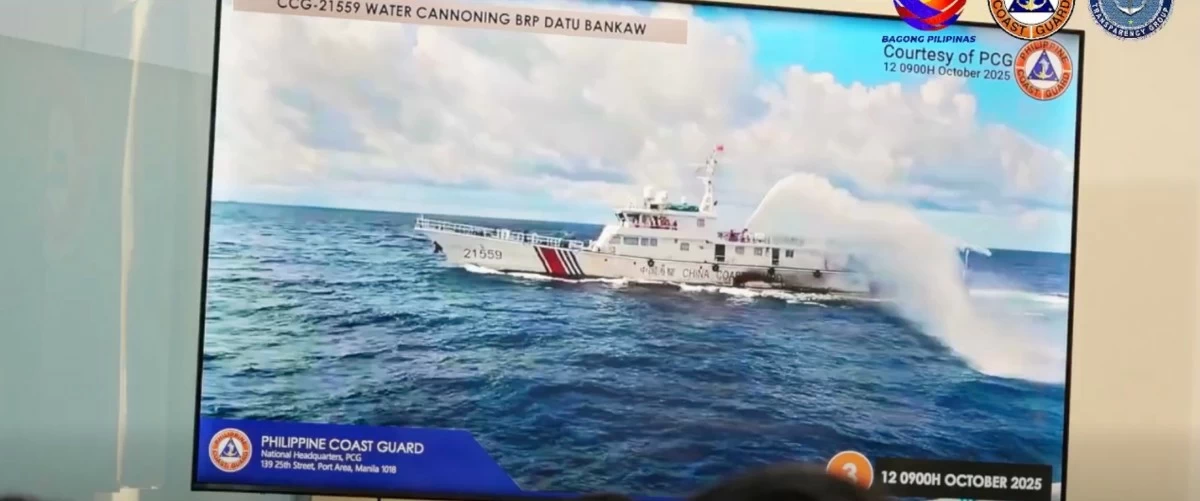
A China Coast Guard ship fires a water cannon at BRP Datu Bankaw while the latter is in Pag-asa Island, West Philippine Sea on Oct. 12, 2025 during a humanitarian mission. (Courtesy of Philippine Coast Guard)
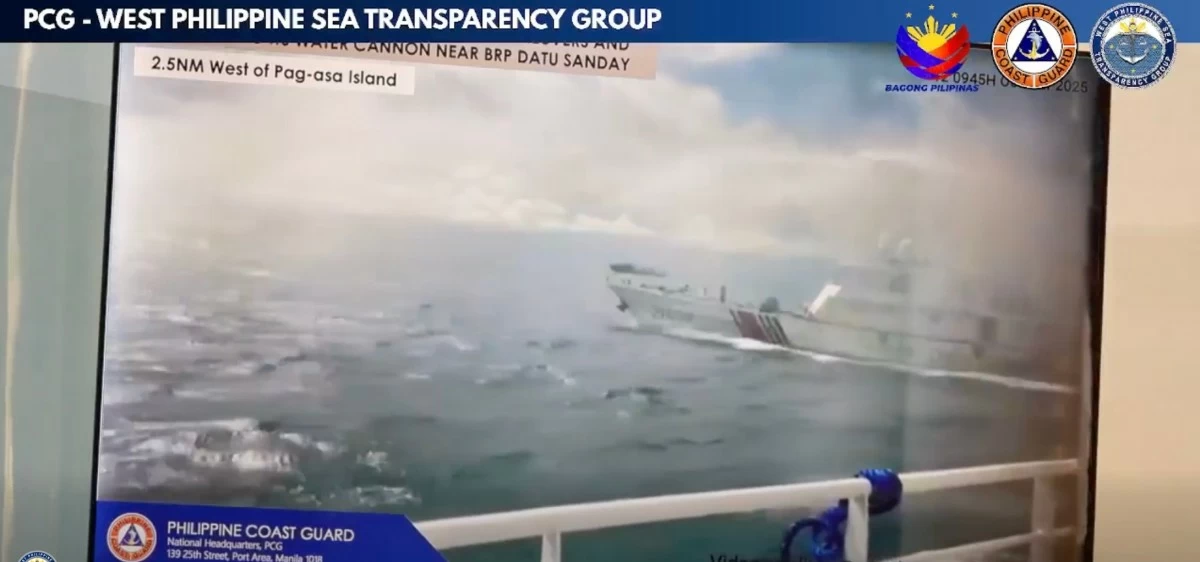
A China Coast Guard ship fires a water cannon at BRP Datu Sanday while the latter is in Pag-asa Island, West Philippine Sea on Oct. 12, 2025 during a humanitarian mission. (Courtesy of Philippine Coast Guard)
The PCG disclosed on Sunday that BRP Datu Pagbuaya was subjected to a water cannon attack and deliberate ramming by CCG-21559 while it was anchored in the territorial waters of Pag-asa Island.
Despite the aggression, the PCG official said no crew of BRP Datu Pagbuaya was injured in the incident. However, the intentional hit and water cannon attack caused minor structural damage on the rear portion of the Philippine vessel.
During the incident, Tarriela said the CCG deployed five ships, CCG-21559, 5102, 5009, 3305, and 23519, all of which entered the territorial sea of Pag-asa Island, as well as more than 15 Chinese maritime militia vessels in the vicinity.
A People’s Liberation Army-Navy warship with bow number “533” was also monitored around six nautical miles off Pag-asa Island while a PLA helicopter with tail number “51” flew over the area within the territorial airspace of Pag-asa Island, Tarriela reported.
Tarriela confirmed that the Chinese vessels came from Mischief Reef and Subi Reef, both are reclaimed features illegally occupied by China within the Philippines’ exclusive economic zone.
The PCG official condemned the continued Chinese harassment of Philippine government and civilian vessels within the country’s own maritime zones, stressing that the BFAR ships were unarmed and on a humanitarian mission.
“All of those actions by the Chinese government, especially near maritime features that we occupy, are very concerning because we are dealing with the lives of the crew of the BFAR and the PCG personnel,” Tarriela said. “We always take these illegal and aggressive acts seriously.”
Creeping presence
Tarriela also said that the recent encounter between the CCG and BFAR vessels near Pag-asa Island was the closest incident in the area so far, occurring less than two nautical miles from the island where a small Filipino community lives along with a detachment of military and police personnel.
“This is the closest that the CCG has harassed and bullied BFAR vessels in Pag-asa Island. Before, their aggressive actions were only near the Pag-asa Cays. This time, it happened just 1.6 to 1.8 nautical miles from Pag-asa Island,” Tarriela said.
Despite this, he rejected Beijing’s claims that it expelled the BFAR vessels from the area.
“I don’t think that they expelled the Philippine vessels. The mere fact that we never departed Pag-asa Island right after the incident disproves that claim,” he explained. “The presence of the PCG and the Armed Forces of the Philippines (AFP) remains in Pag-asa.”
After the incident, Tarriela said the BFAR vessels went to Escoda Shoal, which is also near Pag-asa Island, to continue giving out fuel subsidies to Filipino fishermen.
Tarriela emphasized that the security of Pag-asa Island is a shared responsibility among several government agencies, including the AFP, PNP Maritime Group, BFAR, and the local government unit (LGU).
“I’d like to believe that the entire national government is doing everything to make sure that the locals there will be safe and will not be subjected to any illegal actions from the People’s Republic of China,” he said.