ADVERTISEMENT

OCD: Power outage, minor landslides recorded as M5.8 aftershock rattles northern Cebu

Published Oct 13, 2025 12:10 pm  |  Updated Oct 13, 2025 01:35 pm
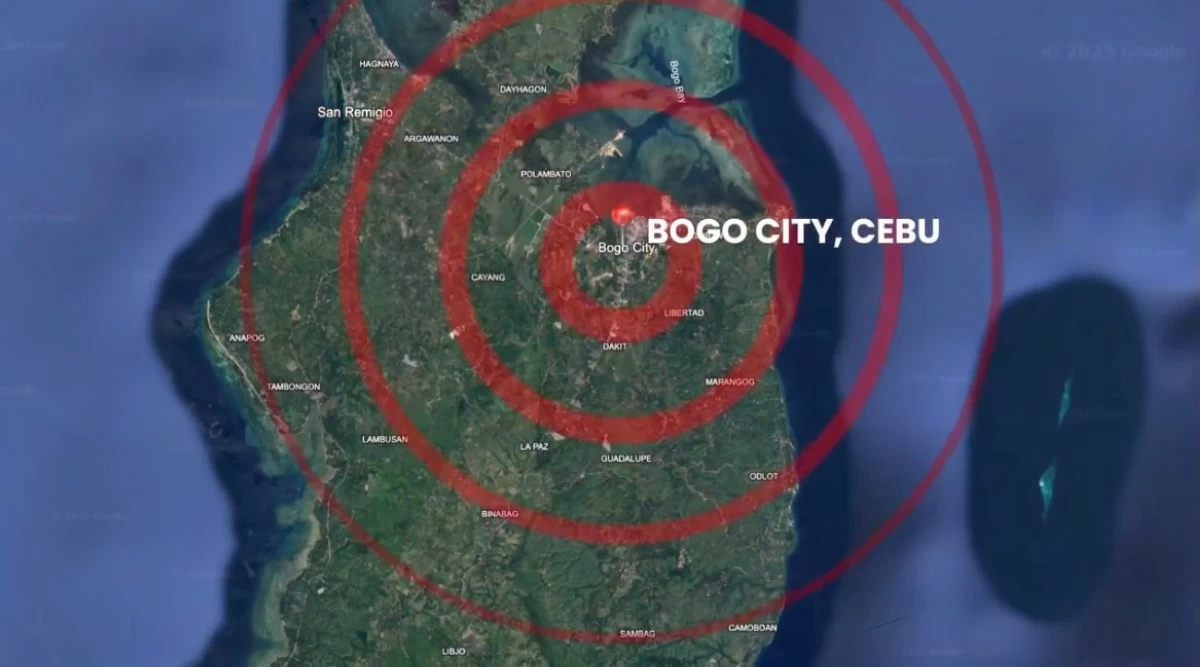
A magnitue. 5.8 earthquake occurs in Bogo City, Cebu on Oct. 13, 2025. The Office of Civil Defense said the tremor is an aftershock of the Sept. 30 earthquake that previously jolted northern Cebu, killing 75 individuals. (Courtesy of OCD)
The Office of Civil Defense (OCD) said that the magnitude 5.8 earthquake that struck northern Cebu in the wee hours of Monday, Oct. 13, caused power outages and minor landslides, as well as triggered panic for worried and weary residents.
OCD Deputy Administrator for Administration Assistant Secretary Bernardo Rafaelito Alejandro IV said the quake was an aftershock of the magnitude 6.9 earthquake that jolted Cebu and neighboring provinces last Sept. 30.
According to the Philippine Institute of Volcanology and Seismology (Phivolcs), the tremor occurred at 1:06 a.m. with its epicenter located 14 kilometers south and 13 kilometers west of Bogo City at a shallow depth of 10 kilometers. It was tectonic in origin, which means that it was caused by the “movement of rock layers beneath the Earth’s crust.”
“The initial assessment shows that the shaking was strong even though it was an aftershock. It was not a separate earthquake, based on the initial finding of Phivolcs. This was an aftershock of the September 30 earthquake,” Alejandro said.
The temblor woke up residents who were in deep slumber and forced them to go out of their homes to seek refuge.
“Last night, many residents went out of their homes. Many are still sleeping outside because there have already been almost 11,000 aftershocks. These continue to occur so our advice is to remain alert as strong aftershocks are still expected due to the September 30 earthquake,” Alejandro noted.
As of 6 a.m. Monday, power was knocked out in areas covered by the Cebu Electric Cooperative 2 (CEBECO 2), including Bogo City. The quake spared the power supply in the island municipalities of Bantayan, Madridejos, and Santa Fe, which remained energized.
Alejandro said the National Grid Corporation of the Philippines (NGCP) and other power sector partners have begun conducting assessments to determine the timeline for full restoration of electricity.
The OCD also received reports of minor rockfalls along the national highway in Sogod, Cebu which were immediately cleared by early morning. Damage assessment teams from the OCD have been deployed to Bogo City to evaluate the extent of the impact.
The death toll from the earlier Cebu earthquake remains at 75 while close to 600 others were injured. Authorities were verifying if there were new casualties resulting from the latest aftershock.
Alejandro said the OCD and all agencies under the National Disaster Risk Reduction and Management Council (NDRRMC) continue to operate under red alert status in line with President Marcos Jr.’s directive for full coordination and mobilization in disaster response and monitoring efforts.
"This means that we are in full mobilization. All agencies are present at the OCD, monitoring and coordinating 24/7 along with our available resources. As directed by the President, it’s an ‘all hands on deck’ response from all government agencies handling these incidents,” he stated.
The OCD official also noted that structural reassessments are ongoing in Metro Manila as part of preparedness measures for potential large-scale earthquakes.
“That is our advocacy, to check the structural integrity of our buildings especially in Metro Manila as part of our preparation for the so-called ‘Big One,’” Alejandro said, referring to a possible major earthquake that could strike Metro Manila and nearby provinces if the West Valley Fault moves.

Related Tags

OCD NDRRMC earthquake aftershock Bogo City Cebu
ADVERTISEMENT
.most-popular .layout-ratio{ padding-bottom: 79.13%; } @media (min-width: 768px) and (max-width: 1024px) { .widget-title { font-size: 15px !important; } }

{{ articles_filter_1561_widget.title }}

.most-popular .layout-ratio{ padding-bottom: 79.13%; } @media (min-width: 768px) and (max-width: 1024px) { .widget-title { font-size: 15px !important; } }

{{ articles_filter_1562_widget.title }}

.most-popular .layout-ratio{ padding-bottom: 79.13%; } @media (min-width: 768px) and (max-width: 1024px) { .widget-title { font-size: 15px !important; } }

{{ articles_filter_1563_widget.title }}

{{ articles_filter_1564_widget.title }}

.mb-article-details { position: relative; } .mb-article-details .article-body-preview, .mb-article-details .article-body-summary{ font-size: 17px; line-height: 30px; font-family: "Libre Caslon Text", serif; color: #000; } .mb-article-details .article-body-preview iframe , .mb-article-details .article-body-summary iframe{ width: 100%; margin: auto; } .read-more-background { background: linear-gradient(180deg, color(display-p3 1.000 1.000 1.000 / 0) 13.75%, color(display-p3 1.000 1.000 1.000 / 0.8) 30.79%, color(display-p3 1.000 1.000 1.000) 72.5%); position: absolute; height: 200px; width: 100%; bottom: 0; display: flex; justify-content: center; align-items: center; padding: 0; } .read-more-background a{ color: #000; } .read-more-btn { padding: 17px 45px; font-family: Inter; font-weight: 700; font-size: 18px; line-height: 16px; text-align: center; vertical-align: middle; border: 1px solid black; background-color: white; } .hidden { display: none; }
function initializeAllSwipers() { // Get all hidden inputs with cms_article_id document.querySelectorAll('[id^="cms_article_id_"]').forEach(function (input) { const cmsArticleId = input.value; const articleSelector = '#article-' + cmsArticleId + ' .body_images'; const swiperElement = document.querySelector(articleSelector); if (swiperElement && !swiperElement.classList.contains('swiper-initialized')) { new Swiper(articleSelector, { loop: true, pagination: false, navigation: { nextEl: '#article-' + cmsArticleId + ' .swiper-button-next', prevEl: '#article-' + cmsArticleId + ' .swiper-button-prev', }, }); } }); } setTimeout(initializeAllSwipers, 3000); const intersectionObserver = new IntersectionObserver( (entries) => { entries.forEach((entry) => { if (entry.isIntersecting) { const newUrl = entry.target.getAttribute("data-url"); if (newUrl) { history.pushState(null, null, newUrl); let article = entry.target; // Extract metadata const author = article.querySelector('.author-section').textContent.replace('By', '').trim(); const section = article.querySelector('.section-info ').textContent.replace(' ', ' '); const title = article.querySelector('.article-title h1').textContent; // Parse URL for Chartbeat path format const parsedUrl = new URL(newUrl, window.location.origin); const cleanUrl = parsedUrl.host + parsedUrl.pathname; // Update Chartbeat configuration if (typeof window._sf_async_config !== 'undefined') { window._sf_async_config.path = cleanUrl; window._sf_async_config.sections = section; window._sf_async_config.authors = author; } // Track virtual page view with Chartbeat if (typeof pSUPERFLY !== 'undefined' && typeof pSUPERFLY.virtualPage === 'function') { try { pSUPERFLY.virtualPage({ path: cleanUrl, title: title, sections: section, authors: author }); } catch (error) { console.error('ping error', error); } } // Optional: Update document title if (title && title !== document.title) { document.title = title; } } } }); }, { threshold: 0.1 } ); function showArticleBody(button) { const article = button.closest("article"); const summary = article.querySelector(".article-body-summary"); const body = article.querySelector(".article-body-preview"); const readMoreSection = article.querySelector(".read-more-background"); // Hide summary and read-more section summary.style.display = "none"; readMoreSection.style.display = "none"; // Show the full article body body.classList.remove("hidden"); } document.addEventListener("DOMContentLoaded", () => { let loadCount = 0; // Track how many times articles are loaded const offset = [1, 2, 3, 4, 5, 6, 7, 8, 9, 10]; // Offset values const currentUrl = window.location.pathname.substring(1); let isLoading = false; // Prevent multiple calls if (!currentUrl) { console.log("Current URL is invalid."); return; } const sentinel = document.getElementById("load-more-sentinel"); if (!sentinel) { console.log("Sentinel element not found."); return; } function isSentinelVisible() { const rect = sentinel.getBoundingClientRect(); return ( rect.top < window.innerHeight && rect.bottom >= 0 ); } function onScroll() { if (isLoading) return; if (isSentinelVisible()) { if (loadCount >= offset.length) { console.log("Maximum load attempts reached."); window.removeEventListener("scroll", onScroll); return; } isLoading = true; const currentOffset = offset[loadCount]; window.loadMoreItems().then(() => { let article = document.querySelector('#widget_1690 > div:nth-last-of-type(2) article'); intersectionObserver.observe(article) loadCount++; }).catch(error => { console.error("Error loading more items:", error); }).finally(() => { isLoading = false; }); } } window.addEventListener("scroll", onScroll); });

Sign up by email to receive news.