






Manila Bulletin
 Philippines
National
Davao quakes affect half a million people; OCD calls on nat'l gov't to fund resilience amid corruption woes
Philippines
National
Davao quakes affect half a million people; OCD calls on nat'l gov't to fund resilience amid corruption woes
Philippines
National
Davao quakes affect half a million people; OCD calls on nat'l gov't to fund resilience amid corruption woes
Davao quakes affect half a million people; OCD calls on nat'l gov't to fund resilience amid corruption woes
Published Oct 13, 2025 11:19 am
|
Updated Oct 13, 2025 01:36 pm


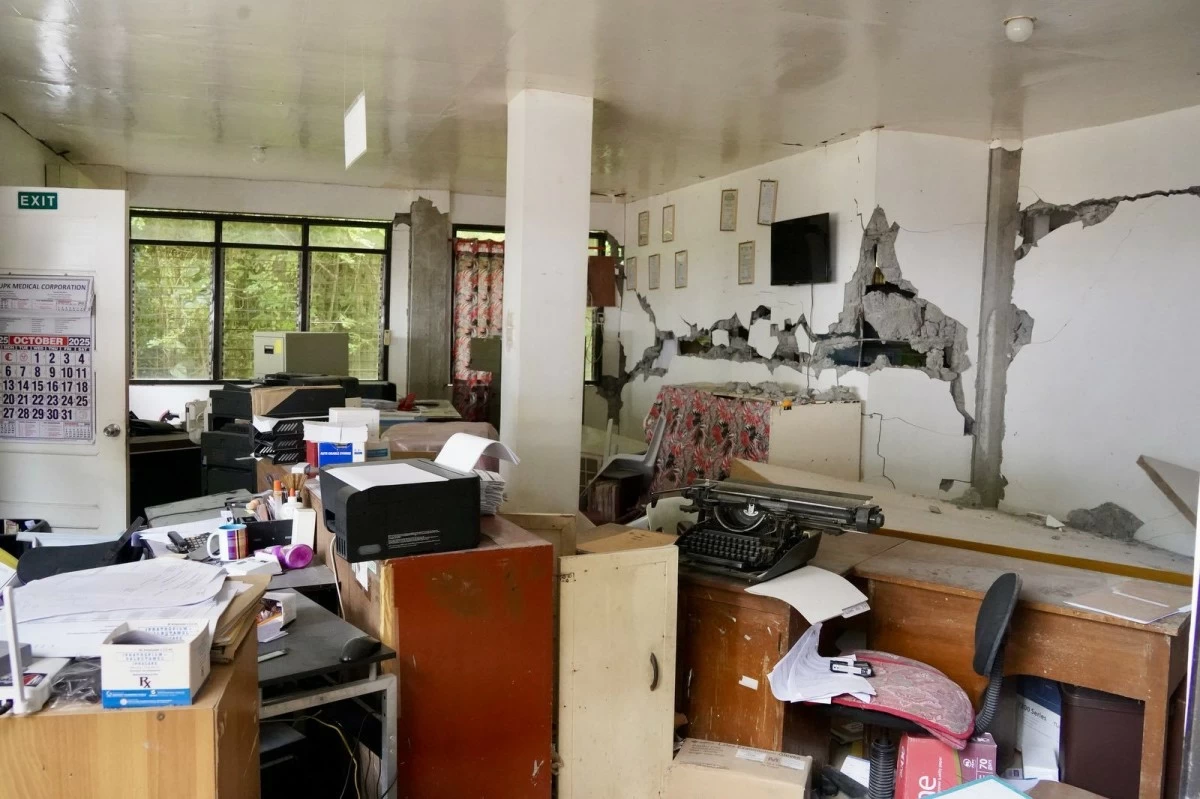
Damage to a community establishment in Brgy. San Isidro, Manay, Davao Oriental can be seen as a result of the twin earthquakes that struck the province as officials from the Office of Civil Defense, Mines and Geosciences Bureau, and the Philippine Institute of Volcanology and Seismology (Phivolcs) conduct an inspection on October 11, 2025. (Photo courtesy of Philippine Information Agency via OCD)
Around half a million individuals have already been affected by the doublet earthquakes that struck Davao Oriental and nearby provinces last week, the National Disaster Risk Reduction and Management Council (NDRRMC) reported on Monday, Oct. 13.
Relatedly, the Office of Civil Defense (OCD) urged the national government to bolster investments in disaster resilience amid massive corruption issues hounding infrastructure projects.
In its latest situational report, the NDRRMC stated that a total of 131,827 families, or 520,185 individuals, were affected by the twin earthquakes in Davao (Region 11) and Caraga (Region 13), encompassing seven provinces, 45 cities, and 331 municipalities, and 331 barangays.
The death toll remained at eight while the number of injured people climbed to 403. The agency said 8,868 people were also taking shelter in 18 evacuation centers.
Authorities also reported 2,102 damaged houses and 548 damaged infrastructures. The estimated cost of infrastructure damage reached P100.26 million.
The twin quakes, measuring magnitude 7.4 and 6.8, both originated off the coast of Manay, Davao Oriental, on Oct. 10.
As of 8 p.m. of Oct. 12, a total of 1,148 aftershocks have been recorded, with 526 plotted and 14 felt, ranging from magnitude 1.2 to 6.8.
Despite the widespread damage, authorities said lifelines have been largely restored. Power, water supply, and communication lines, which were initially disrupted in several areas, have now been restored 100 percent in Davao and Caraga regions.
The Department of Social Welfare and Development (DSWD) has so far provided P26.8 million worth of assistance to affected families, including 24,358 family food packs.
Local government units, along with police and military forces, continue to conduct clearing operations and provide relief in heavily affected areas as aftershocks persist.
International Day for Disaster Risk Reduction
As this developed, the OCD joined the global observance of the United Nations International Day for Disaster Risk Reduction (IDDRR) 2025 at the SM Mall of Asia in Pasay City as it highlighted the urgent call to “fund resilience, not disasters.”
The event, organized by ARISE Philippines and the OCD in partnership with the UN Office for Disaster Risk Reduction (UNDRR) and other stakeholders, underscored the importance of investing in preparedness, resilience, and long-term risk reduction to protect communities from the impacts of natural hazards.
“We, from the Office of Civil Defense, as the executive arm of the National Disaster Risk Reduction and Management Council, strongly support ARISE and UNDRR in this year’s IDDRR. We commit to strengthening disaster resilience in Philippine communities by advocating increased funding through public and international budgets for risk-informed development and initiatives,” Idio said.
He stressed the importance of cultivating a “culture of preparedness” amid the recent series of earthquakes, typhoons, and other hazards that have struck the country.
“This celebration is vital because it raises public awareness of disaster resilience. We need to invest in resilience for proper preparedness, prevention, and mitigation. It should be part of our culture and we must not be complacent,” he added.
The 2025 IDDRR celebration featured activities designed to engage both government and private stakeholders including exhibit booths showcasing resilience initiatives, a resilience relay promoting teamwork and preparedness, and a T-Bandage Contest demonstrating first aid and life-saving skills.
For the private sector, Engineer Liza Silerio, head of ARISE Philippines, highlighted how businesses are increasingly prioritizing disaster preparedness as part of their sustainability and continuity strategies.
“The private sector has been taking preparedness seriously because we protect not only our businesses but also our people. We work closely with partners like the Bureau of Fire Protection and NDRRMC to strengthen readiness, and we encourage all private entities to cooperate with government efforts,” Silerio said.
Meanwhile, Retired Vice Admiral Alexander Palma, ARISE Global Board member and consultant at SM Prime Holdings, Inc., urged Filipinos to translate disaster awareness into concrete action.
“Knowledge alone is not enough. We must develop muscle memory, knowing what to do automatically when disaster strikes. We must also heed warnings and ensure that no one is left behind. Prepared individuals can save not only themselves but others who need help,” Palma emphasized.
The observance comes as the Philippines was once again ranked as the most disaster-prone country in the world in the 2025 World Risk Index, marking the 21st consecutive year it topped the list. The report, published by Germany’s Bündnis Entwicklung Hilft and Ruhr University Bochum, gave the Philippines a “very high risk” score of 46.56 among 193 countries, citing its high exposure to weather-related extremes such as typhoons, flooding, and earthquakes.