ADVERTISEMENT

Davao Oriental quakes death toll increases to 8 – NDRRMC

Published Oct 12, 2025 11:26 am  |  Updated Oct 12, 2025 01:41 pm
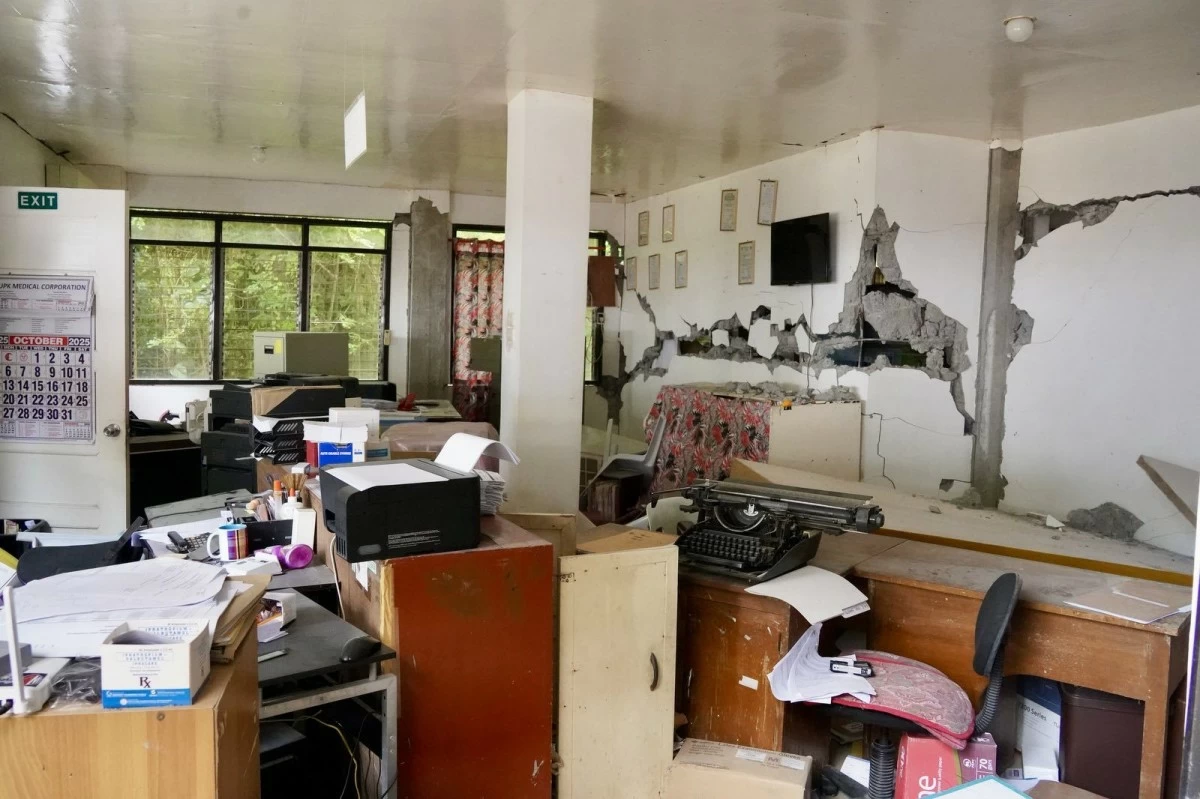
Damage to a community establishment in Brgy. San Isidro, Manay, Davao Oriental can be seen as a result of the twin earthquakes that struck the province as officials from the Office of Civil Defense, Mines and Geosciences Bureau, and the Philippine Institute of Volcanology and Seismology (Phivolcs) conduct an inspection on October 11, 2025. (Photo courtesy of Philippine Information Agency via OCD)
(UPDATED)
The death toll from the twin strong earthquakes that struck Davao Oriental and nearby provinces last Oct. 10 has risen to eight, the National Disaster Risk Reduction and Management Council (NDRRMC) reported on Sunday, Oct. 12.
Office of Civil Defense (OCD) Assistant Secretary Bernardo Rafaelito Alejandro IV said the fatalities include three in Davao Oriental, four in Davao de Oro, and one in Davao City.
“These reports are still subject to validation and verification but these are the numbers we have at the moment. There are no reported missing persons,” Alejandro said.
One fatality was added to the previous death toll of seven which was recorded in Mati City where an individual was crushed by a collapsed wall, Alejandro said. There were 395 persons who were also injured.
Read: Davao 'doublet' quakes death toll rises to 7 – NDRRMC
The magnitude 7.4 and 6.8 earthquakes that struck on Oct. 10 and registered their epicenter in Manay, Davao Oriental have already affected 125,283 families comprised of 491,258 individuals in Davao (Region 11) and Caraga (Region 13).
Of this, more than 8,400 individuals were temporarily sheltered in 14 evacuation centers while close to 200 others were staying in open spaces due to fear of aftershocks.
Members of the NDRRMC's Inter-Agency Coordinating Cell (IACC) led by NDRRMC Chairman and Defense Sec. Gilberto Teodoro Jr. also convened to discuss coordinated response plans to hasten the recovery of Davao de Oro and other affected areas.
Housing needs
Alejandro said the government is now assessing housing needs of the quake victims in coordination with the Department of Human Settlements and Urban Development (DHSUD).
“For totally damaged houses, we are looking into possible transition shelters. For partially damaged ones, the government will provide repair kits or housing assistance after technical assessment,” he said.
According to the NDRRMC, a total of 1,857 houses were partially damaged while 298 homes were totally destroyed due to the twin quakes in Davao Region and Caraga.
Family tents have been installed at Manay District Hospital to serve as temporary shelters for patients amid continuing aftershocks. The Department of Health also began transferring patients from the damaged Davao Oriental Provincial Hospital in Manay town to a new temporary medical center that can accomodate them.
In Tarragona, Davao Oriental, the municipal evacuation center remains operational with Philippine National Police (PNP) personnel on standby for security, health workers addressing medical concerns, and daycare workers conducting child-friendly activities.
Infra damage
The Department of Public Works and Highways (DPWH) also continued to assess the extent of damage to infrastructure such as roads, bridges, schools, health facilities, barangay halls, and churches among others but initial estimates of the damage have reached P100,258,000.
Rapid damage assessment and needs analysis (RDANA) teams from the OCD, Department of Social Welfare and Development (DSWD), and the Philippine Air Force (PAF) have been deployed across Davao Region and Caraga to assess the full extent of the damage.
The PAF’s Tactical Operations Wing Eastern Mindanao (TOWEASTMIN) conducted RDANA operations in Davao Oriental while Tactical Operations Group 10 (TOG 10) utilized an S-70i Black Hawk helicopter to perform aerial reconnaissance over Caraga Region to help identify priority areas for relief and rehabilitation.
There were 32 road sections and seven bridges that were affected in the two regions, including five road sections and three bridges that remained impassable to the public.
Meanwhile, OCD Administrator Usec. Harold Cabreros Harold Cabreros commended the preparedness of local residents and local government units (LGUs) during the strong quakes.
“We are thankful that we did not sustain severe damage although some of our fellow citizens were injured and lost their homes. Considering the magnitude of the quake, it’s a big thing that our people were prepared. Many already know how to duck, cover, and hold as seen in the videos that have circulated,” Cabreros said.
Power interruption was also reported in 27 areas when the quakes occurred, but the supply of electricity has since been completely restored, according to the NDRRMC.
Relief assistance to affected communities was also continuously being delivered by the DSWD.
The OCD said the DSWD has distributed 24,358 family food packs, 3,606 ready-to-eat meals, and 2,500 non-food items such as shelter repair and hygiene kits to the quake victims.
It added that the social welfare department has also prepositioned 100,049 family food packs worth P58.95 million, P7.52 million worth of non-food items, and P2.1 million in standby funds for the quake victims.

Related Tags

OCD NDRRMC earthquake Davao Oriental
ADVERTISEMENT
.most-popular .layout-ratio{ padding-bottom: 79.13%; } @media (min-width: 768px) and (max-width: 1024px) { .widget-title { font-size: 15px !important; } }

{{ articles_filter_1561_widget.title }}

.most-popular .layout-ratio{ padding-bottom: 79.13%; } @media (min-width: 768px) and (max-width: 1024px) { .widget-title { font-size: 15px !important; } }

{{ articles_filter_1562_widget.title }}

.most-popular .layout-ratio{ padding-bottom: 79.13%; } @media (min-width: 768px) and (max-width: 1024px) { .widget-title { font-size: 15px !important; } }

{{ articles_filter_1563_widget.title }}

{{ articles_filter_1564_widget.title }}

.mb-article-details { position: relative; } .mb-article-details .article-body-preview, .mb-article-details .article-body-summary{ font-size: 17px; line-height: 30px; font-family: "Libre Caslon Text", serif; color: #000; } .mb-article-details .article-body-preview iframe , .mb-article-details .article-body-summary iframe{ width: 100%; margin: auto; } .read-more-background { background: linear-gradient(180deg, color(display-p3 1.000 1.000 1.000 / 0) 13.75%, color(display-p3 1.000 1.000 1.000 / 0.8) 30.79%, color(display-p3 1.000 1.000 1.000) 72.5%); position: absolute; height: 200px; width: 100%; bottom: 0; display: flex; justify-content: center; align-items: center; padding: 0; } .read-more-background a{ color: #000; } .read-more-btn { padding: 17px 45px; font-family: Inter; font-weight: 700; font-size: 18px; line-height: 16px; text-align: center; vertical-align: middle; border: 1px solid black; background-color: white; } .hidden { display: none; }
function initializeAllSwipers() { // Get all hidden inputs with cms_article_id document.querySelectorAll('[id^="cms_article_id_"]').forEach(function (input) { const cmsArticleId = input.value; const articleSelector = '#article-' + cmsArticleId + ' .body_images'; const swiperElement = document.querySelector(articleSelector); if (swiperElement && !swiperElement.classList.contains('swiper-initialized')) { new Swiper(articleSelector, { loop: true, pagination: false, navigation: { nextEl: '#article-' + cmsArticleId + ' .swiper-button-next', prevEl: '#article-' + cmsArticleId + ' .swiper-button-prev', }, }); } }); } setTimeout(initializeAllSwipers, 3000); const intersectionObserver = new IntersectionObserver( (entries) => { entries.forEach((entry) => { if (entry.isIntersecting) { const newUrl = entry.target.getAttribute("data-url"); if (newUrl) { history.pushState(null, null, newUrl); let article = entry.target; // Extract metadata const author = article.querySelector('.author-section').textContent.replace('By', '').trim(); const section = article.querySelector('.section-info ').textContent.replace(' ', ' '); const title = article.querySelector('.article-title h1').textContent; // Parse URL for Chartbeat path format const parsedUrl = new URL(newUrl, window.location.origin); const cleanUrl = parsedUrl.host + parsedUrl.pathname; // Update Chartbeat configuration if (typeof window._sf_async_config !== 'undefined') { window._sf_async_config.path = cleanUrl; window._sf_async_config.sections = section; window._sf_async_config.authors = author; } // Track virtual page view with Chartbeat if (typeof pSUPERFLY !== 'undefined' && typeof pSUPERFLY.virtualPage === 'function') { try { pSUPERFLY.virtualPage({ path: cleanUrl, title: title, sections: section, authors: author }); } catch (error) { console.error('ping error', error); } } // Optional: Update document title if (title && title !== document.title) { document.title = title; } } } }); }, { threshold: 0.1 } ); function showArticleBody(button) { const article = button.closest("article"); const summary = article.querySelector(".article-body-summary"); const body = article.querySelector(".article-body-preview"); const readMoreSection = article.querySelector(".read-more-background"); // Hide summary and read-more section summary.style.display = "none"; readMoreSection.style.display = "none"; // Show the full article body body.classList.remove("hidden"); } document.addEventListener("DOMContentLoaded", () => { let loadCount = 0; // Track how many times articles are loaded const offset = [1, 2, 3, 4, 5, 6, 7, 8, 9, 10]; // Offset values const currentUrl = window.location.pathname.substring(1); let isLoading = false; // Prevent multiple calls if (!currentUrl) { console.log("Current URL is invalid."); return; } const sentinel = document.getElementById("load-more-sentinel"); if (!sentinel) { console.log("Sentinel element not found."); return; } function isSentinelVisible() { const rect = sentinel.getBoundingClientRect(); return ( rect.top < window.innerHeight && rect.bottom >= 0 ); } function onScroll() { if (isLoading) return; if (isSentinelVisible()) { if (loadCount >= offset.length) { console.log("Maximum load attempts reached."); window.removeEventListener("scroll", onScroll); return; } isLoading = true; const currentOffset = offset[loadCount]; window.loadMoreItems().then(() => { let article = document.querySelector('#widget_1690 > div:nth-last-of-type(2) article'); intersectionObserver.observe(article) loadCount++; }).catch(error => { console.error("Error loading more items:", error); }).finally(() => { isLoading = false; }); } } window.addEventListener("scroll", onScroll); });

Sign up by email to receive news.