

ADVERTISEMENT

A long-lost ancient Roman artifact reappears in a New Orleans backyard

Published Oct 12, 2025 08:43 am
NEW ORLEANS (AP) — A New Orleans family cleaning up their overgrown backyard made an extremely unusual find: Under the weeds was a mysterious marble tablet with Latin characters that included the phrase "spirits of the dead."
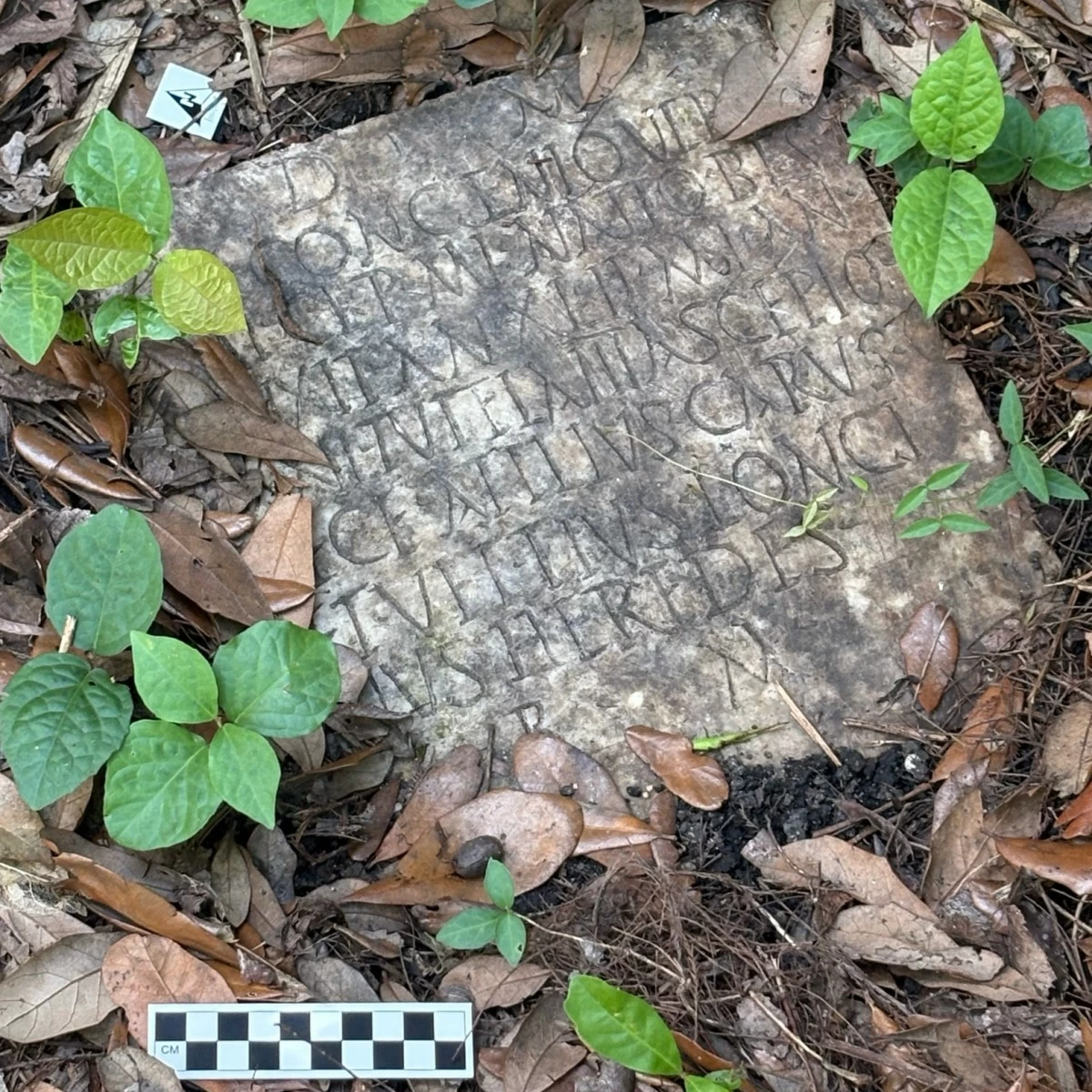
This photo provided by Tulane University classical archeologist Susann Lusnia in October 2025 shows the 1,900-year-old grave marker of a Roman sailor named Sextus Congenius Verus, discovered in a New Orleans backyard. (Susann Lusnia via AP)
"The fact that it was in Latin that really just gave us pause, right?" said Daniella Santoro, a Tulane University anthropologist. "I mean, you see something like that and you say, 'Okay, this is not an ordinary thing.'"
Intrigued and slightly alarmed, Santoro reached out to her classical archaeologist colleague Susann Lusnia, who quickly realized that the slab was the 1,900-year-old grave marker of a Roman sailor named Sextus Congenius Verus.
"When I first saw the image that Daniella sent me, it really did send a shiver up my spine because I was just floored," Lusnia said.
Further sleuthing by Lusnia revealed the tablet had been missing from an Italian museum for decades.
Sextus Congenius Verus had died at age 42, of unknown causes, after serving for more than two decades in the imperial navy on a ship named for the Greco-Roman god of medicine, Asclepius. The gravestone calls the sailor "well deserving" and was commissioned by two people described as his "heirs," who were likely shipmates since Roman military could not be married at the time, Lusnia said.
The tablet had been in an ancient cemetery of around 20 graves of military personnel, found in the 1860s in Civitavecchia, a seaside in northwest Italy about 30 miles (48 kilometers) from Rome. Its text had been recorded in 1910 and included in a catalog of Latin inscriptions, which noted the tablet's whereabouts were unknown.
The tablet was later documented at the National Archeological Museum in Civitavecchia prior to World War II. But the museum had been "pretty much destroyed" during Allied bombing and took several decades to rebuild, Lusnia said. Museum staff confirmed to Lusnia the tablet had been missing for decades. Its recorded measurements — 1 square foot (0.09 square meters) and 1 inch (2.5 centimeters) thick — matched the size of the tablet found in Santoro's backyard.
"You can't have better DNA than that," Lusnia said.
She said the FBI is in talks with Italian authorities to repatriate the tablet. An FBI spokesperson said the agency could not respond to requests for comment during the government shutdown.
A final twist to the story suggests how the tablet made its way to New Orleans.
As media reports of the find began circulating this week, Erin Scott O'Brien says her ex-husband called her and told her to watch the news. She immediately recognized the hunk of marble, which she had always seen as a "cool-ass piece of art." They had used as a garden decoration and then forgot about it before selling the home to Santoro in 2018.
"None of us knew what it was," O'Brien said. "We were watching the video, just like in shock."
O'Brien said she received the tablet from her grandparents — an Italian woman and a New Orleans native who was stationed in the country during World War II.
Perhaps no one would be more thrilled by the tablet's rediscovery than Sextus himself. Grave markers were important in Roman culture to uphold legacies, even of everyday citizens, Lusnia said.
"Now Sextus Congenius Verus is being talked about so much," Lusnia said. "If there's an afterlife and he's in it and he knows, he's very happy because this is what a Roman wants — to be remembered forever."

Related Tags

World news
ADVERTISEMENT
.most-popular .layout-ratio{ padding-bottom: 79.13%; } @media (min-width: 768px) and (max-width: 1024px) { .widget-title { font-size: 15px !important; } }

{{ articles_filter_1561_widget.title }}

.most-popular .layout-ratio{ padding-bottom: 79.13%; } @media (min-width: 768px) and (max-width: 1024px) { .widget-title { font-size: 15px !important; } }

{{ articles_filter_1562_widget.title }}

.most-popular .layout-ratio{ padding-bottom: 79.13%; } @media (min-width: 768px) and (max-width: 1024px) { .widget-title { font-size: 15px !important; } }

{{ articles_filter_1563_widget.title }}

{{ articles_filter_1564_widget.title }}

.mb-article-details { position: relative; } .mb-article-details .article-body-preview, .mb-article-details .article-body-summary{ font-size: 17px; line-height: 30px; font-family: "Libre Caslon Text", serif; color: #000; } .mb-article-details .article-body-preview iframe , .mb-article-details .article-body-summary iframe{ width: 100%; margin: auto; } .read-more-background { background: linear-gradient(180deg, color(display-p3 1.000 1.000 1.000 / 0) 13.75%, color(display-p3 1.000 1.000 1.000 / 0.8) 30.79%, color(display-p3 1.000 1.000 1.000) 72.5%); position: absolute; height: 200px; width: 100%; bottom: 0; display: flex; justify-content: center; align-items: center; padding: 0; } .read-more-background a{ color: #000; } .read-more-btn { padding: 17px 45px; font-family: Inter; font-weight: 700; font-size: 18px; line-height: 16px; text-align: center; vertical-align: middle; border: 1px solid black; background-color: white; } .hidden { display: none; }
function initializeAllSwipers() { // Get all hidden inputs with cms_article_id document.querySelectorAll('[id^="cms_article_id_"]').forEach(function (input) { const cmsArticleId = input.value; const articleSelector = '#article-' + cmsArticleId + ' .body_images'; const swiperElement = document.querySelector(articleSelector); if (swiperElement && !swiperElement.classList.contains('swiper-initialized')) { new Swiper(articleSelector, { loop: true, pagination: false, navigation: { nextEl: '#article-' + cmsArticleId + ' .swiper-button-next', prevEl: '#article-' + cmsArticleId + ' .swiper-button-prev', }, }); } }); } setTimeout(initializeAllSwipers, 3000); const intersectionObserver = new IntersectionObserver( (entries) => { entries.forEach((entry) => { if (entry.isIntersecting) { const newUrl = entry.target.getAttribute("data-url"); if (newUrl) { history.pushState(null, null, newUrl); let article = entry.target; // Extract metadata const author = article.querySelector('.author-section').textContent.replace('By', '').trim(); const section = article.querySelector('.section-info ').textContent.replace(' ', ' '); const title = article.querySelector('.article-title h1').textContent; // Parse URL for Chartbeat path format const parsedUrl = new URL(newUrl, window.location.origin); const cleanUrl = parsedUrl.host + parsedUrl.pathname; // Update Chartbeat configuration if (typeof window._sf_async_config !== 'undefined') { window._sf_async_config.path = cleanUrl; window._sf_async_config.sections = section; window._sf_async_config.authors = author; } // Track virtual page view with Chartbeat if (typeof pSUPERFLY !== 'undefined' && typeof pSUPERFLY.virtualPage === 'function') { try { pSUPERFLY.virtualPage({ path: cleanUrl, title: title, sections: section, authors: author }); } catch (error) { console.error('ping error', error); } } // Optional: Update document title if (title && title !== document.title) { document.title = title; } } } }); }, { threshold: 0.1 } ); function showArticleBody(button) { const article = button.closest("article"); const summary = article.querySelector(".article-body-summary"); const body = article.querySelector(".article-body-preview"); const readMoreSection = article.querySelector(".read-more-background"); // Hide summary and read-more section summary.style.display = "none"; readMoreSection.style.display = "none"; // Show the full article body body.classList.remove("hidden"); } document.addEventListener("DOMContentLoaded", () => { let loadCount = 0; // Track how many times articles are loaded const offset = [1, 2, 3, 4, 5, 6, 7, 8, 9, 10]; // Offset values const currentUrl = window.location.pathname.substring(1); let isLoading = false; // Prevent multiple calls if (!currentUrl) { console.log("Current URL is invalid."); return; } const sentinel = document.getElementById("load-more-sentinel"); if (!sentinel) { console.log("Sentinel element not found."); return; } function isSentinelVisible() { const rect = sentinel.getBoundingClientRect(); return ( rect.top < window.innerHeight && rect.bottom >= 0 ); } function onScroll() { if (isLoading) return; if (isSentinelVisible()) { if (loadCount >= offset.length) { console.log("Maximum load attempts reached."); window.removeEventListener("scroll", onScroll); return; } isLoading = true; const currentOffset = offset[loadCount]; window.loadMoreItems().then(() => { let article = document.querySelector('#widget_1690 > div:nth-last-of-type(2) article'); intersectionObserver.observe(article) loadCount++; }).catch(error => { console.error("Error loading more items:", error); }).finally(() => { isLoading = false; }); } } window.addEventListener("scroll", onScroll); });

Sign up by email to receive news.