







The Department of Foreign Affairs (DFA) on Tuesday, Oct. 7, stressed that the Philippines’ rights and sovereignty covering the contested West Philippine Sea are “incontrovertible” and based on international law and legal principles.
PH asserts 'incontrovertible' WPS rights amid sea dispute
Published Oct 7, 2025 11:31 am
|
Updated Oct 7, 2025 01:01 pm


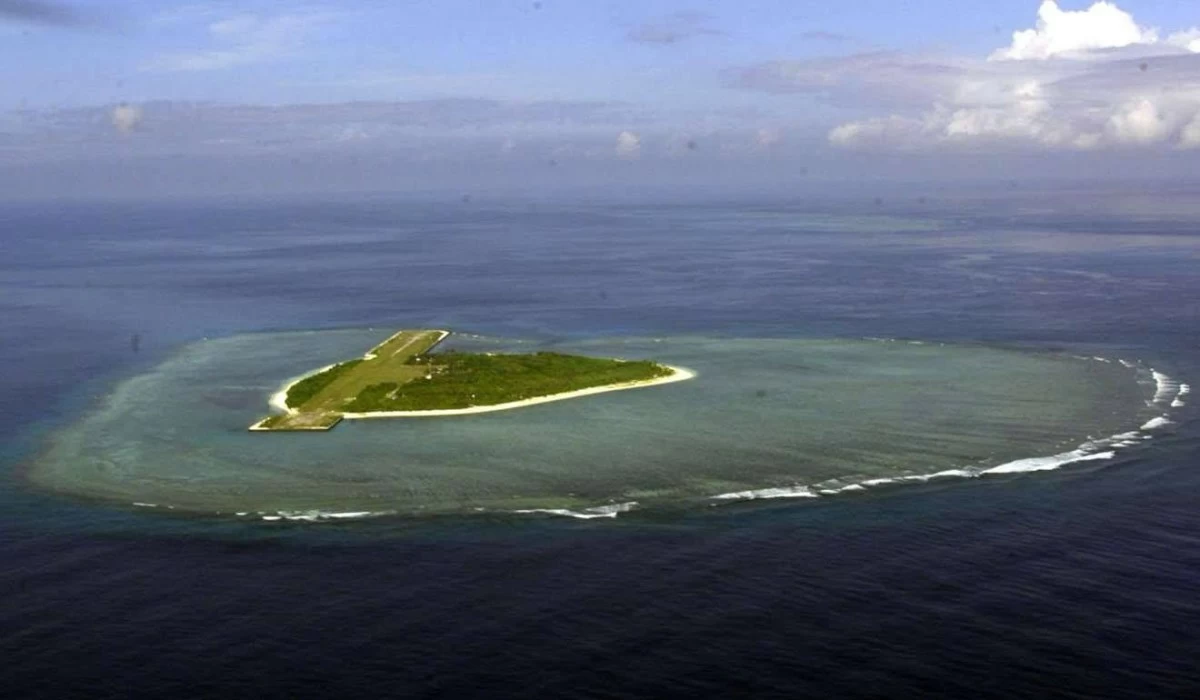
Pag-asa Island (Photo from the Armed Forces of the Philippines)
Without identifying the countries’ names, the DFA referred to how “some countries have been articulating an erroneous opinion that intentionally misreads certain treaties upon which the extent of Philippine territory is partly based.”
“The Philippines underscores that its sovereignty over its archipelago and other territories, including Bajo de Masinloc (BdM) and the high-tide features of the Kalayaan Island Group (KIG), is incontrovertible and firmly founded on international law, legal principles, effective control, and recognition through international treaties and agreements,” the DFA stressed.
The DFA said that the Philippines’ rights and sovereignty in the West Philippine Sea are founded on pertinent international treaties, such as the Treaty of Paris, the Treaty of Washington, and the 1930 United States-Great Britain Treaty.
These treaties, the agency pointed out, “clearly and firmly state the extent of Philippine territory as well as their meaning derived from the concrete and consistent demonstrations of sovereign authority and jurisdiction exercised by the Philippines over its territory through the centuries.”
“The 1935, 1973 and 1987 Constitutions of the Philippines, taken together, are clear on the legal bases and extent of the Philippine national territory,” the DFA added.
It also recalled the statement of President Marcos at the 21st IISS Shangri-la Dialogue in Singapore last May 31, 2024, wherein the chief executive stated that “The Treaty of Paris between Spain and the United States crystallized our islands into a cohesive whole” and “The Treaty of Washington clarified that the extent of our sovereignty and our patrimony transcends the lines set by international powers."
The DFA, who’s at the forefront of pushing for the Philippines’ maritime rights in the resource-rich but highly-disputed region.
“The Philippines will continue to remain vigilant against attempts to misinform the general public,” the department said.
“It will continue to assert and preserve its territorial integrity, and strongly uphold its sovereignty, sovereign rights and jurisdiction in accordance with international law,” it added.
Along with the Philippines, China, Vietnam, Malaysia, Indonesia, Taiwan, and Brunei Darussalam claim parts of the South China Sea, with Beijing claiming almost its entirety.