






Manila Bulletin
 Business
The Economy
Peso volatility from anti-corruption unrest seen to keep BSP on rate hold—Goldman Sachs
Business
The Economy
Peso volatility from anti-corruption unrest seen to keep BSP on rate hold—Goldman Sachs
Business
The Economy
Peso volatility from anti-corruption unrest seen to keep BSP on rate hold—Goldman Sachs
Peso volatility from anti-corruption unrest seen to keep BSP on rate hold—Goldman Sachs
By Derco Rosal
Published Oct 7, 2025 05:30 pm
|
Updated Oct 7, 2025 01:36 pm


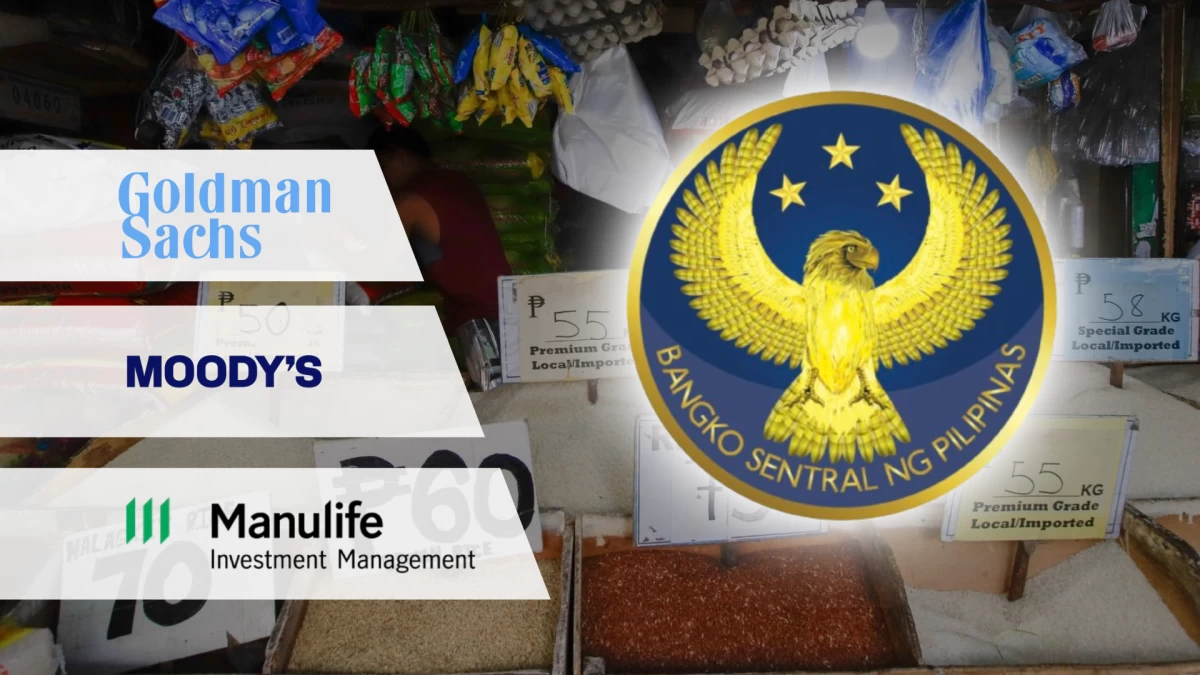
Peso volatility brought about by public protests against government corruption, particularly on “ghost” flood control projects, could prompt the Bangko Sentral ng Pilipinas (BSP) to hold the key lending rate at five percent, according to global investment banking giant Goldman Sachs.
In an Oct. 3 report obtained by Manila Bulletin, Goldman Sachs Economics Research noted that the Philippine peso depreciated by around two percent in September following massive anti-corruption protests on Sept. 21, the day the Martial Law declaration of strongman Ferdinand E. Marcos Sr., the father of President Ferdinand R. Marcos Jr., was commemorated.
The peso weakened against the United States (US) dollar in September, depreciating to the ₱58:$1 level during the month. The local currency ended September at ₱58.171 from ₱57.12 at end-August.
Goldman Sachs said consumer price hikes are also seen reinforcing the case for a BSP hold, given that price movements are gaining momentum. Inflation hit a six-month high of 1.7 percent in September, driven by more expensive oil and higher food prices, especially of vegetables.
Headline inflation, which continued to climb for the second straight month in September, is projected by Goldman Sachs to edge up further and move closer to the lower end of the central bank’s two- to four-percent target band of manageable price increases.
As such, Goldman Sachs forecasts the BSP’s policy-setting Monetary Board (MB) to keep the key interest rate “unchanged” on Thursday, Oct. 9.
Economic think tank Moody’s Analytics also believes the BSP “will likely stand pat, leaving its policy rate at five percent,” noting that the central bank “has already cut rates three times this year.” Year to date, there have been a total of 75 basis points (bps) in easing.
Goldman Sachs added that factory growth in the third quarter moderated from its second-quarter pace, while Moody’s Analytics also expects industrial production to have “stayed soft amid waning export demand.” On the flip side, businesses have turned more optimistic for the fourth quarter of 2025.
On the global front, Goldman Sachs expects growth to slow in the second half of 2025. Domestically, the government is targeting growth within the 5.5- to 6.5-percent range for the entire year, following weaker-than-expected performance in the first semester.
Citing these factors, along with expectations of a dovish US Federal Reserve (Fed), Goldman Sachs maintained its previous forecast that policy easing will continue until early 2026.
“We continue to expect the BSP to cut policy rates by another 50 bps in the cycle—25 bps each at the December 2025 meeting and in the first quarter of 2026—taking the terminal rate to 4.5 percent,” Goldman Sachs said.
For Jean De Castro, head of fixed income for Manulife Investment Management, upside risks to inflation are “sticky food prices due to supply shocks stemming from typhoons and the extended rice import ban.”
“Additionally, potential peso weakness beyond the ₱58 level could complicate the inflation outlook and recommend prudence in adjusting monetary policy,” De Castro said.
As such, De Castro anticipates the BSP to trim the policy rate one more time by year-end, though she sees it as unlikely on Thursday. “We can expect the MB to adopt a cautious stance and pause at the upcoming Oct. 9 meeting.”
“However, with inflation generally contained and liquidity conditions manageable, the BSP could cut the policy rate one more time in December if economic momentum weakens or if the US Fed eases further,” De Castro said.
To recall, BSP Governor Eli M. Remolona Jr. was less dovish in his guidance during the MB policy meeting in August. He said the current policy rates are at a “goldilocks” level, but still leave room for one more easing this year if the economy remains weak.
Since the BSP started its inflation-targeted monetary policy easing in August last year, rates have so far been brought down by 150 bps from 6.5 percent.