







Vietnam coast guard ship arrives in quake-hit Cebu
Published Oct 6, 2025 11:58 am


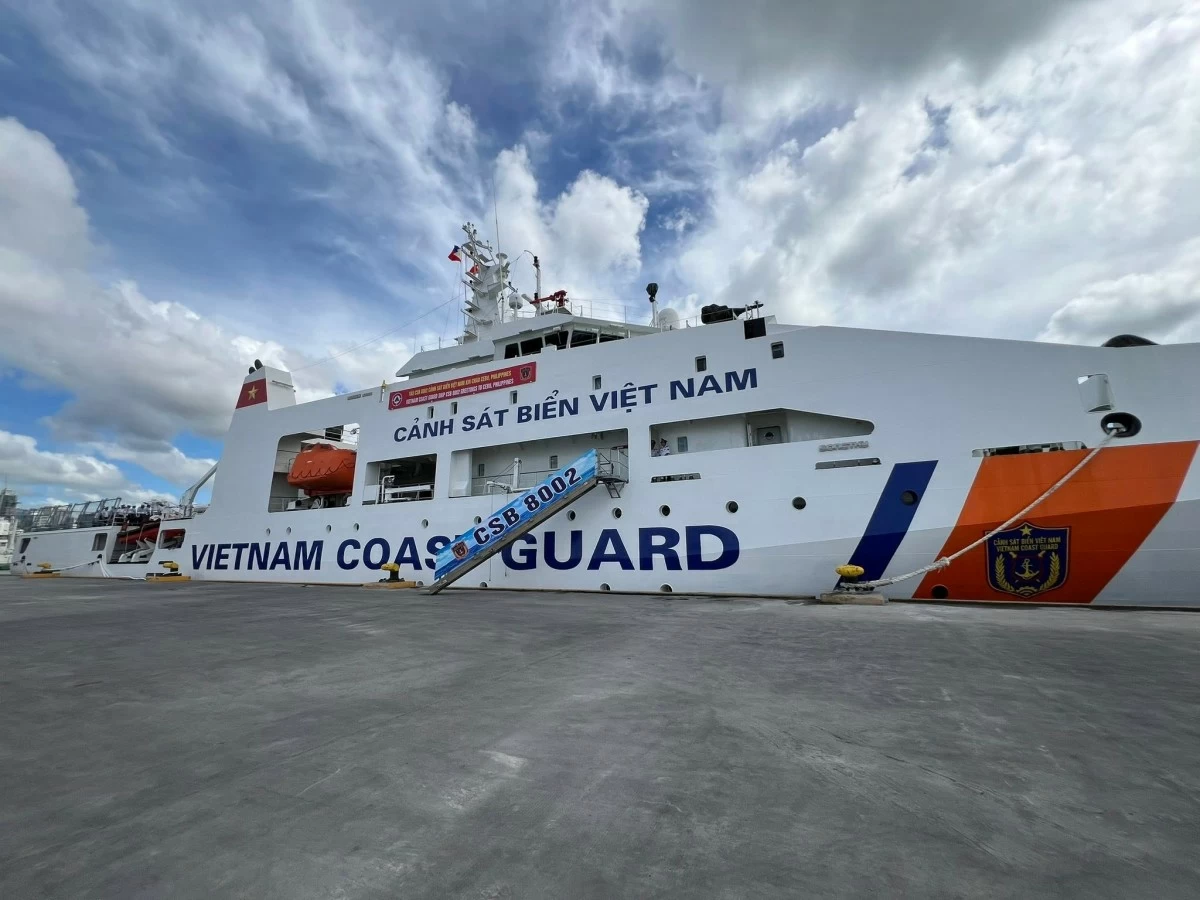
The Philippine Coast Guard (PCG) welcomes the Vietnam Coast Guard (VCG) ship "8002" for a five-day port visit in Cebu City on October 6, 2025. (Photo: Philippine Information Agency Region 7 via PCG)
The Philippine Coast Guard (PCG) welcomed on Monday, Oct. 6, a Vietnam Coast Guard (VCG) vessel in Cebu for a five-day port visit even as the province continues to recover from the recent magnitude 6.9 earthquake.
PCG spokesperson Captain Noemie Cayabyab said the arrival of VCG vessel with bow number “8002” at Pier 3 in Cebu City marked the start of the 2nd PCG–VCG Bilateral Meeting aimed at strengthening maritime cooperation between the two nations in line with a 2024 Memorandum of Understanding on Maritime Cooperation signed by the two nations.
“These engagements underscore the shared commitment of both coast guards to enhance maritime security, search and rescue operations, and regional coordination,” she said.
The Vietnamese delegation, led by Major General Tran Quang Tuan, commander of VCG Region 2, will engage in meetings, courtesy calls, and joint exercises focused on search and rescue (SAR), firefighting, and oil spill prevention with counterparts from the PCG until Oct. 10.
Coordination was also being set for a possible humanitarian assistance and disaster response (HADR) operation to assist quake-hit communities, emphasizing the practical value of Manila and Hanoi’s maritime partnership.
The death toll from the September 30 earthquake that jolted northern Cebu has already increased to 72, with 559 others injured, based on a report from the National Disaster Risk Reduction and Management Council (NDRRMC) issued on Monday.
More than 155,000 families composed of 547,000 individuals were affected in 205 barangays across Central Visayas (Region 7). This includes 18,800 displaced individuals, majority of them living in open spaces due to fear of aftershocks.
The visit follows the April 2025 friendship mission of the PCG ship BRP Gabriela Silang (OPV-8301) to Da Nang, Vietnam, where both sides reaffirmed their commitment to regional peace, maritime safety, and sustainable development.
OCD sustains relief operations for quake-, typhoon-hit areas
Meanwhile, humanitarian operations for victims of the powerful Cebu earthquake and Severe Tropical Storm “Opong” in Masbate continued as national and local agencies coordinate relief, rehabilitation, and logistics support.
At the National Inter-agency Coordinating Cell (NIACC) meeting on Sunday, Oct. 5, officials discussed the establishment of a “Tent City” in Bogo City, a temporary relocation site for displaced families.
The Department of Environment and Natural Resources – Mines and Geosciences Bureau (DENR-MGB) provided hazard assessments to ensure the safety of the area and transmitted findings to local implementers. The Department of Health (DOH) confirmed plans to deploy medical stations within the tent sites, including sanitation and hygiene facilities.
Housing amortization payments for residents affected by the earthquake, Super Typhoon “Nando”, and STS Opong were suspended by the Department of Human Settlements and Urban Development (DHSUD) beginning Oct. 3. The DHSUD said it will provide immediate shelter assistance through its Integrated Disaster Shelter Assistance Program (IDSAP) for damaged homes.
The Department of Public Works and Highways (DPWH) reported post-disaster assessments of 110 infrastructures in Masbate and 278 in Cebu, covering bridges, schools, government buildings, and health centers. A total of 123.02 kilometers of roads in Cebu have also been inspected.
Network restoration in Masbate has reached 75 percent for DITO, 88 percent for Globe, and 50 percent for Smart, according to the Department of Information and Communications Technology (DICT). In Cebu, Globe has completed restoration while Smart and DITO have achieved 98 percent operational capacity.
The Philippine National Police (PNP) reported improved traffic flow in Northern Cebu following the establishment of checkpoints by Police Regional Office 7 (PRO-7). The PNP is assisting the Regional Disaster Risk Reduction and Management Council (RDRRMC) Logistics Cluster in setting up humanitarian checkpoints to prioritize the passage of relief convoys.
The Cebu Provincial Capitol has also been designated as the central drop-off point for private donations. The Central Visayas RDRRMC, in coordination with the Armed Forces of the Philippines (AFP) Visayas Command, is implementing a logistics plan to streamline the transport of humanitarian aid.
Navy organizes JTG ‘Handa’
Meanwhile, the Philippine Navy (PN) has organized a joint task group (JTG) to support ongoing humanitarian operations in northern Cebu.
The PN’s Naval Forces Central (NFC) based at Naval Base Rafael Ramos in Lapu-Lapu City formed JTG “Handa” in coordination with the 53rd Engineer Brigade of the Philippine Army, which leads the multi-service disaster response effort under the Visayas Command.
Two Disaster Relief and Response Teams (DRRTs) from the Navy were dispatched to conduct clearing operations, distribute relief goods, deliver essential supplies, and provide immediate medical and humanitarian aid in the hardest-hit areas including Bogo, San Remigio, Medellin, and Daanbantayan.
In Masbate, the PN also delivered non-food relief items for victims of STS Opong.
PN ship BRP Agta (LC290) transported 44.66 tons of essential construction materials to Masbate. A total of 40 people died and 140,000 houses were damaged due to the combined effects of typhoons Opong, Nando, and Mirasol in Luzon and Visayas last month.
PAF airlifts relief items to Cebu
On the other hand, the Tactical Operations Wing Central (TOWCEN) of the Philippine Air Force (PAF) airlifted relief goods from Cotabato City to Brigadier General Benito N Ebuen Air Base (BGBNEAB), Lapu-Lapu City from Oct. 4 to 5.
An S-70i Black Hawk helicopter was also deployed to deliver family food packs and boxes of drinking water from the Provincial Government of Cebu, which were loaded at BGBNEAB and airlifted to Carnaza Island.
The operation was successfully executed through the combined efforts of PAF personnel and Reserve Officers’ Training Corps (ROTC) cadets from the Philippine State College of Aeronautics (PHILSCA), who assisted in the loading of relief goods.
“This humanitarian mission highlights the Armed Forces of the Philippines’ steadfast commitment to supporting national and local government disaster response initiatives, ensuring that timely assistance reaches communities in need,” PAF spokesperson Col. Ma Christina Basco said.