






Manila Bulletin
 Philippines
National
Phivolcs: Aftershocks from Cebu quake continue but occur less frequently
Philippines
National
Phivolcs: Aftershocks from Cebu quake continue but occur less frequently
Philippines
National
Phivolcs: Aftershocks from Cebu quake continue but occur less frequently
Phivolcs: Aftershocks from Cebu quake continue but occur less frequently
Published Oct 6, 2025 10:39 am


PHIVOLCS
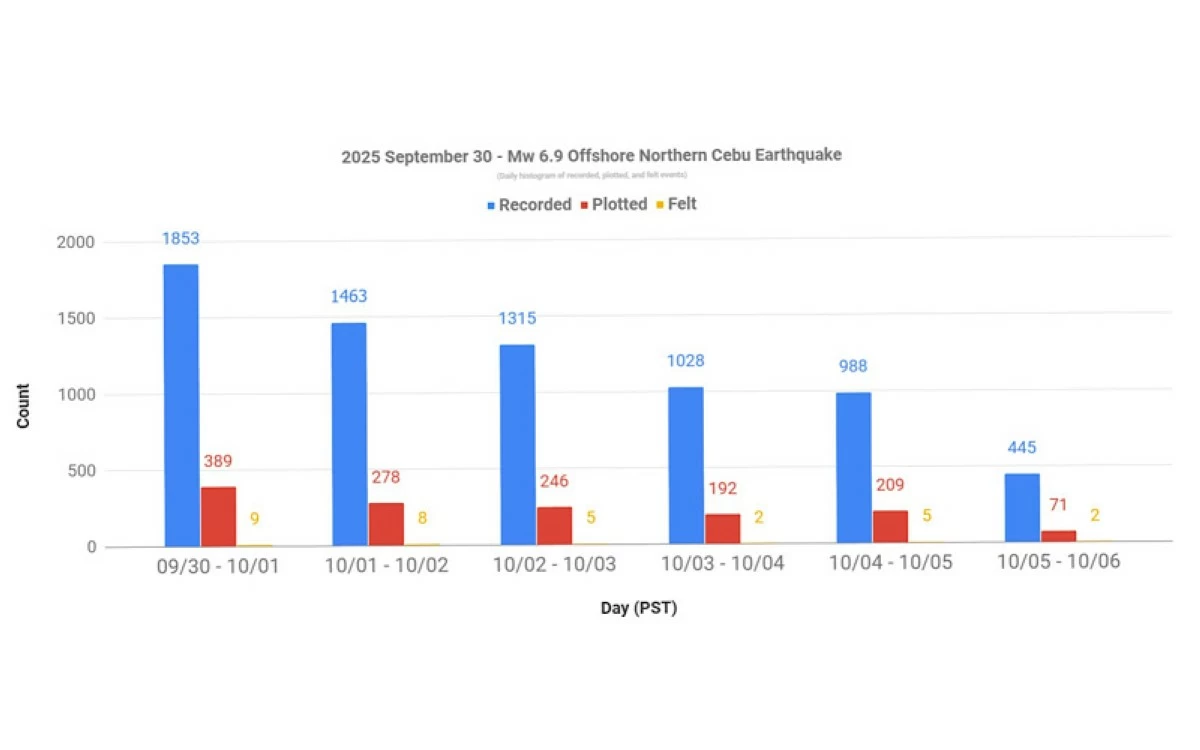
Aftershocks from the magnitude 6.9 earthquake that struck Cebu on Sept. 30 continue to be recorded, but these are now occurring less frequently, said the Philippine Institute of Volcanology and Seismology (Phivolcs).
As of 10 a.m. on Monday, Oct. 6, Phivolcs said it has recorded 7,092 aftershocks, of which 1,385 have been plotted and 31 were felt.
The strongest aftershock so far registered a magnitude of 5.1.
Phivolcs senior science research specialist Charmaine Villamil explained that it is normal and natural to experience aftershocks, especially following a strong earthquake.
“These may persist for weeks to months, as the portion of the Earth’s crust that moved during the main quake continues to adjust to a stable condition,” she said.
However, based on current monitoring, Villamil pointed out that the number of aftershocks per day has been decreasing, indicating that seismic activity in the area is gradually easing.