







Marcos on disaster response: You can't wait, do it now
Published Oct 6, 2025 10:58 am


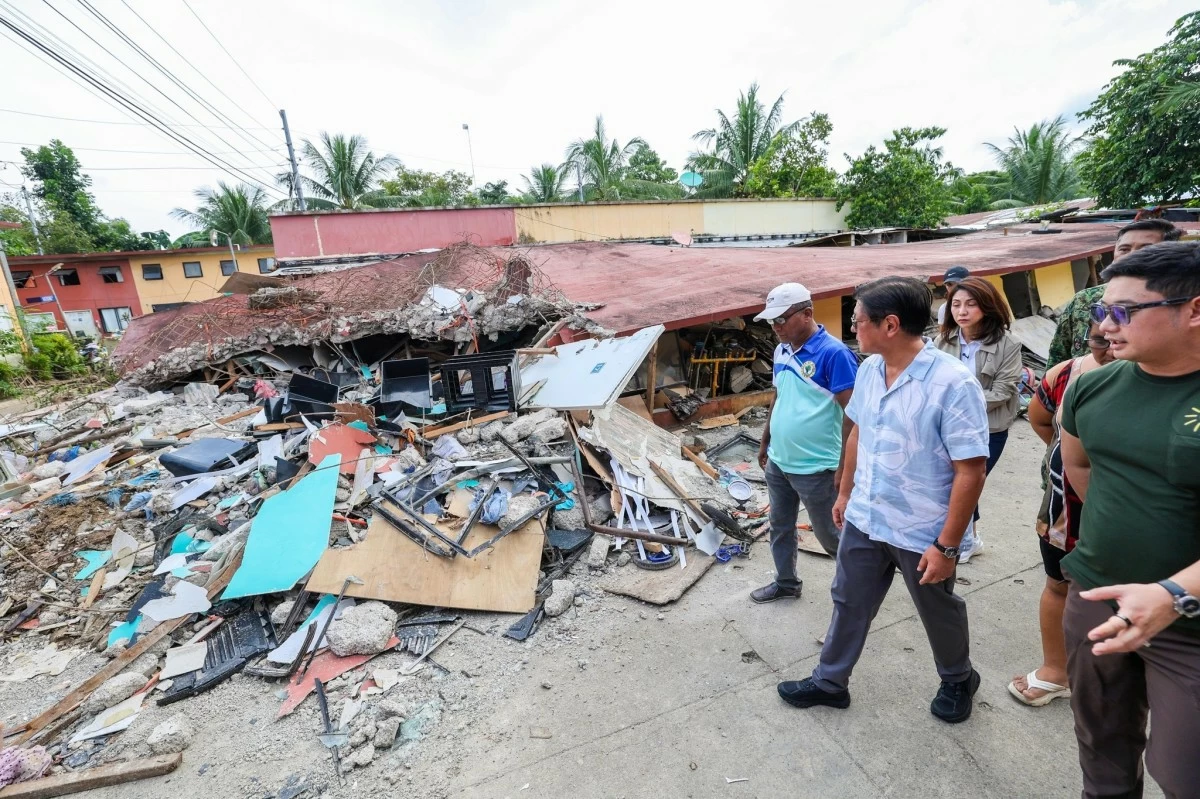
President Ferdinand R. Marcos Jr. visits Bogo City On Oct. 2, 2025 after a strong earthquake struck Cebu. (Photo courtesy of Malacañang)
Confronted with consecutive disasters such as typhoons and a deadly earthquake, President Marcos emphasized that response from the government must "move very quickly" with no delay.
"It's very simple for me. I'm motivated by, like, think of the children that are in distress now. What do they need? What do we have to do? You cannot wait. Don't do it later. Do it now," Marcos said in an interview with the Manila Bulletin’s “The Sit Down.”
While the President did not dwell on giving his assessment when asked to grade the Philippines' preparedness and resilience towards disasters, he stressed that the best the government can do is to be prepared and move promptly.
"In government, the best that we can do is really to be prepared, as prepared as we can possibly be, and move very, very quickly," he said.
He further said that disaster response and relief must cover every affected individual, adding that he wants to avoid having other people suffer amid recovery.
"Well, that's what I want to avoid. And that's why I made it very clear when I went to both Masbate and to Cebu. I said, this is not a one-time thing. We're here. We're gonna stay here until everyone is more or less in a stable condition," he said.
He recognized the challenges in responding to disasters, particularly for the recent 6.9-magnitude earthquake that struck Cebu last week. He said evacuation centers could also not ensure the people's safety.
"The difference between, for example, a storm, a typhoon, like what happened in Masbate, and an earthquake that happened in Cebu, pag bagyo (during a typhoon), you can always say preemptive evacuation, dalhin niyo sa (bring them to the) evacuation center," Marcos said.
"However, after an earthquake, the main damage is infrastructure. It's structure. Pagdating ng lindol, sa Cebu, dalhin natin sa evacuation center. Hindi tayo nakakasiguro sa evacuation center (When the earthquake hit Cebu, we bring them to the evacuation center. But we cannot be certain with evacuation centers)," he added.
"We have to get the engineers to come in to inspect and see. And as a natural reaction, the people do not want to be in concrete buildings. Baka mag-aftershock. So natatakot sila (There could be aftershocks. So, they are scared). So they prefer to stay out," the President further said.
During his visit in Bogo City, Cebu, Marcos said a tent city would be established. As of Oct. 4, it has been put up, he said.
The President said the local chief executives agreed to stay outside, hence the setting up of tent city, utilizing tents from Red Cross that were used during the Covid pandemic.
The Sit Down is an in-depth interview video podcast that brings audiences closer to the most influential voices in the country and beyond. Episodes can be accessed via The Manila Bulletin's YouTube and Spotify channels.