ADVERTISEMENT

DOTr pushes investment framework for MRT-4 ROW acquisition

Published Oct 6, 2025 12:00 am  |  Updated Oct 4, 2025 02:03 pm
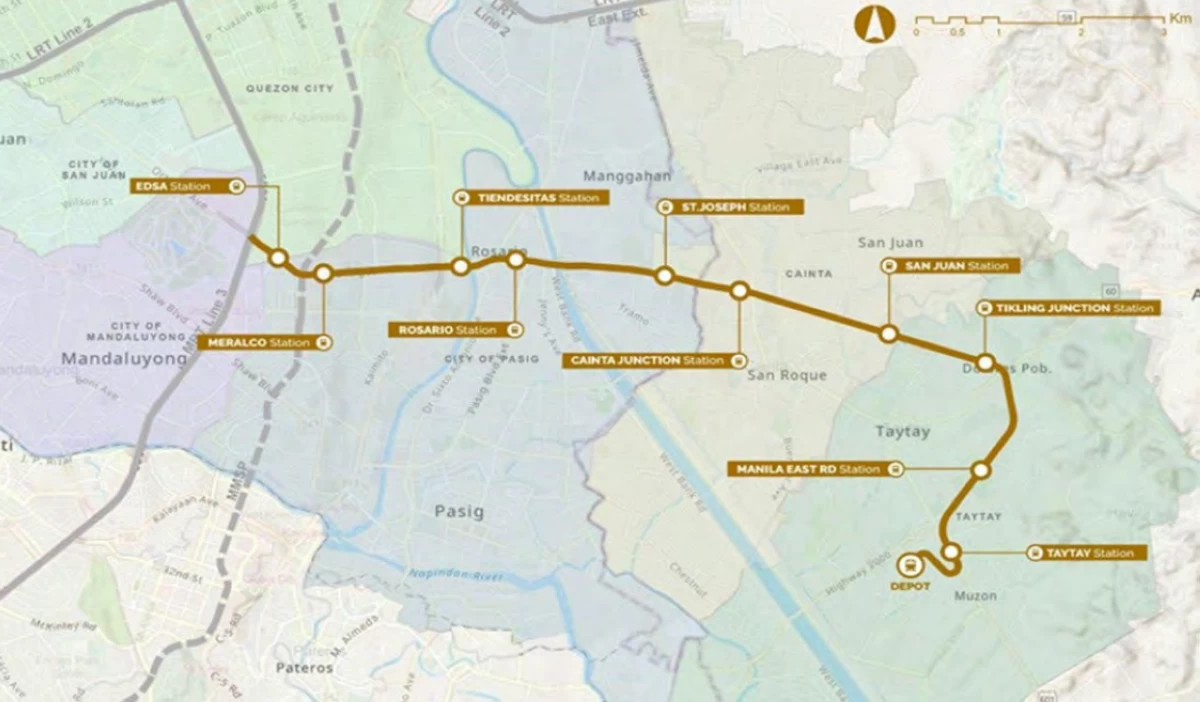
Proposed alignment of MRT-4 stations (ADB photo)
The government is pitching potential investment options for at least five soon-to-rise Metro Rail Transit Line 4 (MRT-4) stations to those who may be affected by right-of-way (ROW) acquisition for the new railway.
In a resettlement framework published on the Asian Development Bank (ADB) website last week, the Department of Transportation (DOTr) proposed the adoption of a transit-oriented development (TOD) framework for the MRT-4 project.
Under TOD, the DOTr said MRT-4 stations will be integrated with mixed-use developments, commuter-oriented infrastructure, and seamless connection to other public transport hubs.
The framework facilitates investments by opening opportunities for commercial and residential establishments around the stations, particularly those with available space for additional economic activity.
The DOTr said half of the 10 MRT-4 stations are primed for TOD. These stations will be located in EDSA, Tiendesitas, St. Joseph, Tikling Junction, and Taytay.
The agency said potential investment options in these stations include public-private partnerships (PPPs). Such a scheme is expected to benefit landowners and business establishments affected by ROW acquisitions for the railway.
“This framework aims to be inclusive in addressing the livelihood and income of the vulnerable groups by providing space and access for them to also commercially and economically benefit from the high human foot traffic,” the DOTr said.
The five other MRT-4 stations will be in Meralco, Rosario, Cainta Junction, San Juan, and Manila East Road.
In an update earlier this year, the DOTr said ROW acquisitions are unlikely to be an issue for MRT-4, as the 13.4-kilometer (km) railway will be built along national highways like Ortigas Avenue and its extension.
The main concern lies in securing ROW for the stations, which was reported to be carefully planned in terms of location, typology, and footprint to minimize unavoidable involuntary resettlement.
In its report to the ADB, the DOTr noted that the entire project will require a total land area of approximately 36.3 hectares (ha), covering stations, viaduct, land for utilities relocation, access road to the depot, and the depot.
While the majority of ROW requirements involve public land, the private properties most affected are residential areas, particularly private subdivisions.
Based on focus group discussions (FGDs) made public by the government, gated villages have opposed the construction of MRT-4, citing reasons ranging from flooding and heavier traffic to the presence of “squatters and street children” and increased crime rate.
The DOTr is betting on the TOD framework to ensure that those affected will have the first dibs on the potential economic growth fueled by MRT-4.
The department said the project is now in the preliminary engineering design stage for some sections, while under detailed architectural and engineering design for other areas.
According to the document, construction would start in the second quarter of 2027 and is projected to be finished by the first quarter of 2031.
Full operation of MRT-4 is targeted for the fourth quarter of 2031.
MRT-4, which will serve the eastern side of Metro Manila and Rizal province, is expected to be co-financed by the Manila-based ADB and the China-led Asian Infrastructure Investment Bank (AIIB) under a multi-tranche financing facility.
The loan facility requires the submission of a resettlement framework, which seeks to avoid involuntary resettlement wherever possible, minimize resettlement impacts, enhance or restore the livelihoods of all displaced persons, and improve the standards of living of the displaced poor and other vulnerable groups.
The DOTr’s TOD proposal for MRT-4 is the response to this requirement.
In its analysis, the ADB said the new railway will help maintain the high economic growth and inclusive urban development of eastern Metro Manila, Ortigas central business district (CBD), Pasig City, and Rizal.
Once operational, MRT-4 is projected to benefit 400,000 passengers daily.
ADVERTISEMENT
.most-popular .layout-ratio{ padding-bottom: 79.13%; } @media (min-width: 768px) and (max-width: 1024px) { .widget-title { font-size: 15px !important; } }

{{ articles_filter_1561_widget.title }}

.most-popular .layout-ratio{ padding-bottom: 79.13%; } @media (min-width: 768px) and (max-width: 1024px) { .widget-title { font-size: 15px !important; } }

{{ articles_filter_1562_widget.title }}

.most-popular .layout-ratio{ padding-bottom: 79.13%; } @media (min-width: 768px) and (max-width: 1024px) { .widget-title { font-size: 15px !important; } }

{{ articles_filter_1563_widget.title }}

{{ articles_filter_1564_widget.title }}

.mb-article-details { position: relative; } .mb-article-details .article-body-preview, .mb-article-details .article-body-summary{ font-size: 17px; line-height: 30px; font-family: "Libre Caslon Text", serif; color: #000; } .mb-article-details .article-body-preview iframe , .mb-article-details .article-body-summary iframe{ width: 100%; margin: auto; } .read-more-background { background: linear-gradient(180deg, color(display-p3 1.000 1.000 1.000 / 0) 13.75%, color(display-p3 1.000 1.000 1.000 / 0.8) 30.79%, color(display-p3 1.000 1.000 1.000) 72.5%); position: absolute; height: 200px; width: 100%; bottom: 0; display: flex; justify-content: center; align-items: center; padding: 0; } .read-more-background a{ color: #000; } .read-more-btn { padding: 17px 45px; font-family: Inter; font-weight: 700; font-size: 18px; line-height: 16px; text-align: center; vertical-align: middle; border: 1px solid black; background-color: white; } .hidden { display: none; }
function initializeAllSwipers() { // Get all hidden inputs with cms_article_id document.querySelectorAll('[id^="cms_article_id_"]').forEach(function (input) { const cmsArticleId = input.value; const articleSelector = '#article-' + cmsArticleId + ' .body_images'; const swiperElement = document.querySelector(articleSelector); if (swiperElement && !swiperElement.classList.contains('swiper-initialized')) { new Swiper(articleSelector, { loop: true, pagination: false, navigation: { nextEl: '#article-' + cmsArticleId + ' .swiper-button-next', prevEl: '#article-' + cmsArticleId + ' .swiper-button-prev', }, }); } }); } setTimeout(initializeAllSwipers, 3000); const intersectionObserver = new IntersectionObserver( (entries) => { entries.forEach((entry) => { if (entry.isIntersecting) { const newUrl = entry.target.getAttribute("data-url"); if (newUrl) { history.pushState(null, null, newUrl); let article = entry.target; // Extract metadata const author = article.querySelector('.author-section').textContent.replace('By', '').trim(); const section = article.querySelector('.section-info ').textContent.replace(' ', ' '); const title = article.querySelector('.article-title h1').textContent; // Parse URL for Chartbeat path format const parsedUrl = new URL(newUrl, window.location.origin); const cleanUrl = parsedUrl.host + parsedUrl.pathname; // Update Chartbeat configuration if (typeof window._sf_async_config !== 'undefined') { window._sf_async_config.path = cleanUrl; window._sf_async_config.sections = section; window._sf_async_config.authors = author; } // Track virtual page view with Chartbeat if (typeof pSUPERFLY !== 'undefined' && typeof pSUPERFLY.virtualPage === 'function') { try { pSUPERFLY.virtualPage({ path: cleanUrl, title: title, sections: section, authors: author }); } catch (error) { console.error('ping error', error); } } // Optional: Update document title if (title && title !== document.title) { document.title = title; } } } }); }, { threshold: 0.1 } ); function showArticleBody(button) { const article = button.closest("article"); const summary = article.querySelector(".article-body-summary"); const body = article.querySelector(".article-body-preview"); const readMoreSection = article.querySelector(".read-more-background"); // Hide summary and read-more section summary.style.display = "none"; readMoreSection.style.display = "none"; // Show the full article body body.classList.remove("hidden"); } document.addEventListener("DOMContentLoaded", () => { let loadCount = 0; // Track how many times articles are loaded const offset = [1, 2, 3, 4, 5, 6, 7, 8, 9, 10]; // Offset values const currentUrl = window.location.pathname.substring(1); let isLoading = false; // Prevent multiple calls if (!currentUrl) { console.log("Current URL is invalid."); return; } const sentinel = document.getElementById("load-more-sentinel"); if (!sentinel) { console.log("Sentinel element not found."); return; } function isSentinelVisible() { const rect = sentinel.getBoundingClientRect(); return ( rect.top < window.innerHeight && rect.bottom >= 0 ); } function onScroll() { if (isLoading) return; if (isSentinelVisible()) { if (loadCount >= offset.length) { console.log("Maximum load attempts reached."); window.removeEventListener("scroll", onScroll); return; } isLoading = true; const currentOffset = offset[loadCount]; window.loadMoreItems().then(() => { let article = document.querySelector('#widget_1690 > div:nth-last-of-type(2) article'); intersectionObserver.observe(article) loadCount++; }).catch(error => { console.error("Error loading more items:", error); }).finally(() => { isLoading = false; }); } } window.addEventListener("scroll", onScroll); });

Sign up by email to receive news.