






Manila Bulletin
 Philippines
National
'Tao lang kami': Brawner says soldiers 'angry' at corruption in flood control projects
Philippines
National
'Tao lang kami': Brawner says soldiers 'angry' at corruption in flood control projects
Philippines
National
'Tao lang kami': Brawner says soldiers 'angry' at corruption in flood control projects
'Tao lang kami': Brawner says soldiers 'angry' at corruption in flood control projects
Military chief bares details of meeting with ex-soldiers calling for withdrawal of AFP support for Marcos
Published Oct 4, 2025 05:04 pm


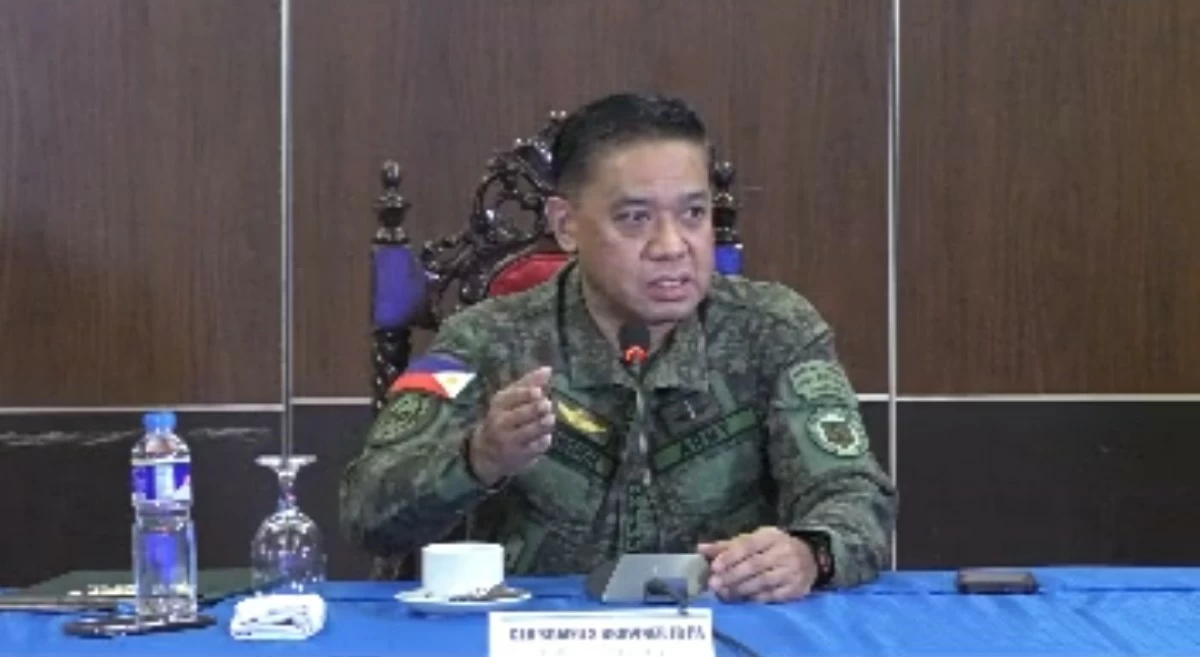
Armed Forces of the Philippines (AFP) Chief of Staf Gen. Romeo Brawner Jr. says that soldiers are angry at corruption in the government during a forum hosted by the Foreign Correspondents Association of the Philippines (FOCAP) at Camp Aguinaldo in Quezon City on Oct. 3, 2025. (Courtesy of AFP-Public Affairs Office)
Armed Forces of the Philippines (AFP) Chief of Staff General Romeo Brawner Jr. has admitted that soldiers, like ordinary Filipinos, are not immune to frustration over corruption, particularly in flood control projects, but firmly rejected calls for military intervention in politics.
“We know what is happening, and we are just people also. We get angry and we are angry at what is happening to our country,” Brawner said during a forum hosted by the Foreign Correspondents Association of the Philippines (FOCAP) at Camp Aguinaldo in Quezon City on Friday, Oct. 3.
“In the Armed Forces, we conduct ourselves properly, we try to do things properly. We promote transparency and accountability within our ranks, and yet we continue to see these things happening in our country. We understand the sentiments of the people and, in fact, we are one with them in the fight against corruption,” he added.
What came with the troops’ fury were calls for Brawner from former military officers led by retired Air Force major general Romeo Poquiz, a vocal critic of the current administration, to withdraw the AFP’s support for President Marcos Jr.
Brawner said the rumored destabilization of the Marcos Jr. administration “are not true,” but he confirmed meeting Poquiz’ group to hear their grievances. Other groups of retired officers also reached out to him via social media.
“Yes, there are calls for the Armed Forces of the Philippines to intervene. In fact, if you look at posters during the September 21 rally, there were posters and there were speeches calling for the Armed Forces of the Philippines to intervene. Some of them were saying we should withdraw our support [for] the President. This is not hidden, this is not new,” Brawner said.
The coup rumors were tied to the September 21 anti-corruption protest that coincided with the commemoration of the declaration of martial law declared by former president Ferdinand Marcos Sr., the ousted dictator and father of the current President.
The meeting
Prior to the September 21 protest, Brawner said Poquiz’ group, the United People’s Initiative (UPI), an alliance of retired military and other uniformed personnel, youth and student groups, transport and religious sector, began marching from Batasan to Camp Aguinaldo on September 16 to 17 to call for a dialogue with him.
“When they were outside the gates of Camp Aguinaldo, they were shouting that they wanted an audience with me. In fact, they had a letter delivered. I received it on Friday (September 19), and by Saturday (September 20), I gave them the chance to speak with us,” Brawner recounted.
The meeting, which took place while the AFP was on red alert for the September 21 protest, allowed the group to express its concerns. According to Brawner, the retired officials stressed that they were against corruption.
“I told them, ‘yes sir, we are one with the people in our fight against corruption. In that sense, we are actually the same.’ But I reminded them that as soldiers, we gave up some rights when we took our oath to defend the Constitution, the people, our territory, and our sovereign rights. That includes the right to self-expression. We cannot just go out to the streets to air grievances,” he said.
Brawner emphasized that there was no agreement reached during the meeting with Poquiz but the dialogue served as a venue to assure the retired officers that the military remains “united, solid, disciplined, and professional” despite calls for military intervention amid the widespread corruption in the government.
“I assured them that the AFP is solid. I told them, ‘I am very proud to report to you, sir, that your AFP is now a highly professional and disciplined organization, and that is partly because of the foundations you yourselves laid when you were still in active service,” he told Poquiz.
Brawner then reported to President Marcos the coup rumors, including calls for the AFP’s withdrawal of support for the administration and the establishment of a military junta "in order to come up with a reset for the entire Philippine society," as well as his meeting with Poquiz’ group.
Lessons from the past
Given that the soldiers are already furious at the corruption within the government, what made Brawner stand his ground and reject calls for military intervention? It was because of the lessons of the previous coups during the tumultuous presidency of the late Corazon Aquino, who toppled Marcos Sr. via the bloodless People Power revolution in 1986.
He recalled that during the EDSA People Power 1, what occurred before the People Power was an intervention on the part of some military officers withdrawing their support for Ferdinand Marcos Sr. For EDSA People Power 2 (EDSA Dos) which led to the ouster of Joseph Estrada, Brawner said people came to EDSA "and the military sided with them."
During a 1989 coup, the bloodiest revolt during the Aquino presidency, Brawner recalled that soldiers were fighting against soldiers, and brothers were killing each other.
“Literally brother against brother, it really happened. In one of those stories, it happened that an Army soldier fired an RPG [rocket propelled grenade] at a Marine tank, not knowing that his own brother was inside. His brother died inside the armored personnel carrier,” Brawner shared.
“We had these experiences twice already but look at where it brought us, we are still here. So we believe that a military intervention in any form is not the solution to the things that we are now experiencing in our country: corruption and other malpractices in the government,” he cotinued.
“Once the military intervenes, it could mean several things but it will not be good for the country because it will set the Philippines back several years. The investors will start pulling out, there will be a stoppage of the normal lives of the Filipinos, livelihoods will be interrupted, magulo (it would be chaotic). We saw this already in the past,” he added.
Helping in their own way
Despite the soldiers’ fury, Brawner said the AFP remains professional and part of their own way to help rid corruption in the government is to assist the Department of Public Works and Highways (DPWH) in auditing infrastructure projects nationwide.
He said the AFP was given a list of 16,000 government projects that need to be audited. Field units were then tasked to locate and audit the projects using grid coordinates to ensure they exist and are not substandard.
“We have inspected around 30 percent of the total projects and from that number, we have identified ghost projects. We submitted these to Secretary Vince and even to [Baguio City] Mayor [Benjamin] Magalong,” said Brawner, referring to the resigned special adviser of the Independent Commission for Infrastructure (ICI) probing anomalies in flood control projects.
The work is no longer new to the AFP. Under the National Task Force to End Local Communist Armed Conflict (NTF-ELCAC), Barwner said AFP engineers were already tasked to validate Barangay Development Projects such as bridges, farm to market roads, schools, and other infrastructure to make sure they are quality projects.
On calls for the AFP to overtake from the DPWH in constructing flood control projects, Brawner said, "we cannot do it all," but he promised to lend a hand to the DPWH by allowing the military to perform an oversight function.
“We committed to Secretary Vince that we are going to help them in terms of playing an oversight, from the planning of the project, to the costing, to the bidding, to the implementation, inspection, evaluation of the project. But only for oversight,” he said.