ADVERTISEMENT

Metro Manila's Christmas gridlock: An annual ordeal

Published Oct 4, 2025 12:05 am  |  Updated Oct 3, 2025 05:30 pm
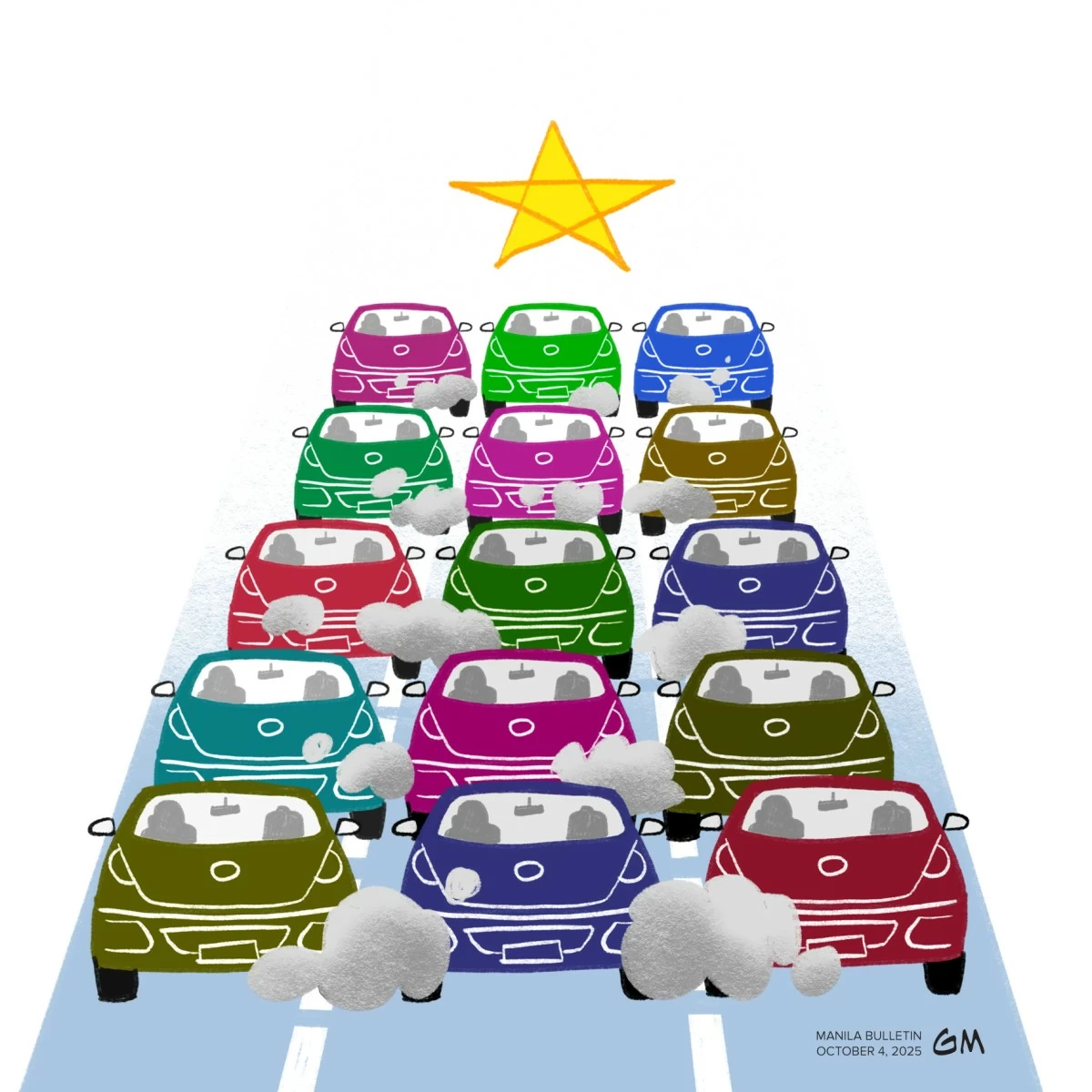
Traffic in Metro Manila is now on crawling speed as the Christmas season nears. On the road, this is not the season to be merry. Instead, it has become synonymous with another tradition: unbearable traffic. Only a few days into October and travel time has become longer — vehicles crawl on EDSA, and side streets choke with cars, jeepneys, buses, delivery vans, and motorcycles. By December, the gridlock worsens—especially when the rain falls or payday weekends collide with holiday shopping rush.
It is an ordeal so familiar that we joke about leaving hours earlier than usual for what should be a 30-minute trip. Others resign themselves to long stretches of time wasted in vehicles, scrolling on their phones or dozing off, while productivity, fuel, and patience are drained away. But beneath the humor and resignation lies a serious problem that continues to sap the quality of life, the economy, and even the health of Metro Manila’s residents.
Traffic congestion is not just an inconvenience—it is a cost. A 2022 Japan International Cooperation Agency (JICA) study estimated that the Philippines loses more than ₱3.5 billion daily due to traffic in Metro Manila in terms of lost productivity, wasted fuel, and inefficiency. During peak holiday season, that figure likely soars higher. What could have been spent with family, in leisure, or in creative work, is instead burned away on congested highways.
The annual Christmas rush exposes the chronic weaknesses of our transport system. Roads are saturated beyond capacity, yet car ownership continues to rise. Public transport, though essential, is unreliable—jeepneys and buses are caught in the same traffic, while train systems suffer breakdowns or overcrowding. Ride-hailing services, meant to provide convenience, often add more vehicles to already clogged streets. And some local government units, to allow more night markets and holiday events, often close lanes or reroute traffic without effective coordination.
The result is chaos repeated year after year, with no lasting solution in sight. Short-term schemes—number coding, mall hours adjustment, or deployment of more traffic enforcers—merely patch the problem. They provide marginal relief at best, but do not address the underlying causes.
The deeper issue lies in decades of delaying mass transport development and urban planning. Metro Manila remains car-centric, with roads prioritized over efficient public transportation. The MRT and LRT systems have not expanded quickly enough to meet demand, and new infrastructure projects take years—sometimes decades—to complete due to bureaucratic delays, corruption, and lack of continuity between administrations. Meanwhile, pedestrians and cyclists are still treated as afterthoughts, despite evidence that shifting to active transport can ease congestion.
On the bright side, projects are in the pipeline: the Metro Manila Subway, the extension of LRT-1 and LRT-2, and new expressways. But even when these are completed, they must be integrated into a broader strategy that prioritizes moving people, not cars. Until then, commuters and motorists will continue to bear the heavy costs of wasted hours and mounting stress.
What can be done immediately? Authorities must enforce better traffic discipline, crack down on illegal parking and terminal loading, and coordinate roadworks to avoid simultaneous lane closures. Private sector stakeholders, especially malls and delivery companies, can help by managing logistics better and extending operating hours to spread out traffic.
But these are band-aid measures. The real solution lies in a sustained investment in efficient, affordable, and reliable mass transport—one that makes it unnecessary to use private cars daily. A strong policy shift away from car-centric planning and toward people-centered mobility is long overdue.
For now, Metro Manila residents brace themselves for another season of gridlock. But we should stop treating this as an unavoidable holiday situation. The annual Christmas traffic nightmare is not an inevitability—it is the result of decades of poor planning and weak political will.
The season calls for patience, yes, but also for urgency. Because until we demand more than short-term fixes, Christmas in Metro Manila will remain not only a season of giving—but also of waiting, honking, and inching along in endless traffic.
ADVERTISEMENT
.most-popular .layout-ratio{ padding-bottom: 79.13%; } @media (min-width: 768px) and (max-width: 1024px) { .widget-title { font-size: 15px !important; } }

{{ articles_filter_1561_widget.title }}

.most-popular .layout-ratio{ padding-bottom: 79.13%; } @media (min-width: 768px) and (max-width: 1024px) { .widget-title { font-size: 15px !important; } }

{{ articles_filter_1562_widget.title }}

.most-popular .layout-ratio{ padding-bottom: 79.13%; } @media (min-width: 768px) and (max-width: 1024px) { .widget-title { font-size: 15px !important; } }

{{ articles_filter_1563_widget.title }}

{{ articles_filter_1564_widget.title }}

.mb-article-details { position: relative; } .mb-article-details .article-body-preview, .mb-article-details .article-body-summary{ font-size: 17px; line-height: 30px; font-family: "Libre Caslon Text", serif; color: #000; } .mb-article-details .article-body-preview iframe , .mb-article-details .article-body-summary iframe{ width: 100%; margin: auto; } .read-more-background { background: linear-gradient(180deg, color(display-p3 1.000 1.000 1.000 / 0) 13.75%, color(display-p3 1.000 1.000 1.000 / 0.8) 30.79%, color(display-p3 1.000 1.000 1.000) 72.5%); position: absolute; height: 200px; width: 100%; bottom: 0; display: flex; justify-content: center; align-items: center; padding: 0; } .read-more-background a{ color: #000; } .read-more-btn { padding: 17px 45px; font-family: Inter; font-weight: 700; font-size: 18px; line-height: 16px; text-align: center; vertical-align: middle; border: 1px solid black; background-color: white; } .hidden { display: none; }
function initializeAllSwipers() { // Get all hidden inputs with cms_article_id document.querySelectorAll('[id^="cms_article_id_"]').forEach(function (input) { const cmsArticleId = input.value; const articleSelector = '#article-' + cmsArticleId + ' .body_images'; const swiperElement = document.querySelector(articleSelector); if (swiperElement && !swiperElement.classList.contains('swiper-initialized')) { new Swiper(articleSelector, { loop: true, pagination: false, navigation: { nextEl: '#article-' + cmsArticleId + ' .swiper-button-next', prevEl: '#article-' + cmsArticleId + ' .swiper-button-prev', }, }); } }); } setTimeout(initializeAllSwipers, 3000); const intersectionObserver = new IntersectionObserver( (entries) => { entries.forEach((entry) => { if (entry.isIntersecting) { const newUrl = entry.target.getAttribute("data-url"); if (newUrl) { history.pushState(null, null, newUrl); let article = entry.target; // Extract metadata const author = article.querySelector('.author-section').textContent.replace('By', '').trim(); const section = article.querySelector('.section-info ').textContent.replace(' ', ' '); const title = article.querySelector('.article-title h1').textContent; // Parse URL for Chartbeat path format const parsedUrl = new URL(newUrl, window.location.origin); const cleanUrl = parsedUrl.host + parsedUrl.pathname; // Update Chartbeat configuration if (typeof window._sf_async_config !== 'undefined') { window._sf_async_config.path = cleanUrl; window._sf_async_config.sections = section; window._sf_async_config.authors = author; } // Track virtual page view with Chartbeat if (typeof pSUPERFLY !== 'undefined' && typeof pSUPERFLY.virtualPage === 'function') { try { pSUPERFLY.virtualPage({ path: cleanUrl, title: title, sections: section, authors: author }); } catch (error) { console.error('ping error', error); } } // Optional: Update document title if (title && title !== document.title) { document.title = title; } } } }); }, { threshold: 0.1 } ); function showArticleBody(button) { const article = button.closest("article"); const summary = article.querySelector(".article-body-summary"); const body = article.querySelector(".article-body-preview"); const readMoreSection = article.querySelector(".read-more-background"); // Hide summary and read-more section summary.style.display = "none"; readMoreSection.style.display = "none"; // Show the full article body body.classList.remove("hidden"); } document.addEventListener("DOMContentLoaded", () => { let loadCount = 0; // Track how many times articles are loaded const offset = [1, 2, 3, 4, 5, 6, 7, 8, 9, 10]; // Offset values const currentUrl = window.location.pathname.substring(1); let isLoading = false; // Prevent multiple calls if (!currentUrl) { console.log("Current URL is invalid."); return; } const sentinel = document.getElementById("load-more-sentinel"); if (!sentinel) { console.log("Sentinel element not found."); return; } function isSentinelVisible() { const rect = sentinel.getBoundingClientRect(); return ( rect.top < window.innerHeight && rect.bottom >= 0 ); } function onScroll() { if (isLoading) return; if (isSentinelVisible()) { if (loadCount >= offset.length) { console.log("Maximum load attempts reached."); window.removeEventListener("scroll", onScroll); return; } isLoading = true; const currentOffset = offset[loadCount]; window.loadMoreItems().then(() => { let article = document.querySelector('#widget_1690 > div:nth-last-of-type(2) article'); intersectionObserver.observe(article) loadCount++; }).catch(error => { console.error("Error loading more items:", error); }).finally(() => { isLoading = false; }); } } window.addEventListener("scroll", onScroll); });

Sign up by email to receive news.