







There's a hole in Kirby Roxas' sky
Fantasy mixes with reality in this Art Verité Gallery exhibit
By S.C. Fojas
Published Oct 3, 2025 09:32 am


At A Glance
- What binds these works together is the act of looking. Kirby does not present images as fixed entities, he builds them as contingent, shifting, dependent on one's vantage point.
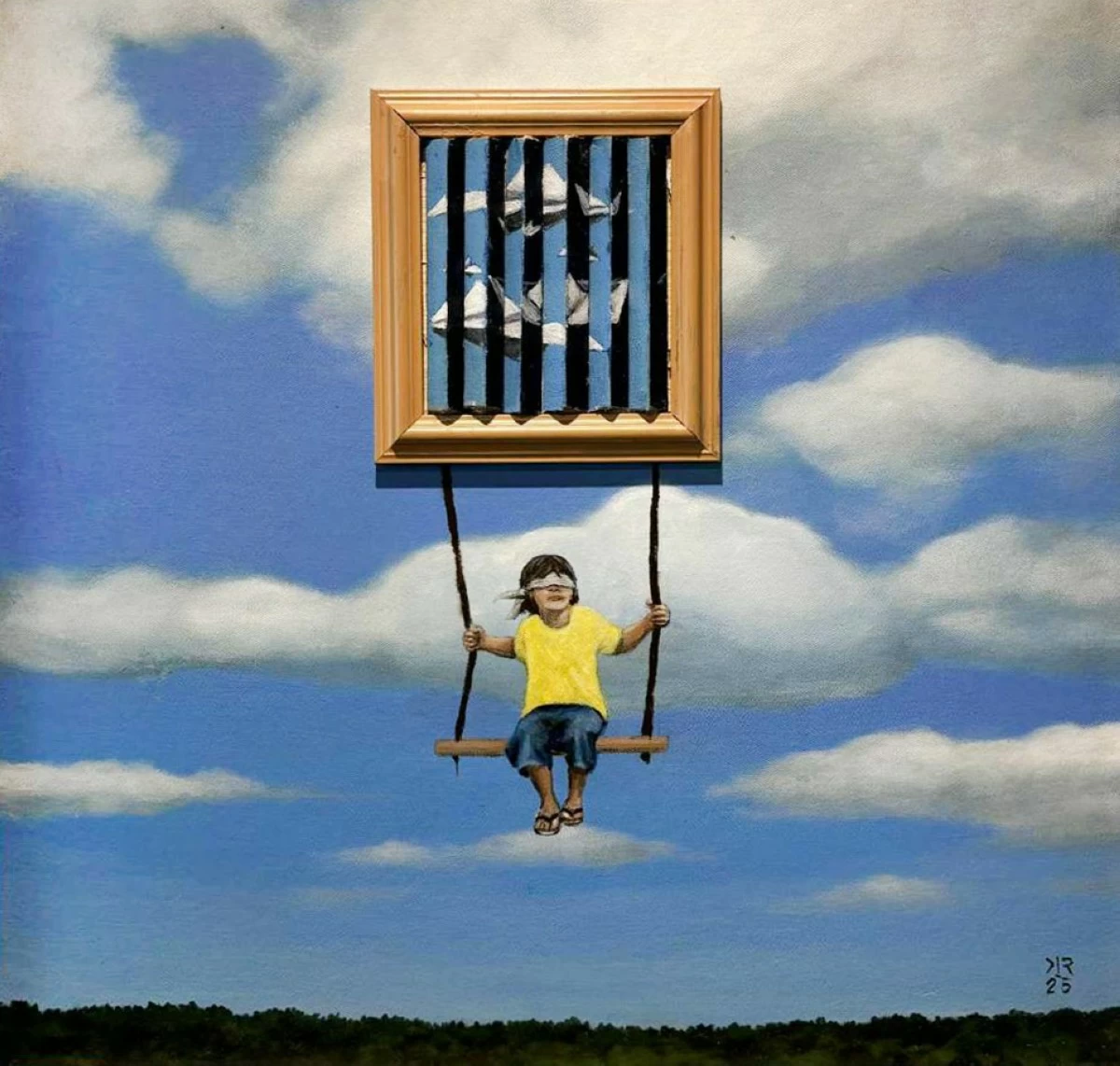
'DREAMER'S SWING' acrylic on wood and canvas, 24x24 inches, 2025
Kirby Roxas’ exhibit “A Hole in the Sky” does not announce itself with grand gestures. The works are modest in number, just six, but their presence fills the gallery with a quiet intensity. To spend time with them is to be reminded of how Kirby has consistently redefined the role of the painted surface. For over a decade, he has been creating lenticular paintings, the kind that shift depending on where the viewer stands, demanding an engagement that is both physical and perceptual. In this latest show, he pushes the idea further, constructing not simply shifting images but layered portals, openings into other places where memory, fantasy, and longing converge.
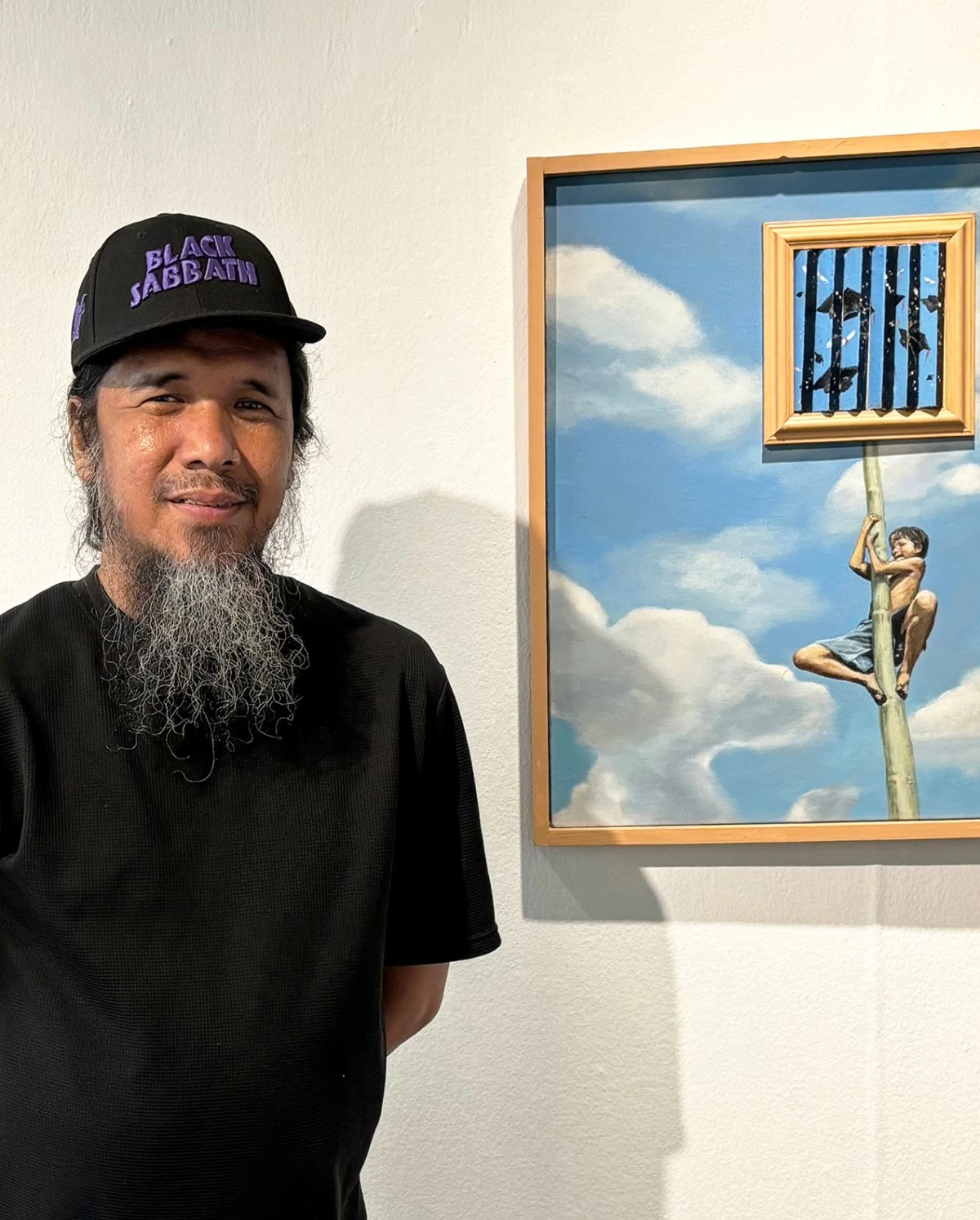
MEET THE ARTIST Kirby Roxas
At first, the works appear straightforward. Acrylic on wood and canvas, neatly framed, hanging still against white walls. But the stillness is deceptive. As you move in front of them, scenes flicker and transform, the surface of the painting revealing multiple worlds at once. Kirby does not settle for illusion; he builds his canvases like layered stages, each one hiding another, like stories tucked inside stories. The experience is almost cinematic, as if each painting were spliced into frames of a film reels, and the viewer’s body moving across the room becomes the projector.
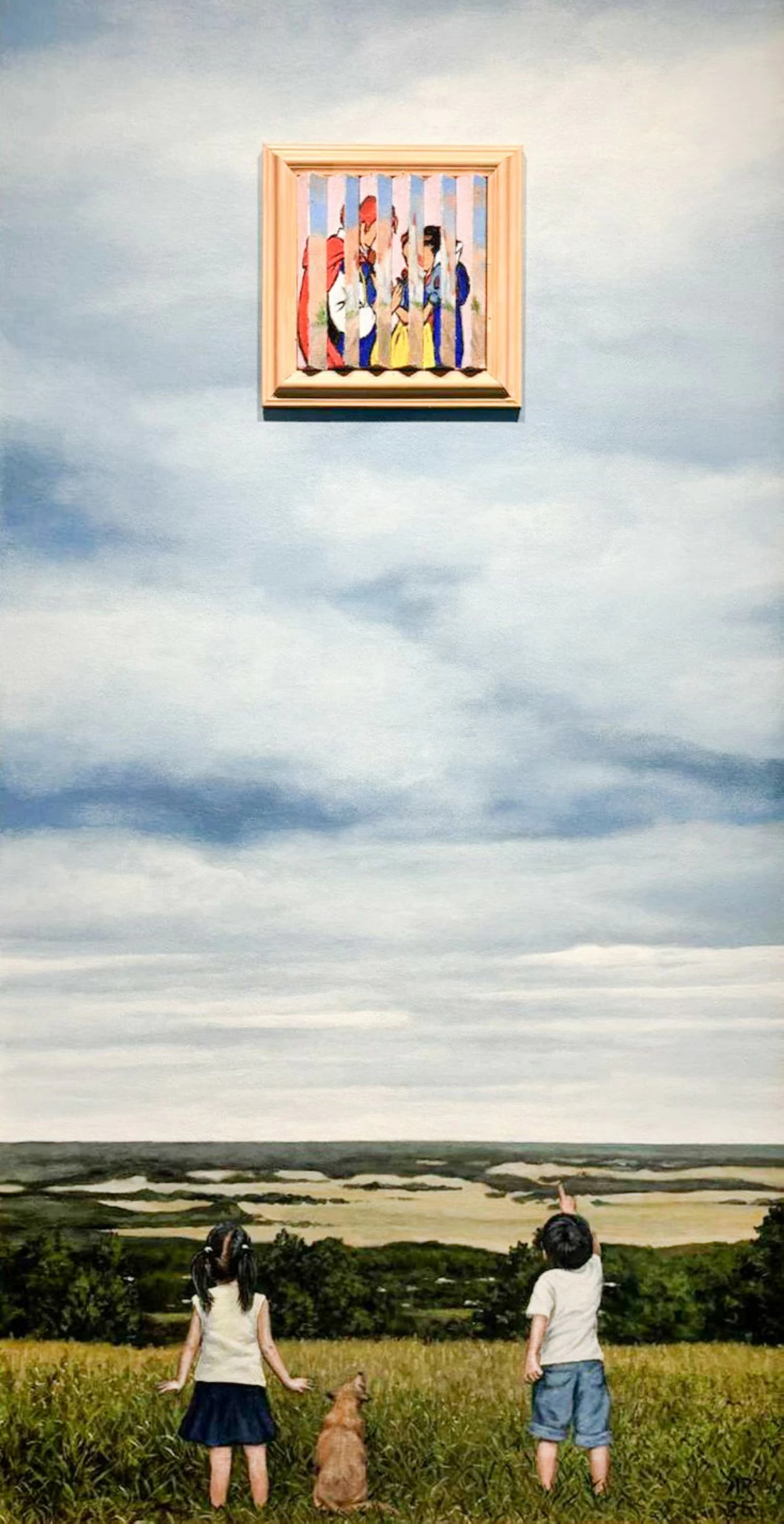
'IF THEY LIVED HAPPILY EVER AFTER' acrylic on wood and canvas, 48x24 inches, 2025
Each of the six works carries a distinct atmosphere. “If They Lived, Happily Ever After” captures two children gazing upward toward a storybook vision suspended in the clouds. Depending on the angle, the scene shifts, suggesting not just the enchantment of fairytales but also the fragility of those endings we are taught to believe in. The painting carries both nostalgia and melancholy, as though reminding us that not all narratives close with “happily ever after.”
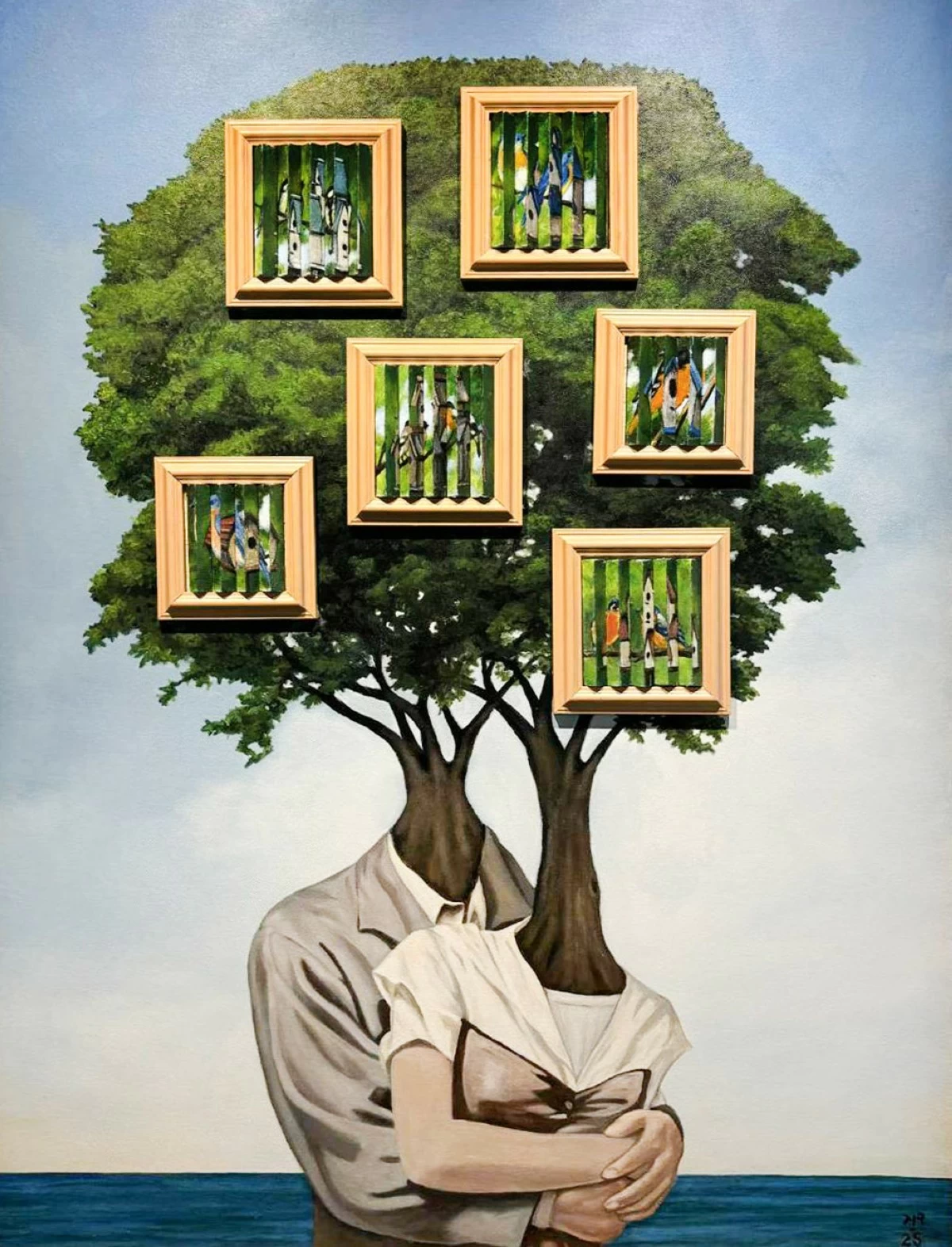
'SANCTUARY' acrylic on wood and canvas, 48x36 inches, 2025
In “Dreamer’s Swing,” a girl arcs through the air on a swing, the sky around her transforming into a cage of birds and shifting clouds. The piece is light and playful at first glance, yet also weighted with yearning. The swing becomes a vehicle of escape, the sky a promise of elsewhere. Childhood fantasy and adult longing intermingle here, layered as neatly as Kirby’s acrylic surfaces.
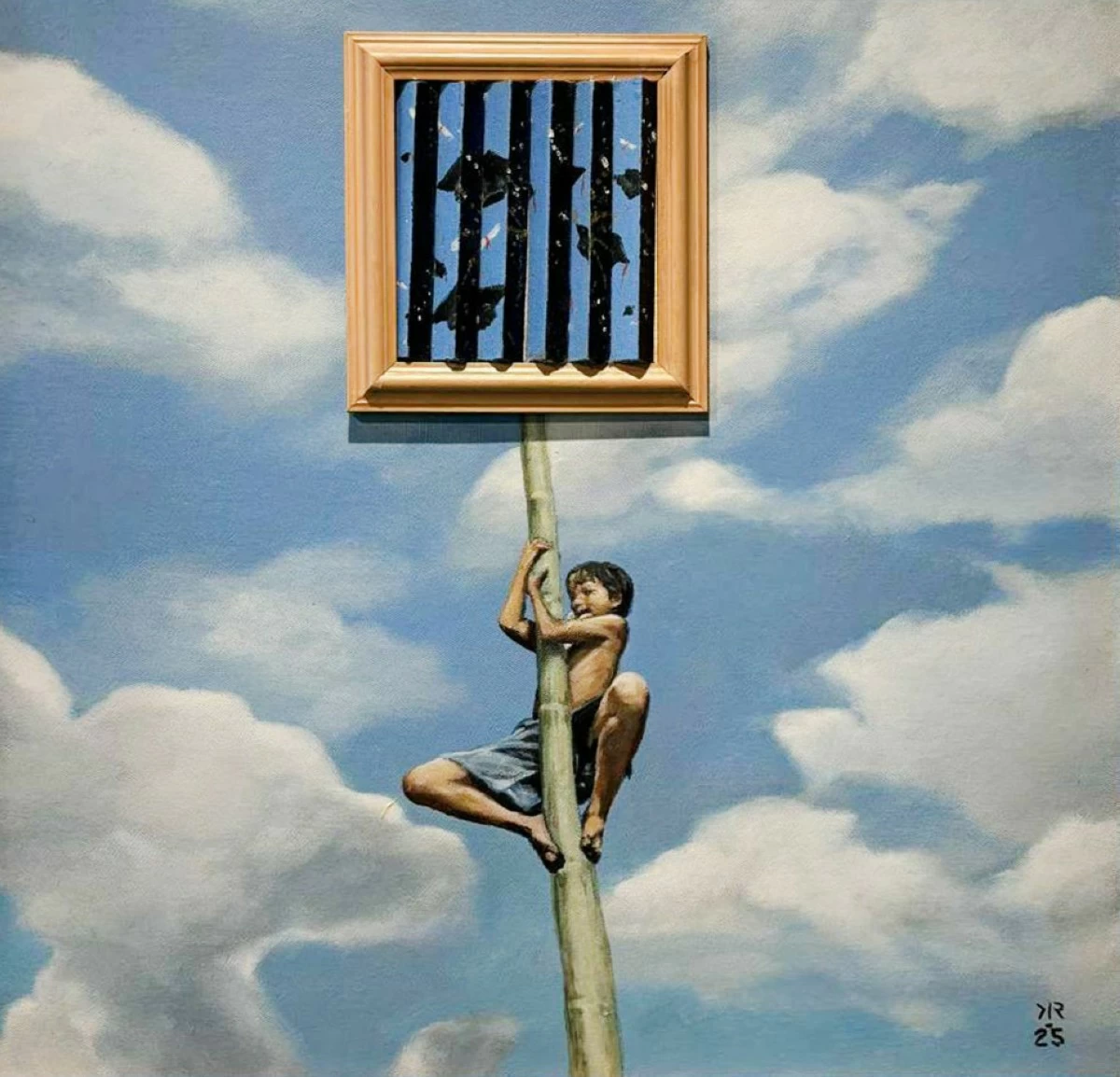
'PALOCEBO' acrylic on wood and canvas, 24x24 inches, 2025
“Palocebo,” on the other hand, roots itself in Filipino cultural memory. Referencing the traditional game of climbing a greased bamboo pole, the painting shows a boy scaling upward, striving toward an unseen goal. The lenticular shift creates a dual sense of struggle and triumph, a metaphor for belief and persistence. One sees not just a child at play but also the broader human drive to reach beyond one’s grasp.
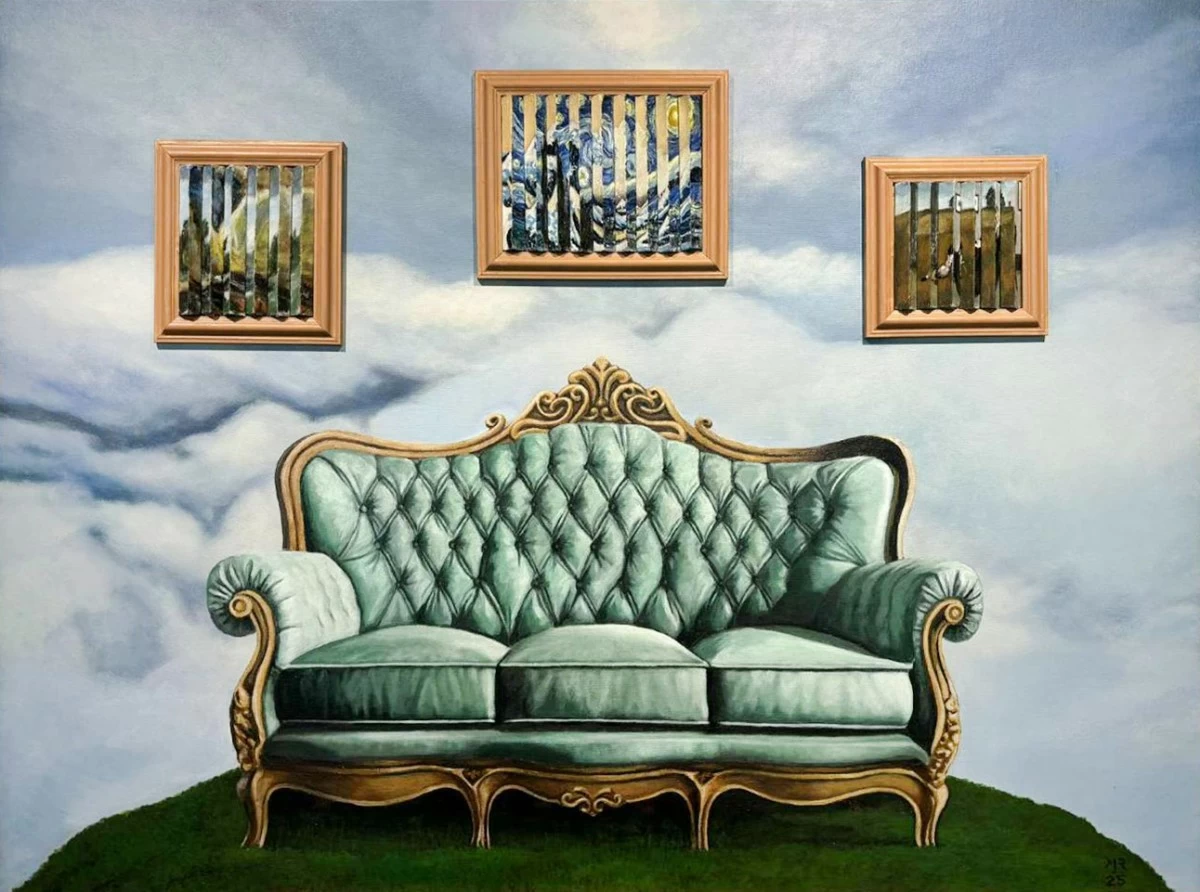
'SUMMIT' acrylic on wood and canvas, 36x48 inches, 2025
In “Sanctuary,” intimacy becomes architecture. A couple’s embrace forms the trunk of a tree, its branches splitting into portals that hold glimpses of other realms. It is at once personal and universal, an image of refuge that expands into a metaphor for the places of safety we carry within. This work, perhaps more than the others, demonstrates Kirby's gift for weaving tenderness with ambition.
The exhibit culminates in “Summit,” a painting that at first looks indulgent, a baroque sofa perched on a cloud, flanked by inset portals containing miniature reproductions of iconic works of art. It reads as a statement on ambition, ownership, and the desire to possess culture itself. Yet it is also tinged with irony. The sofa is cushy, excessive, even ridiculous, suggesting that the climb to the “summit” may not always lead to nobility but to vanity. It is here that Kirby's humor surfaces most clearly.
What binds these works together is the act of looking. Kirby does not present images as fixed entities, he builds them as contingent, shifting, dependent on one’s vantage point. This makes the viewer not a passive spectator but an active participant. You cannot simply glance—you must move, adjust, reconsider. In doing so, you become aware of the instability of perspective itself: how stories, memories, and desires change when seen from different angles.
The title “A Hole in the Sky” resonates in this regard. These “holes” are not voids but openings. They do not signify absence but possibility. Each work is a threshold, suggesting that what lies beyond may be as important as what is contained within the frame. The exhibition asks: what do we long for when we look up? Is it refuge, triumph, fantasy, or recognition? Kirby’s answer is that it is all of these, overlapping and contradictory, glimpsed in fragments, never fully whole.
There is also a contemporary timeliness to the show. In a world where our attention is constantly divided among windows, tabs, and screens, Kirby turns this fractured way of seeing into poetry. Instead of lamenting distraction, he harnesses it, showing how desire itself is scattered—how we can want several things at once, how we peer into multiple openings in the hope of finding coherence. His canvases reflect back to us not only the images of children, swings, couches, or trees, but also the way we live now: caught between frames, moving from one view to another, searching for the angle that makes sense.
What lingers after leaving the gallery is not a single image but a collection of moods: nostalgia, yearning, humor, ambition. The works resist closure, and that resistance feels intentional. Kirby seems less interested in giving answers than in offering spaces where viewers can bring their own. In that sense, “A Hole in the Sky” is less a finished statement than an open conversation—one that continues as long as we are willing to move, look, and imagine.
Kirby Roxas reminds us that painting, even in its oldest forms, still has the capacity to surprise, to demand motion, and to open worlds. These holes in the sky are not ruptures but invitations, and the invitation is clear: step closer, shift your stance, and discover what waits beyond the frame.
“A Hole in the Sky” by Kirby Roxas ran from Aug. 9 to 23 at Art Verité Gallery, Serendra, BGC.