

ADVERTISEMENT

Philippines most exposed to US remittances but seen resilient to immigration crackdown

Published Oct 3, 2025 02:55 pm

At A Glance

  • Japanese financial giant MUFG said the Philippine economy has the highest exposure to United States (US) remittances relative to its Asian peers.

While the Philippine economy has the highest exposure to United States (US) remittances relative to its Asian peers, inflows from overseas Filipinos (OFs) would emerge relatively unscathed from US President Donald Trump’s immigration crackdown, Japanese financial giant MUFG Bank Ltd. said.
This is because the Philippines has a small share of illegal migrants and diversified remittance sources, MUFG Global Markets Research said in its Asia foreign exchange (forex) outlook for the fourth quarter of 2025, published on Oct. 2.
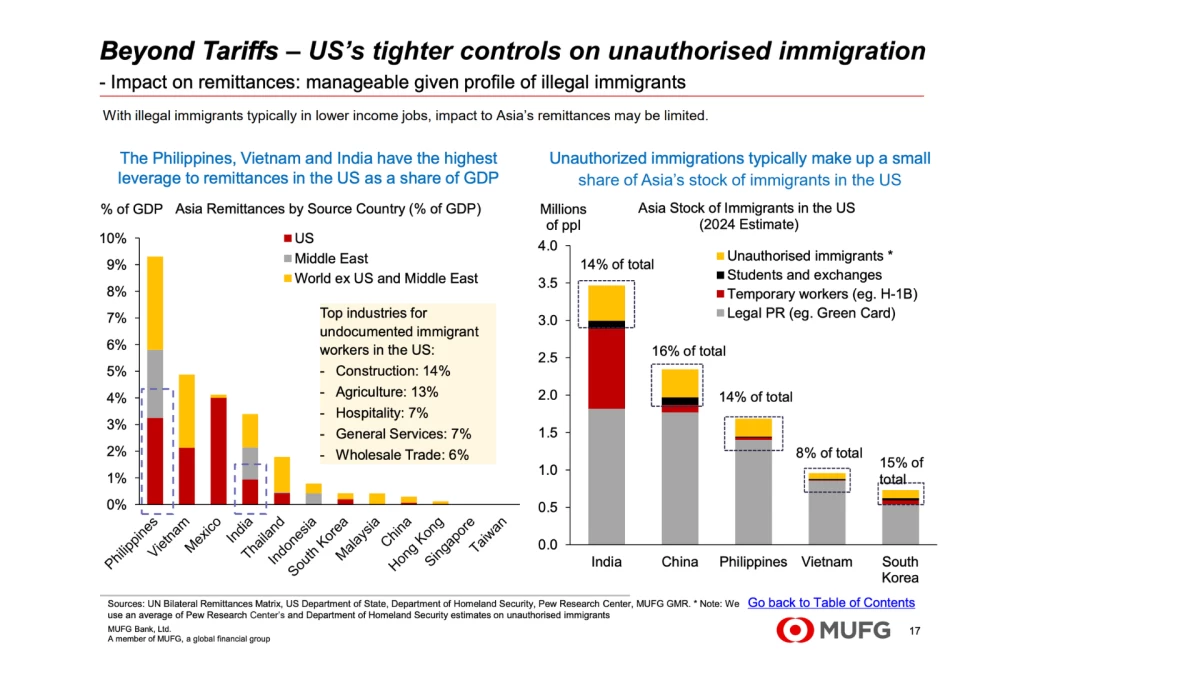
The Philippines, alongside Vietnam and India, has the “highest leverage to remittances in the US” as a share of its gross domestic product (GDP), MUFG noted.
Cash sent into the country by Filipinos working and living in the US is equivalent to a little over three percent of GDP. Remittances from the Middle East are about two percent of GDP, while remittances from the rest of the world edge out the share from the US, at around 3.5 percent of GDP.
Asian people working illegally in the US are mostly employed in the construction industry, at 14 percent of total; followed by agriculture, 13 percent; hospitality and general services, seven percent each; and wholesale trade, six percent.
These jobs are generally low-paying, so stricter enforcement is likely to have only a limited impact on the overall dollar inflows sent home.
Based on last year’s data, there were about 1.7 million Filipinos in the US, ranking third among the five countries covered by the MUFG report. Indians numbered nearly 3.5 million—the largest group—followed by Chinese nationals, at around 2.4 million. Vietnamese and South Korean nationals each totaled less than one million.
Notably, China recorded the largest share of unauthorized immigrants in the US, at 16 percent of its nationals. South Korea followed, at 15 percent. The Philippines and India each had 14 percent. Vietnam had the smallest share, at eight percent.
To recall, money sent home by OFs reached a seven-month high of $3.18 billion in July, driven by higher spending needs during the school opening season.
According to the Bangko Sentral ng Pilipinas (BSP), total cash remittances in July were three-percent higher than the $3.08 billion in July last year, which was the second-largest monthly remittance in 2024, only next to the holiday-driven inflows in December 2024.
As of end-July, cash remittances were predominantly from the US, accounting for 40.3 percent of total; followed by Singapore, 7.1 percent; Saudi Arabia, 6.2 percent; Japan, five percent; and the United Kingdom (UK), 4.8 percent.
Several money transfer centers abroad remit money through partner banks, which are mostly based in the US.
Remittances sent through money transfer firms are logged under the country where the company is based—often the US—not the actual source. This makes the US appear as the main origin of OF remittances, since banks tag the most immediate source.
Meanwhile, MUFG flagged the Halting International Relocation of Employment (HIRE) Bill, which was filed in the US Congress last month.
It seeks to charge US companies a 25-percent tax on payments they make to foreign service providers—call centers, information technology (IT) support teams, etc.—and would no longer allow those outsourcing costs to be deducted from their taxes.
If passed, this “could raise the costs of offshoring by US companies to the likes of India and the Philippines,” MUFG warned.
ADVERTISEMENT
.most-popular .layout-ratio{ padding-bottom: 79.13%; } @media (min-width: 768px) and (max-width: 1024px) { .widget-title { font-size: 15px !important; } }

{{ articles_filter_1561_widget.title }}

.most-popular .layout-ratio{ padding-bottom: 79.13%; } @media (min-width: 768px) and (max-width: 1024px) { .widget-title { font-size: 15px !important; } }

{{ articles_filter_1562_widget.title }}

.most-popular .layout-ratio{ padding-bottom: 79.13%; } @media (min-width: 768px) and (max-width: 1024px) { .widget-title { font-size: 15px !important; } }

{{ articles_filter_1563_widget.title }}

{{ articles_filter_1564_widget.title }}

.mb-article-details { position: relative; } .mb-article-details .article-body-preview, .mb-article-details .article-body-summary{ font-size: 17px; line-height: 30px; font-family: "Libre Caslon Text", serif; color: #000; } .mb-article-details .article-body-preview iframe , .mb-article-details .article-body-summary iframe{ width: 100%; margin: auto; } .read-more-background { background: linear-gradient(180deg, color(display-p3 1.000 1.000 1.000 / 0) 13.75%, color(display-p3 1.000 1.000 1.000 / 0.8) 30.79%, color(display-p3 1.000 1.000 1.000) 72.5%); position: absolute; height: 200px; width: 100%; bottom: 0; display: flex; justify-content: center; align-items: center; padding: 0; } .read-more-background a{ color: #000; } .read-more-btn { padding: 17px 45px; font-family: Inter; font-weight: 700; font-size: 18px; line-height: 16px; text-align: center; vertical-align: middle; border: 1px solid black; background-color: white; } .hidden { display: none; }
function initializeAllSwipers() { // Get all hidden inputs with cms_article_id document.querySelectorAll('[id^="cms_article_id_"]').forEach(function (input) { const cmsArticleId = input.value; const articleSelector = '#article-' + cmsArticleId + ' .body_images'; const swiperElement = document.querySelector(articleSelector); if (swiperElement && !swiperElement.classList.contains('swiper-initialized')) { new Swiper(articleSelector, { loop: true, pagination: false, navigation: { nextEl: '#article-' + cmsArticleId + ' .swiper-button-next', prevEl: '#article-' + cmsArticleId + ' .swiper-button-prev', }, }); } }); } setTimeout(initializeAllSwipers, 3000); const intersectionObserver = new IntersectionObserver( (entries) => { entries.forEach((entry) => { if (entry.isIntersecting) { const newUrl = entry.target.getAttribute("data-url"); if (newUrl) { history.pushState(null, null, newUrl); let article = entry.target; // Extract metadata const author = article.querySelector('.author-section').textContent.replace('By', '').trim(); const section = article.querySelector('.section-info ').textContent.replace(' ', ' '); const title = article.querySelector('.article-title h1').textContent; // Parse URL for Chartbeat path format const parsedUrl = new URL(newUrl, window.location.origin); const cleanUrl = parsedUrl.host + parsedUrl.pathname; // Update Chartbeat configuration if (typeof window._sf_async_config !== 'undefined') { window._sf_async_config.path = cleanUrl; window._sf_async_config.sections = section; window._sf_async_config.authors = author; } // Track virtual page view with Chartbeat if (typeof pSUPERFLY !== 'undefined' && typeof pSUPERFLY.virtualPage === 'function') { try { pSUPERFLY.virtualPage({ path: cleanUrl, title: title, sections: section, authors: author }); } catch (error) { console.error('ping error', error); } } // Optional: Update document title if (title && title !== document.title) { document.title = title; } } } }); }, { threshold: 0.1 } ); function showArticleBody(button) { const article = button.closest("article"); const summary = article.querySelector(".article-body-summary"); const body = article.querySelector(".article-body-preview"); const readMoreSection = article.querySelector(".read-more-background"); // Hide summary and read-more section summary.style.display = "none"; readMoreSection.style.display = "none"; // Show the full article body body.classList.remove("hidden"); } document.addEventListener("DOMContentLoaded", () => { let loadCount = 0; // Track how many times articles are loaded const offset = [1, 2, 3, 4, 5, 6, 7, 8, 9, 10]; // Offset values const currentUrl = window.location.pathname.substring(1); let isLoading = false; // Prevent multiple calls if (!currentUrl) { console.log("Current URL is invalid."); return; } const sentinel = document.getElementById("load-more-sentinel"); if (!sentinel) { console.log("Sentinel element not found."); return; } function isSentinelVisible() { const rect = sentinel.getBoundingClientRect(); return ( rect.top < window.innerHeight && rect.bottom >= 0 ); } function onScroll() { if (isLoading) return; if (isSentinelVisible()) { if (loadCount >= offset.length) { console.log("Maximum load attempts reached."); window.removeEventListener("scroll", onScroll); return; } isLoading = true; const currentOffset = offset[loadCount]; window.loadMoreItems().then(() => { let article = document.querySelector('#widget_1690 > div:nth-last-of-type(2) article'); intersectionObserver.observe(article) loadCount++; }).catch(error => { console.error("Error loading more items:", error); }).finally(() => { isLoading = false; }); } } window.addEventListener("scroll", onScroll); });

Sign up by email to receive news.