






Manila Bulletin
 Philippines
National
Newly-identified fault triggered 6.9-magnitude Cebu quake — Phivolcs
Philippines
National
Newly-identified fault triggered 6.9-magnitude Cebu quake — Phivolcs
Philippines
National
Newly-identified fault triggered 6.9-magnitude Cebu quake — Phivolcs
Newly-identified fault triggered 6.9-magnitude Cebu quake — Phivolcs
Published Oct 3, 2025 06:39 pm


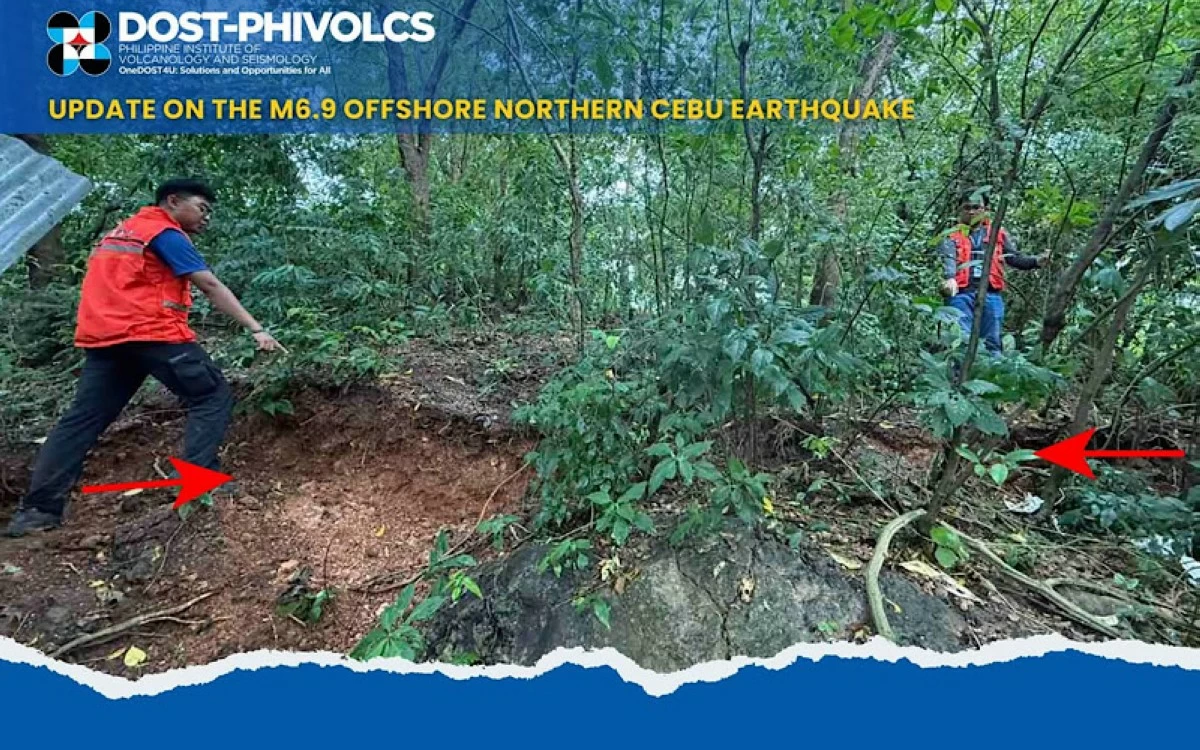
PHIVOLCS
The Philippine Institute of Volcanology and Seismology (Phivolcs) has traced the source of the Sept. 30 magnitude 6.9 offshore northern Cebu earthquake to a newly-identified fault in Bogo City, Cebu.
Phivolcs on Friday, Oct. 3 said its Quick Response Team “identified the onland extension of the fault that generated the Sept. 30 earthquake” in Sitio Looc, Barangay Nailon.
The agency has since named the feature the “Bogo Bay Fault.”
Phivolcs explained that the Bogo Bay Fault is the onland extension of the offshore fault initially identified as the generator of the Cebu earthquake.
Since the feature had not been mapped before, it is now considered a newly-identified fault.
The experts found evidence of the rupture, which included “open cracks, local pressure mounds, and fault scarps within a two-meter-wide deformation zone.”
According to Phivolcs, “initial ground mapping measured about 200 meters of rupture, but a drone survey imaged approximately 1.5 kilometers of fault-related features, indicating right-lateral movement.”
It added that “field verification is ongoing to determine the full extent of the rupture zone.”
Meanwhile, seismic activity has persisted in Cebu and nearby areas.
As of 4 p.m. on Oct. 3, Phivolcs recorded 4,378 aftershocks since the main shock. Of these, 859 were “plotted,” meaning their epicenters were located using data from at least three seismic stations.
At least 21 aftershocks were strong enough to be felt by residents.
The aftershocks have ranged in magnitude from 1.0 to 5.1.
Phivolcs advised the public to remain vigilant, saying that while aftershocks are expected to gradually ease in frequency and intensity, strong ones remain possible.