ADVERTISEMENT

Education agencies sign landmark agreement to establish unified learner data system

DepEd, CHED, and TESDA move to end fragmented education records with a unified learner reference number

Published Oct 3, 2025 07:31 pm
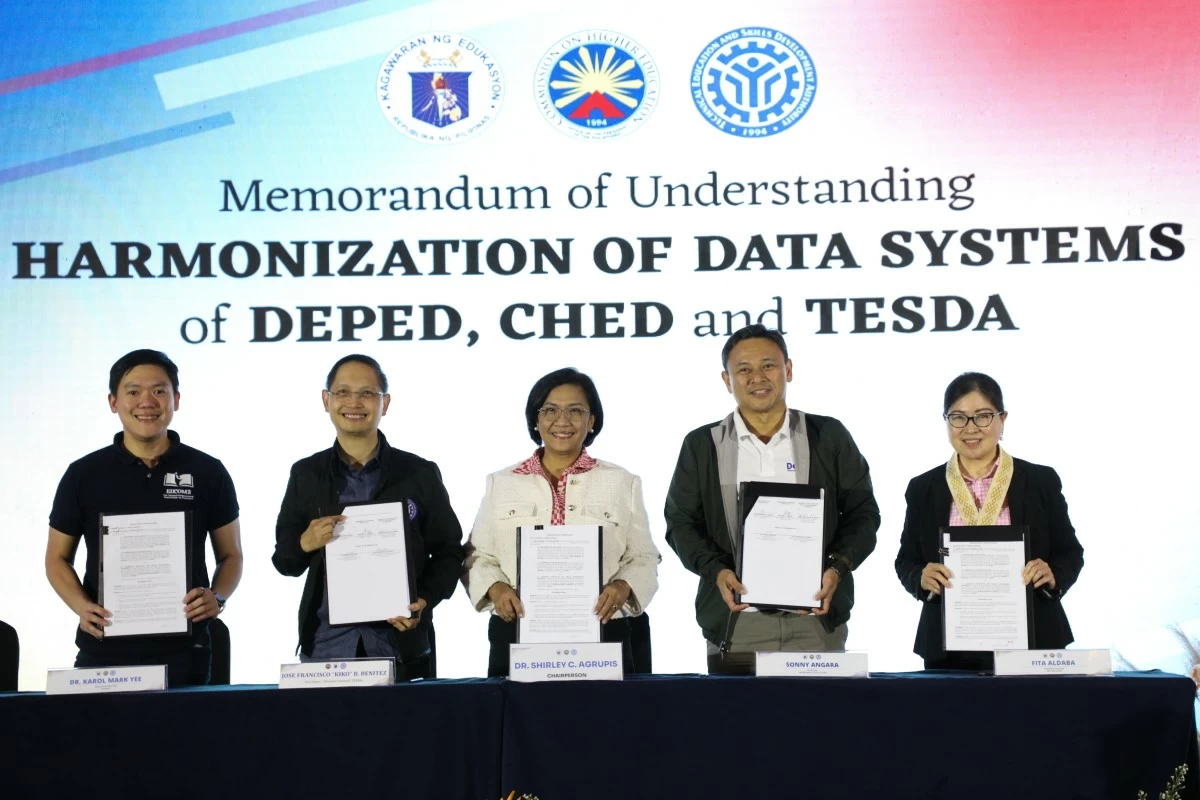
DepEd, CHED, and TESDA signed an agreement to unify learner data systems, adopting a single Learner Reference Number (LRN) to track Filipino students from basic to higher and technical-vocational education. (Photo from EDCOM 2)
To build a unified and interoperable learner data system that will allow seamless tracking of Filipino students from basic to higher and technical-vocational education, the Department of Education (DepEd), Commission on Higher Education (CHED), and Technical Education and Skills Development Authority (TESDA) signed a landmark agreement on Friday, October 3.
The agreement was formalized during the first-ever Joint Management Committee Meeting of the three agencies, with DepEd Secretary Sonny Angara, CHED Chairperson Shirley Agrupis, and TESDA Director General Kiko Benitez as signatories.
Ending fragmented education data
The initiative directly addresses the long-standing challenge of fragmented education data systems.
Previously, DepEd, CHED, and TESDA maintained separate records, such as the Learner Reference Number (LRN) and the Unique Learner Identifier (ULI), making it difficult to monitor a student’s journey from enrollment to employment.
In its Year One Report, the Second Congressional Commission on Education (EDCOM 2) flagged this fragmentation as a major barrier to effective policymaking, describing its impact as a “miseducation” of learners.
“For too long, our view of a student's journey has been fragmented,” Angara said. “We are finally seeing the complete picture—from their first day in kindergarten to their entry into the workforce,” he added. 
Angara emphasized that the initiative is not just about the numbers: “It’s about understanding our learners’ pathways, identifying where they need support, and ensuring that every Filipino has a genuine opportunity to succeed,” he explained. 
He noted that this initiative also fulfills a core recommendation of EDCOM 2—turning a “critical diagnosis into decisive action.”
Boosting jobs and policy reforms
Benitez called the agreement a “game-changer,” highlighting its role in aligning education with labor market demands.
“It allows us to more effectively bridge the gap between education and employment,” Benitez said. “By understanding a learner’s background, we can better guide them into technical-vocational tracks that lead directly to in-demand jobs,” he added. 
He added that the unified system will serve as a “compass” for agencies like TESDA in upskilling and reskilling the Filipino workforce, ensuring training programs are not only world-class but also aligned with the needs of the growing economy.
At the tertiary level, Agrupis emphasized its impact. 

“In higher education, our goal is to cultivate the next generation of leaders, innovators, and professionals,” she said. “This unified data system provides us with the clarity needed to make that happen,” she added. 
Agrupis noted that the system will enable CHED to refine scholarship programs, improve enrollment projections for State Universities and Colleges (SUCs), and ensure that degree offerings remain relevant and high quality.
Key features of the unified system
Under the Memorandum of Understanding (MOU), the three agencies will:
- adopt the DepEd-issued Learner Reference Number (LRN) as the single identifier across all education levels.
- harmonize and streamline data for better targeting of support programs like 4Ps and the Bagong Pilipinas Merit Scholarship Program.
- improve enrollment projections in higher education and TVET to guide budget allocation for state universities and training programs.
- coordinate with Department of Information and Communications Technology (DICT), Department of Labor and Employment (DOLE), Department of Social Welfare and Development (DSWD) and the Philippine Statistics Authority (PSA) to align education data with national development goals.
The agencies plan to pilot the system by 2026 and fully implement it by 2027, with technical support from the Education Center for AI Research (ECAIR).
Evidence-based policy for education reform
The unified learner data system is a major outcome of the First Education Data Harmonization Meeting convened by EDCOM 2.
It supports one of the Commission’s core recommendations: the need for reliable, accessible data to drive evidence-based policymaking and reforms in Philippine education.
By linking their systems, DepEd, CHED, and TESDA aim not only to improve student support and program planning but also to address the country’s education crisis through smarter and more responsive governance.

Related Tags

DepEd CHED TESDA unified learner data system EDCOM 2 education reforms Philippines education
ADVERTISEMENT
.most-popular .layout-ratio{ padding-bottom: 79.13%; } @media (min-width: 768px) and (max-width: 1024px) { .widget-title { font-size: 15px !important; } }

{{ articles_filter_1561_widget.title }}

.most-popular .layout-ratio{ padding-bottom: 79.13%; } @media (min-width: 768px) and (max-width: 1024px) { .widget-title { font-size: 15px !important; } }

{{ articles_filter_1562_widget.title }}

.most-popular .layout-ratio{ padding-bottom: 79.13%; } @media (min-width: 768px) and (max-width: 1024px) { .widget-title { font-size: 15px !important; } }

{{ articles_filter_1563_widget.title }}

{{ articles_filter_1564_widget.title }}

.mb-article-details { position: relative; } .mb-article-details .article-body-preview, .mb-article-details .article-body-summary{ font-size: 17px; line-height: 30px; font-family: "Libre Caslon Text", serif; color: #000; } .mb-article-details .article-body-preview iframe , .mb-article-details .article-body-summary iframe{ width: 100%; margin: auto; } .read-more-background { background: linear-gradient(180deg, color(display-p3 1.000 1.000 1.000 / 0) 13.75%, color(display-p3 1.000 1.000 1.000 / 0.8) 30.79%, color(display-p3 1.000 1.000 1.000) 72.5%); position: absolute; height: 200px; width: 100%; bottom: 0; display: flex; justify-content: center; align-items: center; padding: 0; } .read-more-background a{ color: #000; } .read-more-btn { padding: 17px 45px; font-family: Inter; font-weight: 700; font-size: 18px; line-height: 16px; text-align: center; vertical-align: middle; border: 1px solid black; background-color: white; } .hidden { display: none; }
function initializeAllSwipers() { // Get all hidden inputs with cms_article_id document.querySelectorAll('[id^="cms_article_id_"]').forEach(function (input) { const cmsArticleId = input.value; const articleSelector = '#article-' + cmsArticleId + ' .body_images'; const swiperElement = document.querySelector(articleSelector); if (swiperElement && !swiperElement.classList.contains('swiper-initialized')) { new Swiper(articleSelector, { loop: true, pagination: false, navigation: { nextEl: '#article-' + cmsArticleId + ' .swiper-button-next', prevEl: '#article-' + cmsArticleId + ' .swiper-button-prev', }, }); } }); } setTimeout(initializeAllSwipers, 3000); const intersectionObserver = new IntersectionObserver( (entries) => { entries.forEach((entry) => { if (entry.isIntersecting) { const newUrl = entry.target.getAttribute("data-url"); if (newUrl) { history.pushState(null, null, newUrl); let article = entry.target; // Extract metadata const author = article.querySelector('.author-section').textContent.replace('By', '').trim(); const section = article.querySelector('.section-info ').textContent.replace(' ', ' '); const title = article.querySelector('.article-title h1').textContent; // Parse URL for Chartbeat path format const parsedUrl = new URL(newUrl, window.location.origin); const cleanUrl = parsedUrl.host + parsedUrl.pathname; // Update Chartbeat configuration if (typeof window._sf_async_config !== 'undefined') { window._sf_async_config.path = cleanUrl; window._sf_async_config.sections = section; window._sf_async_config.authors = author; } // Track virtual page view with Chartbeat if (typeof pSUPERFLY !== 'undefined' && typeof pSUPERFLY.virtualPage === 'function') { try { pSUPERFLY.virtualPage({ path: cleanUrl, title: title, sections: section, authors: author }); } catch (error) { console.error('ping error', error); } } // Optional: Update document title if (title && title !== document.title) { document.title = title; } } } }); }, { threshold: 0.1 } ); function showArticleBody(button) { const article = button.closest("article"); const summary = article.querySelector(".article-body-summary"); const body = article.querySelector(".article-body-preview"); const readMoreSection = article.querySelector(".read-more-background"); // Hide summary and read-more section summary.style.display = "none"; readMoreSection.style.display = "none"; // Show the full article body body.classList.remove("hidden"); } document.addEventListener("DOMContentLoaded", () => { let loadCount = 0; // Track how many times articles are loaded const offset = [1, 2, 3, 4, 5, 6, 7, 8, 9, 10]; // Offset values const currentUrl = window.location.pathname.substring(1); let isLoading = false; // Prevent multiple calls if (!currentUrl) { console.log("Current URL is invalid."); return; } const sentinel = document.getElementById("load-more-sentinel"); if (!sentinel) { console.log("Sentinel element not found."); return; } function isSentinelVisible() { const rect = sentinel.getBoundingClientRect(); return ( rect.top < window.innerHeight && rect.bottom >= 0 ); } function onScroll() { if (isLoading) return; if (isSentinelVisible()) { if (loadCount >= offset.length) { console.log("Maximum load attempts reached."); window.removeEventListener("scroll", onScroll); return; } isLoading = true; const currentOffset = offset[loadCount]; window.loadMoreItems().then(() => { let article = document.querySelector('#widget_1690 > div:nth-last-of-type(2) article'); intersectionObserver.observe(article) loadCount++; }).catch(error => { console.error("Error loading more items:", error); }).finally(() => { isLoading = false; }); } } window.addEventListener("scroll", onScroll); });

Sign up by email to receive news.