ADVERTISEMENT

Cebu quake revives fears of Metro Manila's 'Big One'

Published Oct 3, 2025 08:52 pm
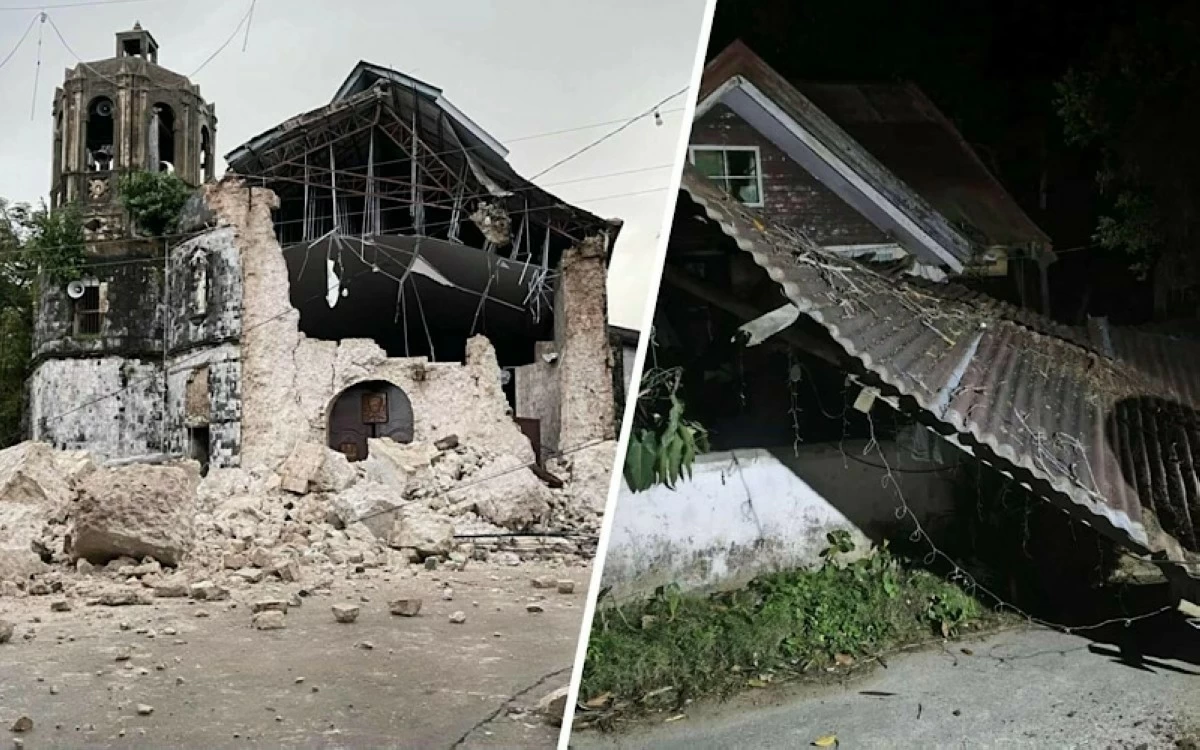
A magnitude 6.9 earthquake damages the Archdiocesan Shrine of Santa Rosa de Lima and a house in Cebu on Tuesday, Sept. 30, 2025.(Photos from the Archdiocesan Shrine of Santa Rosa de Lima and Cebu Gov. Pam Baricuatro)
The 6.9-magnitude earthquake that struck Cebu on Sept. 30 exposes the serious risk Metro Manila faces from a potential West Valley Fault tremor, a danger experts identified in the 2004 Metro Manila Earthquake Impact Reduction Study (MMEIRS).
While fatalities in Bogo City, Cebu remained under a hundred, Department of Science and Technology Secretary Renato Solidum remarked in a television inteview that a similar event in Metro Manila could claim “tens of thousands” of lives.
“Kung mangyari kunyari [ang magnitude] 6.5 na lindol sa kalagitnaan ng West Valley Fault ay tens of thousands ang ating casualty (If, for example, a magnitude 6.5 earthquake strikes along the middle of the West Valley Fault, we could have tens of thousands of casualties),” Solidum said, noting that the capital’s dense population and numerous high-rise buildings make it far more vulnerable.
The West Valley Fault, which stretches from Quezon City to Laguna, has not moved for centuries. Studies show it has a recurrence interval of about 200 to 400 years for major earthquakes.
As early as 2004, the Japan-funded MMEIRS projected the consequences of a magnitude 7.2 quake along the West Valley Fault, estimating:
* 170,000 houses collapsing
* 340,000 houses partly damaged
* 34,000 deaths and 114,000 injuries
* Fires destroying 1,710 hectares and killing at least 18,000 more people
* Heavy damage to bridges, water supply, power lines, and communication facilities
The study also warned that Metro Manila could be divided into four isolated sectors due to collapsed structures, fires, liquefaction, and ruptured roads, which could make evacuation and rescue extremely difficult.
The Cebu quake serves as a reminder of what could happen in a larger, denser, and more complex urban setting like Metro Manila.
With the nation’s population now around 15 million, up from 10 million at the time of the MMEIRS study, the potential impact of a major quake could be even greater.
Solidum reminded Metro Manila residents that preparedness begins at the individual and community level.
“The seriousness of effort is needed… your family, yourselves, and the community should make sure na handa tayo parati. Kasi ‘yung lindol is not an easy event to prepare [for], but it can be prepared for by making sure that our houses, our infrastructures, the places we visit like churches or malls are earthquake-resistant (The seriousness of effort is needed. Your family, yourselves, and the community should make sure that we are always prepared. Because an earthquake is not an easy event to prepare for, but it can be managed by making sure that our houses, our infrastructures, and the places we visit like churches or malls are earthquake-resistant),” he said.
While earthquakes cannot be prevented, Solidum said their impacts can be mitigated through compliance with building standards, retrofitting old structures, and regular preparedness drills.

Related Tags

PHIVOLCS 6.9-MAGNITUDE EARTHQUAKE THE BIG ONE METRO MANILA MMEIRS
ADVERTISEMENT
.most-popular .layout-ratio{ padding-bottom: 79.13%; } @media (min-width: 768px) and (max-width: 1024px) { .widget-title { font-size: 15px !important; } }

{{ articles_filter_1561_widget.title }}

.most-popular .layout-ratio{ padding-bottom: 79.13%; } @media (min-width: 768px) and (max-width: 1024px) { .widget-title { font-size: 15px !important; } }

{{ articles_filter_1562_widget.title }}

.most-popular .layout-ratio{ padding-bottom: 79.13%; } @media (min-width: 768px) and (max-width: 1024px) { .widget-title { font-size: 15px !important; } }

{{ articles_filter_1563_widget.title }}

{{ articles_filter_1564_widget.title }}

.mb-article-details { position: relative; } .mb-article-details .article-body-preview, .mb-article-details .article-body-summary{ font-size: 17px; line-height: 30px; font-family: "Libre Caslon Text", serif; color: #000; } .mb-article-details .article-body-preview iframe , .mb-article-details .article-body-summary iframe{ width: 100%; margin: auto; } .read-more-background { background: linear-gradient(180deg, color(display-p3 1.000 1.000 1.000 / 0) 13.75%, color(display-p3 1.000 1.000 1.000 / 0.8) 30.79%, color(display-p3 1.000 1.000 1.000) 72.5%); position: absolute; height: 200px; width: 100%; bottom: 0; display: flex; justify-content: center; align-items: center; padding: 0; } .read-more-background a{ color: #000; } .read-more-btn { padding: 17px 45px; font-family: Inter; font-weight: 700; font-size: 18px; line-height: 16px; text-align: center; vertical-align: middle; border: 1px solid black; background-color: white; } .hidden { display: none; }
function initializeAllSwipers() { // Get all hidden inputs with cms_article_id document.querySelectorAll('[id^="cms_article_id_"]').forEach(function (input) { const cmsArticleId = input.value; const articleSelector = '#article-' + cmsArticleId + ' .body_images'; const swiperElement = document.querySelector(articleSelector); if (swiperElement && !swiperElement.classList.contains('swiper-initialized')) { new Swiper(articleSelector, { loop: true, pagination: false, navigation: { nextEl: '#article-' + cmsArticleId + ' .swiper-button-next', prevEl: '#article-' + cmsArticleId + ' .swiper-button-prev', }, }); } }); } setTimeout(initializeAllSwipers, 3000); const intersectionObserver = new IntersectionObserver( (entries) => { entries.forEach((entry) => { if (entry.isIntersecting) { const newUrl = entry.target.getAttribute("data-url"); if (newUrl) { history.pushState(null, null, newUrl); let article = entry.target; // Extract metadata const author = article.querySelector('.author-section').textContent.replace('By', '').trim(); const section = article.querySelector('.section-info ').textContent.replace(' ', ' '); const title = article.querySelector('.article-title h1').textContent; // Parse URL for Chartbeat path format const parsedUrl = new URL(newUrl, window.location.origin); const cleanUrl = parsedUrl.host + parsedUrl.pathname; // Update Chartbeat configuration if (typeof window._sf_async_config !== 'undefined') { window._sf_async_config.path = cleanUrl; window._sf_async_config.sections = section; window._sf_async_config.authors = author; } // Track virtual page view with Chartbeat if (typeof pSUPERFLY !== 'undefined' && typeof pSUPERFLY.virtualPage === 'function') { try { pSUPERFLY.virtualPage({ path: cleanUrl, title: title, sections: section, authors: author }); } catch (error) { console.error('ping error', error); } } // Optional: Update document title if (title && title !== document.title) { document.title = title; } } } }); }, { threshold: 0.1 } ); function showArticleBody(button) { const article = button.closest("article"); const summary = article.querySelector(".article-body-summary"); const body = article.querySelector(".article-body-preview"); const readMoreSection = article.querySelector(".read-more-background"); // Hide summary and read-more section summary.style.display = "none"; readMoreSection.style.display = "none"; // Show the full article body body.classList.remove("hidden"); } document.addEventListener("DOMContentLoaded", () => { let loadCount = 0; // Track how many times articles are loaded const offset = [1, 2, 3, 4, 5, 6, 7, 8, 9, 10]; // Offset values const currentUrl = window.location.pathname.substring(1); let isLoading = false; // Prevent multiple calls if (!currentUrl) { console.log("Current URL is invalid."); return; } const sentinel = document.getElementById("load-more-sentinel"); if (!sentinel) { console.log("Sentinel element not found."); return; } function isSentinelVisible() { const rect = sentinel.getBoundingClientRect(); return ( rect.top < window.innerHeight && rect.bottom >= 0 ); } function onScroll() { if (isLoading) return; if (isSentinelVisible()) { if (loadCount >= offset.length) { console.log("Maximum load attempts reached."); window.removeEventListener("scroll", onScroll); return; } isLoading = true; const currentOffset = offset[loadCount]; window.loadMoreItems().then(() => { let article = document.querySelector('#widget_1690 > div:nth-last-of-type(2) article'); intersectionObserver.observe(article) loadCount++; }).catch(error => { console.error("Error loading more items:", error); }).finally(() => { isLoading = false; }); } } window.addEventListener("scroll", onScroll); });

Sign up by email to receive news.