






Manila Bulletin
 Business
Trade & Industry
ASEAN to strengthen internal food trade, shifting focus from US deals
Business
Trade & Industry
ASEAN to strengthen internal food trade, shifting focus from US deals
Business
Trade & Industry
ASEAN to strengthen internal food trade, shifting focus from US deals
ASEAN to strengthen internal food trade, shifting focus from US deals
Published Oct 3, 2025 12:22 pm


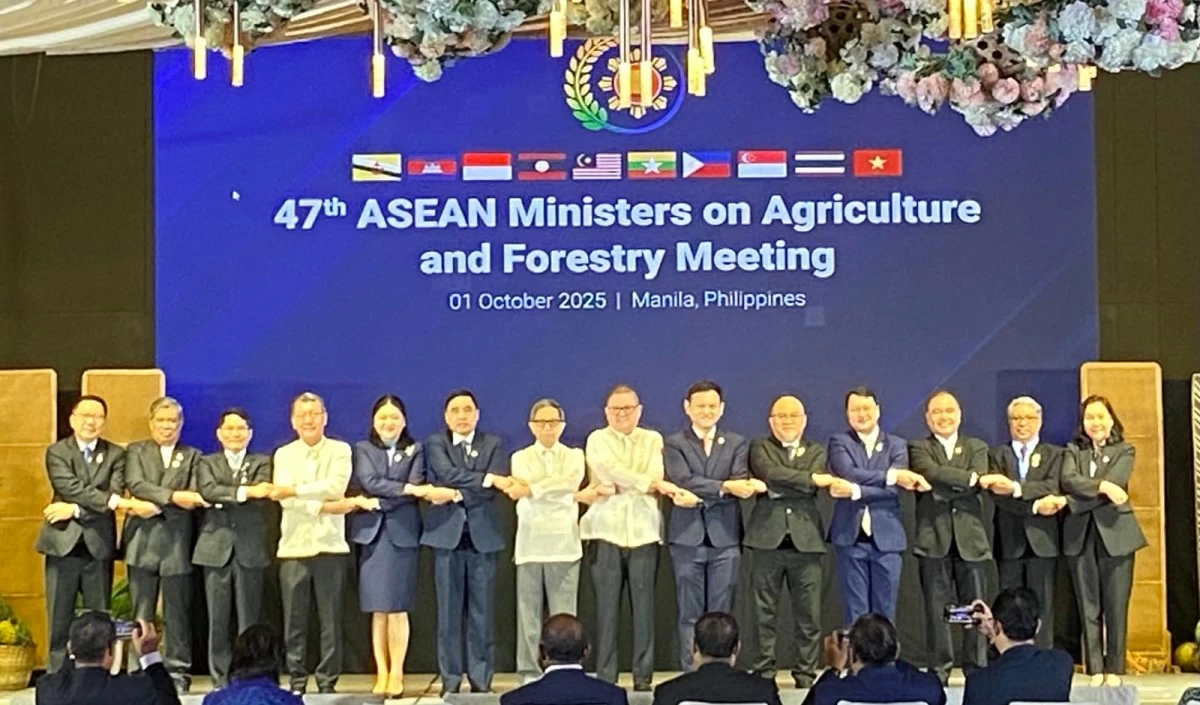
Agriculture officials posing for a photo during the opening of the 47th Meeting of the ASEAN Ministers on Agriculture and Forestry (AMAF) in Manila (Dexter Barro II/MANILA BULLETIN)
Top-ranking agriculture officials of the Association of Southeast Asian Nations (ASEAN) have agreed to strengthen trade within the region, as most of the bloc’s members are still awaiting progress on their respective deals with the United States (US) concerning reciprocal tariffs.
This agreement was formalized during the 47th Meeting of the ASEAN Ministers on Agriculture and Forestry (AMAF) in Manila, chaired by Agriculture Secretary Francisco Tiu Laurel.
“We have all agreed that we should increase trade among ASEAN members so that we can rely on each other first rather than relying on others that are far away,” said Tiu Laurel in a press briefing on Tuesday, Oct. 2, following the conclusion of the meeting.
Detailing the meeting to reporters, he said the current imposition of tariffs by the US was not directly discussed during the official forum.
Instead, Tiu Laurel said the matter came up informally over lunch, with agriculture officials asking one another, “Have you reached agreements with the US on tariffs?”
“When asked that question, most of us said that there's no final agreement yet,” he noted.
The Philippines is currently facing a 19 percent tariff rate on its exports to the United States, with certain exemptions recently disclosed for coconut products, fruits, and other goods.
Of the 10-member bloc, only Vietnam and Indonesia have secured final agreements with the US.
Tiu Laurel said such uncertainty compels ASEAN members to boost trade among one another, leveraging their proximity and long-standing trade relationships.
“The whole ASEAN, we also think alike in general, and we more or less have the same weather, so if we plan everything properly, we can produce more,” he said.
Citing a report from the Food and Agriculture Organization (FAO), Tiu Laurel said that ASEAN members still import around 30 percent of their food requirements, as demand lags behind strong demand.
The secretary stated that addressing these deficits is crucial for the region to ensure food security and reduce its reliance on external markets.
Nonetheless, he said the Philippines remains open to pursuing dialogue with the US, with the hope of securing additional tariff exemptions.
Tiu Laurel stated that during his meeting with the US-ASEAN Business Council, the advocacy group disclosed the “possibility of exceptions on certain products that are not produced or planted or manufactured or produced or processed in the US.”
During the 47th AMAF, agriculture ministers reaffirmed the ASEAN Vision for Agriculture: Toward 2045, which is a strategic framework aimed at enhancing food security, promoting climate resilience, and supporting rural development in the region.
Complementing this, officials also approved the ASEAN Food, Agriculture and Forestry Sectoral Plan (FAF-SP) for 2026–2030. FAF-SP is a medium-term roadmap outlining key regional initiatives and priorities for the next five years.
AMAF Plus Three—comprising the ten ASEAN member states along with China, Japan, and South Korea—also agreed on nine strategic areas of cooperation for the agriculture sector.
These areas include strengthening food security, developing biomass energy, promoting sustainable forest management, mitigating and adapting to climate change, and controlling animal and plant health diseases.
Also included are enhancements in capacity building and human resource development, improvements in productivity, quality, and marketability of agricultural products, strengthening of information and knowledge networking and exchange, and strengthened collaboration on research and development.