ADVERTISEMENT

Swiss glaciers shrank 3% this year, the fourth-biggest retreat on record - experts

Published Oct 2, 2025 09:34 am
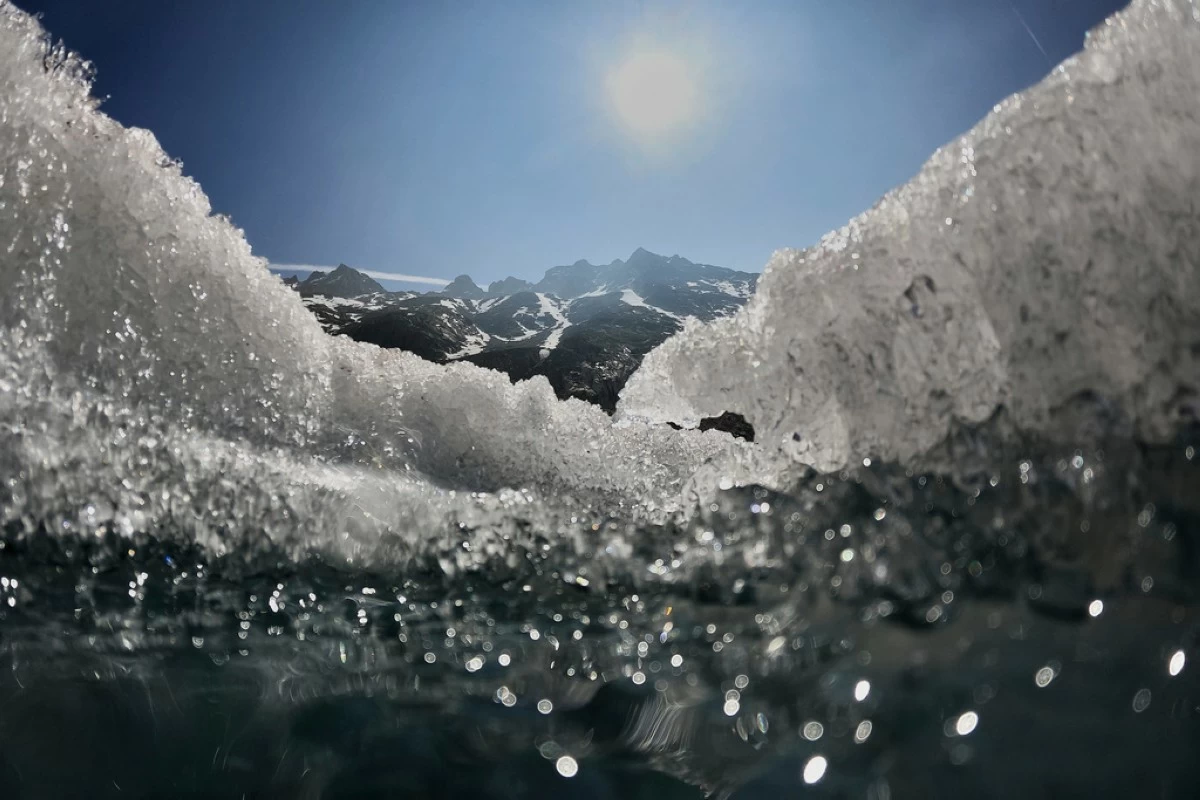
The sun shines over the melting Rhone Glacier near Goms, Switzerland, on June 10, 2025. (AP Photo/Matthias Schrader, File)
GENEVA (AP) — Switzerland's glaciers have faced “enormous” melting this year with a 3% drop in total volume — the fourth-largest annual drop on record — due to the effects of global warming, top Swiss glaciologists reported on Wednesday.
The shrinkage this year means that ice mass in Switzerland — home to the most glaciers in Europe — has declined by one-quarter over the last decade, the Swiss glacier monitoring group GLAMOS and the Swiss Academy of Sciences said in their new report.
“Glacial melting in Switzerland was once again enormous in 2025," the scientists said. “A winter with low snow depth combined with heat waves in June and August led to a loss of 3% of the glacier volume.”
Switzerland is home to nearly 1,400 glaciers, the most of any country in Europe, and the ice mass and its gradual melting have implications for hydropower, tourism, farming and water resources in many European countries.
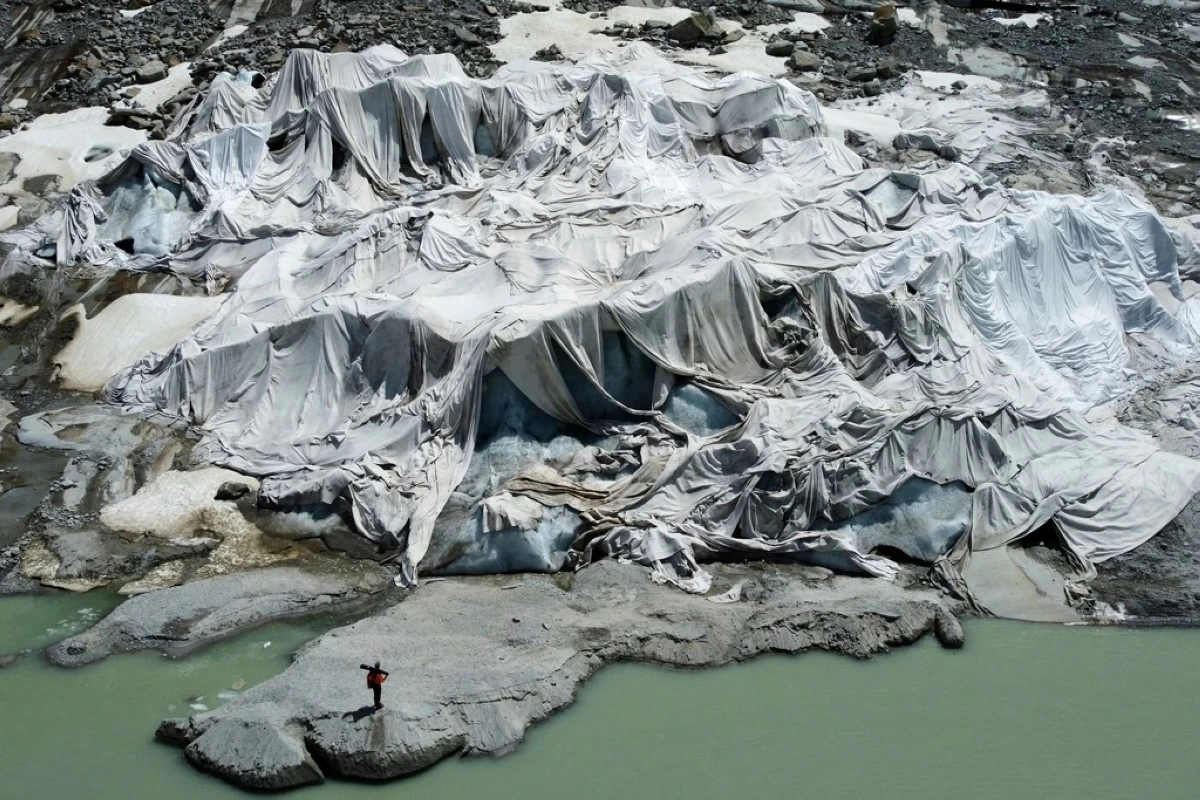
Matthias Huss, of the Federal Institute of Technology in Zurich and glacier monitoring group GLAMOS, stands at the Rhone Glacier that is partially covered with sheets near Goms, Switzerland, on June 10, 2025. (AP Photo/Matthias Schrader, File)
More than 1,000 small glaciers in Switzerland have already disappeared, the experts said.
The teams reported that a winter with little snow was followed by heat waves in June — the second-warmest June on record — which left the snow reserves depleted by early July. Ice masses began to melt earlier than ever, they said.
“Glaciers are clearly retreating because of anthropogenic global warming,” said Matthias Huss, the head of GLAMOS, referring to climate change caused by human activity.
“This is the main cause for the acceleration we are seeing in the last two years,” added Huss, who is also a glaciologist at Zurich’s ETHZ university.
The shrinkage is the fourth-largest after those in 2022, 2023 and back in 2003.
The retreat and loss of glaciers is also having an impact on Switzerland's landscape, causing mountains to shift and ground to become unstable.
Swiss authorities have been on heightened alert for such changes after a huge mass of rock and ice from a glacier thundered down a mountainside that covered nearly all of the southern village of Blatten in May.

Related Tags

WORLDNEWS GLOBAL WARMING Climate change
ADVERTISEMENT
.most-popular .layout-ratio{ padding-bottom: 79.13%; } @media (min-width: 768px) and (max-width: 1024px) { .widget-title { font-size: 15px !important; } }

{{ articles_filter_1561_widget.title }}

.most-popular .layout-ratio{ padding-bottom: 79.13%; } @media (min-width: 768px) and (max-width: 1024px) { .widget-title { font-size: 15px !important; } }

{{ articles_filter_1562_widget.title }}

.most-popular .layout-ratio{ padding-bottom: 79.13%; } @media (min-width: 768px) and (max-width: 1024px) { .widget-title { font-size: 15px !important; } }

{{ articles_filter_1563_widget.title }}

{{ articles_filter_1564_widget.title }}

.mb-article-details { position: relative; } .mb-article-details .article-body-preview, .mb-article-details .article-body-summary{ font-size: 17px; line-height: 30px; font-family: "Libre Caslon Text", serif; color: #000; } .mb-article-details .article-body-preview iframe , .mb-article-details .article-body-summary iframe{ width: 100%; margin: auto; } .read-more-background { background: linear-gradient(180deg, color(display-p3 1.000 1.000 1.000 / 0) 13.75%, color(display-p3 1.000 1.000 1.000 / 0.8) 30.79%, color(display-p3 1.000 1.000 1.000) 72.5%); position: absolute; height: 200px; width: 100%; bottom: 0; display: flex; justify-content: center; align-items: center; padding: 0; } .read-more-background a{ color: #000; } .read-more-btn { padding: 17px 45px; font-family: Inter; font-weight: 700; font-size: 18px; line-height: 16px; text-align: center; vertical-align: middle; border: 1px solid black; background-color: white; } .hidden { display: none; }
function initializeAllSwipers() { // Get all hidden inputs with cms_article_id document.querySelectorAll('[id^="cms_article_id_"]').forEach(function (input) { const cmsArticleId = input.value; const articleSelector = '#article-' + cmsArticleId + ' .body_images'; const swiperElement = document.querySelector(articleSelector); if (swiperElement && !swiperElement.classList.contains('swiper-initialized')) { new Swiper(articleSelector, { loop: true, pagination: false, navigation: { nextEl: '#article-' + cmsArticleId + ' .swiper-button-next', prevEl: '#article-' + cmsArticleId + ' .swiper-button-prev', }, }); } }); } setTimeout(initializeAllSwipers, 3000); const intersectionObserver = new IntersectionObserver( (entries) => { entries.forEach((entry) => { if (entry.isIntersecting) { const newUrl = entry.target.getAttribute("data-url"); if (newUrl) { history.pushState(null, null, newUrl); let article = entry.target; // Extract metadata const author = article.querySelector('.author-section').textContent.replace('By', '').trim(); const section = article.querySelector('.section-info ').textContent.replace(' ', ' '); const title = article.querySelector('.article-title h1').textContent; // Parse URL for Chartbeat path format const parsedUrl = new URL(newUrl, window.location.origin); const cleanUrl = parsedUrl.host + parsedUrl.pathname; // Update Chartbeat configuration if (typeof window._sf_async_config !== 'undefined') { window._sf_async_config.path = cleanUrl; window._sf_async_config.sections = section; window._sf_async_config.authors = author; } // Track virtual page view with Chartbeat if (typeof pSUPERFLY !== 'undefined' && typeof pSUPERFLY.virtualPage === 'function') { try { pSUPERFLY.virtualPage({ path: cleanUrl, title: title, sections: section, authors: author }); } catch (error) { console.error('ping error', error); } } // Optional: Update document title if (title && title !== document.title) { document.title = title; } } } }); }, { threshold: 0.1 } ); function showArticleBody(button) { const article = button.closest("article"); const summary = article.querySelector(".article-body-summary"); const body = article.querySelector(".article-body-preview"); const readMoreSection = article.querySelector(".read-more-background"); // Hide summary and read-more section summary.style.display = "none"; readMoreSection.style.display = "none"; // Show the full article body body.classList.remove("hidden"); } document.addEventListener("DOMContentLoaded", () => { let loadCount = 0; // Track how many times articles are loaded const offset = [1, 2, 3, 4, 5, 6, 7, 8, 9, 10]; // Offset values const currentUrl = window.location.pathname.substring(1); let isLoading = false; // Prevent multiple calls if (!currentUrl) { console.log("Current URL is invalid."); return; } const sentinel = document.getElementById("load-more-sentinel"); if (!sentinel) { console.log("Sentinel element not found."); return; } function isSentinelVisible() { const rect = sentinel.getBoundingClientRect(); return ( rect.top < window.innerHeight && rect.bottom >= 0 ); } function onScroll() { if (isLoading) return; if (isSentinelVisible()) { if (loadCount >= offset.length) { console.log("Maximum load attempts reached."); window.removeEventListener("scroll", onScroll); return; } isLoading = true; const currentOffset = offset[loadCount]; window.loadMoreItems().then(() => { let article = document.querySelector('#widget_1690 > div:nth-last-of-type(2) article'); intersectionObserver.observe(article) loadCount++; }).catch(error => { console.error("Error loading more items:", error); }).finally(() => { isLoading = false; }); } } window.addEventListener("scroll", onScroll); });

Sign up by email to receive news.