ADVERTISEMENT

Sugar production projected to fall 8% amid pest threat

Published Oct 1, 2025 05:40 pm
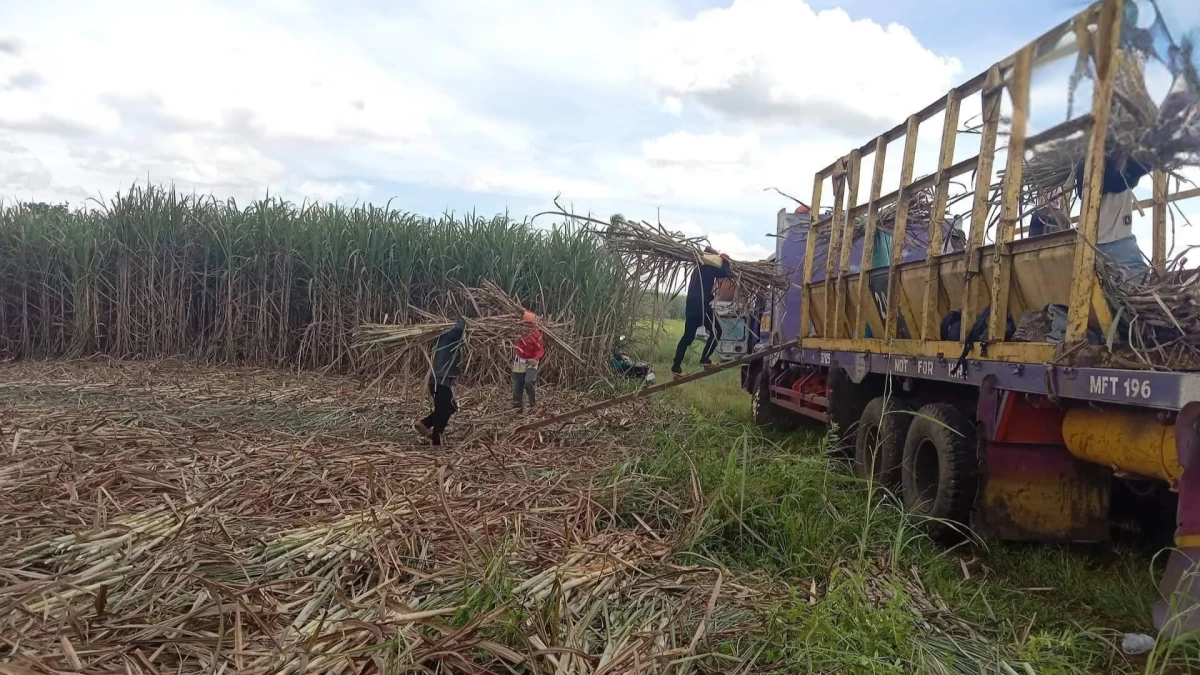
(Sugar Regulatory Administration-Bukidnon Mill District photo)
The country’s sugar production is projected to fall by eight percent in the current crop year, as the government adopts a more conservative estimate due to threats from pests and weather conditions that could damage sugarcane.
The Sugar Regulatory Administration (SRA) expects raw sugar output in crop year 2025 to 2026 to reach 1.92 million metric tons (MT), lower than 2.08 million MT in the previous crop year.
Under Sugar Order No. 1, the current crop year started on Wednesday, Oct. 1, and would end on Sept. 30, 2026.
The SRA lowered its estimate due to potential for sugarcane infestation from the spread of the red-stripe soft scale insect (RSSI).
The sugar agency reported in August that RSSI infestation has spread over 3,200 hectares in Negros Island and Panay.
RSSI is a sap-sucking insect that attacks sugarcane leaves, reducing sugar content by as much as 50 percent.
The SRA had earlier restricted the transportation of sugarcane plants and planting materials by issuing a permit to transport in an effort to curb their spread to other sugar-producing provinces.
United Sugar Producers Federation of the Philippines (Unifed) President Manuel Lamata said he agrees with the SRA’s lower projection for the current crop year due to the widespread impact of RSSI.
“We never imagined the damage caused by RSSI was that extensive,” said Lamata in a message to reporters. “Hopefully, we can recover this coming crop year.”
The SRA also cited extreme weather conditions, particularly excessive rainfall in Negros Island, as a factor dragging production.
Negros, which encompasses the provinces of Negros Oriental and Negros Occidental, is the country’s leading sugar producer, accounting for approximately 65 percent of the country’s total production.
For crop year 2024 to 2025, the SRA initially projected production at 1.78 million MT due to the lingering effects of last year’s El Niño.
Driven by favorable weather conditions and government intervention, sugar output reached 2.08 million MT in the previous crop year. This was the first time the sugar industry exceeded the two-million mark since the crop year 2020 to 2021.
The SRA projects a total sugar withdrawal of 2.20 million MT for the crop year, indicating a gap of approximately 280,000 MT, which could be addressed through higher production or importation.
Under Sugar Order No. 1, the agency retained the designation of “B” for the entire sugar production in the crop year, leaving all raw sugar for the domestic market.
The SRA classifies raw sugar output as “A” for raw sugar to be exported to the United States, “B” for domestic consumption, “C” for reserves, and “D” for export to the world market.
The classification for the country’s sugar production has remained at “B” since 2022 as output still lags behind overall demand.
The Office of the United States Trade Representative (USTR) recently allotted 145,235 metric tons raw value (MTRV) to the Philippines for the crop year. This enables the country to export under a relatively low tariff.
The quota is expected to no longer come into play in the crop year following the designation of all sugar output for domestic use.
The SRA will periodically assess sugar production and withdrawal trends, which could lead to adjustments in policies.

Related Tags

Sugar Regulatory Administration (SRA)
ADVERTISEMENT
.most-popular .layout-ratio{ padding-bottom: 79.13%; } @media (min-width: 768px) and (max-width: 1024px) { .widget-title { font-size: 15px !important; } }

{{ articles_filter_1561_widget.title }}

.most-popular .layout-ratio{ padding-bottom: 79.13%; } @media (min-width: 768px) and (max-width: 1024px) { .widget-title { font-size: 15px !important; } }

{{ articles_filter_1562_widget.title }}

.most-popular .layout-ratio{ padding-bottom: 79.13%; } @media (min-width: 768px) and (max-width: 1024px) { .widget-title { font-size: 15px !important; } }

{{ articles_filter_1563_widget.title }}

{{ articles_filter_1564_widget.title }}

.mb-article-details { position: relative; } .mb-article-details .article-body-preview, .mb-article-details .article-body-summary{ font-size: 17px; line-height: 30px; font-family: "Libre Caslon Text", serif; color: #000; } .mb-article-details .article-body-preview iframe , .mb-article-details .article-body-summary iframe{ width: 100%; margin: auto; } .read-more-background { background: linear-gradient(180deg, color(display-p3 1.000 1.000 1.000 / 0) 13.75%, color(display-p3 1.000 1.000 1.000 / 0.8) 30.79%, color(display-p3 1.000 1.000 1.000) 72.5%); position: absolute; height: 200px; width: 100%; bottom: 0; display: flex; justify-content: center; align-items: center; padding: 0; } .read-more-background a{ color: #000; } .read-more-btn { padding: 17px 45px; font-family: Inter; font-weight: 700; font-size: 18px; line-height: 16px; text-align: center; vertical-align: middle; border: 1px solid black; background-color: white; } .hidden { display: none; }
function initializeAllSwipers() { // Get all hidden inputs with cms_article_id document.querySelectorAll('[id^="cms_article_id_"]').forEach(function (input) { const cmsArticleId = input.value; const articleSelector = '#article-' + cmsArticleId + ' .body_images'; const swiperElement = document.querySelector(articleSelector); if (swiperElement && !swiperElement.classList.contains('swiper-initialized')) { new Swiper(articleSelector, { loop: true, pagination: false, navigation: { nextEl: '#article-' + cmsArticleId + ' .swiper-button-next', prevEl: '#article-' + cmsArticleId + ' .swiper-button-prev', }, }); } }); } setTimeout(initializeAllSwipers, 3000); const intersectionObserver = new IntersectionObserver( (entries) => { entries.forEach((entry) => { if (entry.isIntersecting) { const newUrl = entry.target.getAttribute("data-url"); if (newUrl) { history.pushState(null, null, newUrl); let article = entry.target; // Extract metadata const author = article.querySelector('.author-section').textContent.replace('By', '').trim(); const section = article.querySelector('.section-info ').textContent.replace(' ', ' '); const title = article.querySelector('.article-title h1').textContent; // Parse URL for Chartbeat path format const parsedUrl = new URL(newUrl, window.location.origin); const cleanUrl = parsedUrl.host + parsedUrl.pathname; // Update Chartbeat configuration if (typeof window._sf_async_config !== 'undefined') { window._sf_async_config.path = cleanUrl; window._sf_async_config.sections = section; window._sf_async_config.authors = author; } // Track virtual page view with Chartbeat if (typeof pSUPERFLY !== 'undefined' && typeof pSUPERFLY.virtualPage === 'function') { try { pSUPERFLY.virtualPage({ path: cleanUrl, title: title, sections: section, authors: author }); } catch (error) { console.error('ping error', error); } } // Optional: Update document title if (title && title !== document.title) { document.title = title; } } } }); }, { threshold: 0.1 } ); function showArticleBody(button) { const article = button.closest("article"); const summary = article.querySelector(".article-body-summary"); const body = article.querySelector(".article-body-preview"); const readMoreSection = article.querySelector(".read-more-background"); // Hide summary and read-more section summary.style.display = "none"; readMoreSection.style.display = "none"; // Show the full article body body.classList.remove("hidden"); } document.addEventListener("DOMContentLoaded", () => { let loadCount = 0; // Track how many times articles are loaded const offset = [1, 2, 3, 4, 5, 6, 7, 8, 9, 10]; // Offset values const currentUrl = window.location.pathname.substring(1); let isLoading = false; // Prevent multiple calls if (!currentUrl) { console.log("Current URL is invalid."); return; } const sentinel = document.getElementById("load-more-sentinel"); if (!sentinel) { console.log("Sentinel element not found."); return; } function isSentinelVisible() { const rect = sentinel.getBoundingClientRect(); return ( rect.top < window.innerHeight && rect.bottom >= 0 ); } function onScroll() { if (isLoading) return; if (isSentinelVisible()) { if (loadCount >= offset.length) { console.log("Maximum load attempts reached."); window.removeEventListener("scroll", onScroll); return; } isLoading = true; const currentOffset = offset[loadCount]; window.loadMoreItems().then(() => { let article = document.querySelector('#widget_1690 > div:nth-last-of-type(2) article'); intersectionObserver.observe(article) loadCount++; }).catch(error => { console.error("Error loading more items:", error); }).finally(() => { isLoading = false; }); } } window.addEventListener("scroll", onScroll); });

Sign up by email to receive news.