ADVERTISEMENT

Phivolcs warns aftershocks from Cebu quake may persist for weeks

Published Oct 1, 2025 06:13 pm
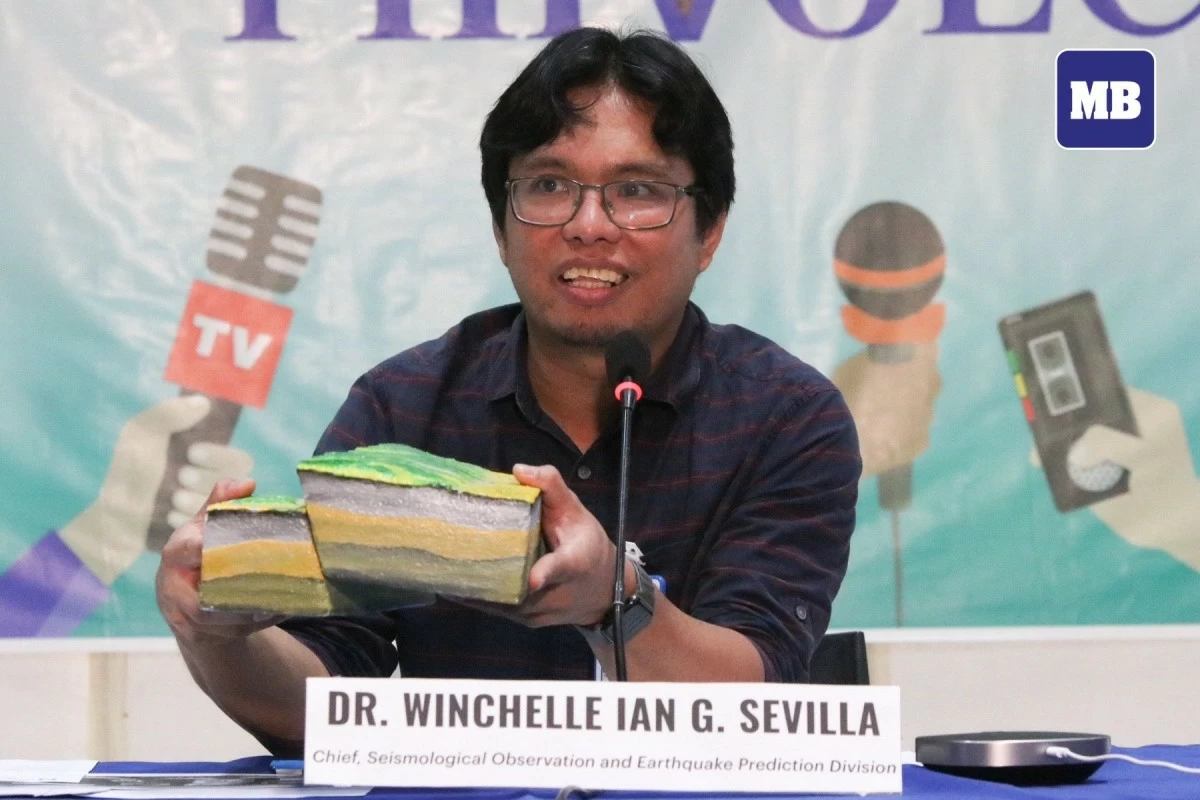
Philippine Institute of Volcanology and Seismology (Phivolcs) Seismological Observation and Earthquake Prediction Division Chief Dr. Winchelle Ian G. Sevilla discusses the magnitude 6.9 earthquake that struck Cebu and nearby areas during a press briefing in Quezon City on Wednesday, Oct. 1. (Santi San Juan/Manila Bulletin)
The Philippine Institute of Volcanology and Seismology (Phivolcs) on Wednesday, Oct. 1, warned that aftershocks from the magnitude 6.9 earthquake that struck offshore northern Cebu on Sept. 30 may last for days or weeks.
As of 10 a.m., Phivolcs recorded 848 aftershocks ranging from magnitude 1.4 to 4.8, only four of which were felt.
Phivolcs’ Seismological Observation and Earthquake Prediction Division chief Dr. Winchelle Ian Sevilla explained that the high number of aftershocks was expected since less than a day had passed since the tremor.
“Mataas pa yung ating bilang ng aftershocks dahil wala pa halos isang araw pero ine-expect natin na habang tumatagal ay kokonti po ‘yan at papahina (The number of aftershocks is still high since it has been less than a day since the quake, but we expect them to decrease and weaken over time,” he said in a press conference on Wednesday.
“Based on the earthquake events before, posible pong weeks, posible ring months, so medyo may katagalan pa po. Mabuti na lang at karamihan nito ay hindi natin nararamdaman. Pero mahalaga pa rin po na lagi tayong nakahanda kung saka-sakali mang magkaroon ng pagyanig (Based on past earthquake events, aftershocks may last for weeks or even months. Fortunately, most are unfelt, but it remains important to be prepared should stronger ones occur),” he said.
Sevilla added that while most of the aftershocks are too weak to be felt, residents should remain alert for possible stronger tremors.
He also recommended checking structures that may have been damaged.
“Napakahalaga na masuri natin yung mga istruktura kung matibay pa rin ba ito matapos ang lindol kasi ang mga paggalaw na ito baka sakali yung mahinang struktura ay lalo pa humina (It is very important to check whether structures remain sturdy after the earthquake because these movements could further weaken those already fragile),” Sevilla said.
Phivolcs also warned the public that the quake could trigger secondary hazards, such as landslides and liquefaction.
“Earthquake-induced landslides, rock falls, and other types of mass movement may occur on sloping terrains, specifically in mountainous or hilly areas,” it said in a primer released on Wednesday.
Liquefaction, manifested through subsidence, ground fissures, sand boils, or lateral spreading, could affect low-lying and water-saturated communities.
Coastal areas may also be exposed to seawater inundation if land subsidence coincides with high tide, while sinkholes could develop in limestone zones.
Although a tsunami information was lifted three hours after the quake, Phivolcs urged residents to remain alert, particularly along beaches and coastal areas, should another strong earthquake occur.
The agency advised residents to practice “drop, cover, and hold” during aftershocks, avoid entering damaged or weakened buildings, and check slopes for cracks that may lead to landslides.
Phivolcs also assured that the 6.9-magnitude earthquake was tectonic in origin and not related to volcanic activity, although monitoring of nearby volcanoes such as Kanlaon and Biliran will continue.
“As part of DOST-Phivolcs’ (Department of Science and Technology-Phivolcs) monitoring procedures for moderate to major earthquakes occurring near active volcanoes, the Institute will continue to monitor any activity that may affect these two volcanoes,” it said.

Related Tags

PHIVOLCS 6.9-MAGNITUDE EARTHQUAKE CEBU AFTERSHOCKS
ADVERTISEMENT
.most-popular .layout-ratio{ padding-bottom: 79.13%; } @media (min-width: 768px) and (max-width: 1024px) { .widget-title { font-size: 15px !important; } }

{{ articles_filter_1561_widget.title }}

.most-popular .layout-ratio{ padding-bottom: 79.13%; } @media (min-width: 768px) and (max-width: 1024px) { .widget-title { font-size: 15px !important; } }

{{ articles_filter_1562_widget.title }}

.most-popular .layout-ratio{ padding-bottom: 79.13%; } @media (min-width: 768px) and (max-width: 1024px) { .widget-title { font-size: 15px !important; } }

{{ articles_filter_1563_widget.title }}

{{ articles_filter_1564_widget.title }}

.mb-article-details { position: relative; } .mb-article-details .article-body-preview, .mb-article-details .article-body-summary{ font-size: 17px; line-height: 30px; font-family: "Libre Caslon Text", serif; color: #000; } .mb-article-details .article-body-preview iframe , .mb-article-details .article-body-summary iframe{ width: 100%; margin: auto; } .read-more-background { background: linear-gradient(180deg, color(display-p3 1.000 1.000 1.000 / 0) 13.75%, color(display-p3 1.000 1.000 1.000 / 0.8) 30.79%, color(display-p3 1.000 1.000 1.000) 72.5%); position: absolute; height: 200px; width: 100%; bottom: 0; display: flex; justify-content: center; align-items: center; padding: 0; } .read-more-background a{ color: #000; } .read-more-btn { padding: 17px 45px; font-family: Inter; font-weight: 700; font-size: 18px; line-height: 16px; text-align: center; vertical-align: middle; border: 1px solid black; background-color: white; } .hidden { display: none; }
function initializeAllSwipers() { // Get all hidden inputs with cms_article_id document.querySelectorAll('[id^="cms_article_id_"]').forEach(function (input) { const cmsArticleId = input.value; const articleSelector = '#article-' + cmsArticleId + ' .body_images'; const swiperElement = document.querySelector(articleSelector); if (swiperElement && !swiperElement.classList.contains('swiper-initialized')) { new Swiper(articleSelector, { loop: true, pagination: false, navigation: { nextEl: '#article-' + cmsArticleId + ' .swiper-button-next', prevEl: '#article-' + cmsArticleId + ' .swiper-button-prev', }, }); } }); } setTimeout(initializeAllSwipers, 3000); const intersectionObserver = new IntersectionObserver( (entries) => { entries.forEach((entry) => { if (entry.isIntersecting) { const newUrl = entry.target.getAttribute("data-url"); if (newUrl) { history.pushState(null, null, newUrl); let article = entry.target; // Extract metadata const author = article.querySelector('.author-section').textContent.replace('By', '').trim(); const section = article.querySelector('.section-info ').textContent.replace(' ', ' '); const title = article.querySelector('.article-title h1').textContent; // Parse URL for Chartbeat path format const parsedUrl = new URL(newUrl, window.location.origin); const cleanUrl = parsedUrl.host + parsedUrl.pathname; // Update Chartbeat configuration if (typeof window._sf_async_config !== 'undefined') { window._sf_async_config.path = cleanUrl; window._sf_async_config.sections = section; window._sf_async_config.authors = author; } // Track virtual page view with Chartbeat if (typeof pSUPERFLY !== 'undefined' && typeof pSUPERFLY.virtualPage === 'function') { try { pSUPERFLY.virtualPage({ path: cleanUrl, title: title, sections: section, authors: author }); } catch (error) { console.error('ping error', error); } } // Optional: Update document title if (title && title !== document.title) { document.title = title; } } } }); }, { threshold: 0.1 } ); function showArticleBody(button) { const article = button.closest("article"); const summary = article.querySelector(".article-body-summary"); const body = article.querySelector(".article-body-preview"); const readMoreSection = article.querySelector(".read-more-background"); // Hide summary and read-more section summary.style.display = "none"; readMoreSection.style.display = "none"; // Show the full article body body.classList.remove("hidden"); } document.addEventListener("DOMContentLoaded", () => { let loadCount = 0; // Track how many times articles are loaded const offset = [1, 2, 3, 4, 5, 6, 7, 8, 9, 10]; // Offset values const currentUrl = window.location.pathname.substring(1); let isLoading = false; // Prevent multiple calls if (!currentUrl) { console.log("Current URL is invalid."); return; } const sentinel = document.getElementById("load-more-sentinel"); if (!sentinel) { console.log("Sentinel element not found."); return; } function isSentinelVisible() { const rect = sentinel.getBoundingClientRect(); return ( rect.top < window.innerHeight && rect.bottom >= 0 ); } function onScroll() { if (isLoading) return; if (isSentinelVisible()) { if (loadCount >= offset.length) { console.log("Maximum load attempts reached."); window.removeEventListener("scroll", onScroll); return; } isLoading = true; const currentOffset = offset[loadCount]; window.loadMoreItems().then(() => { let article = document.querySelector('#widget_1690 > div:nth-last-of-type(2) article'); intersectionObserver.observe(article) loadCount++; }).catch(error => { console.error("Error loading more items:", error); }).finally(() => { isLoading = false; }); } } window.addEventListener("scroll", onScroll); });

Sign up by email to receive news.