ADVERTISEMENT

Phivolcs: 400-year dormant fault likely behind powerful Cebu quake

Published Oct 1, 2025 03:11 pm
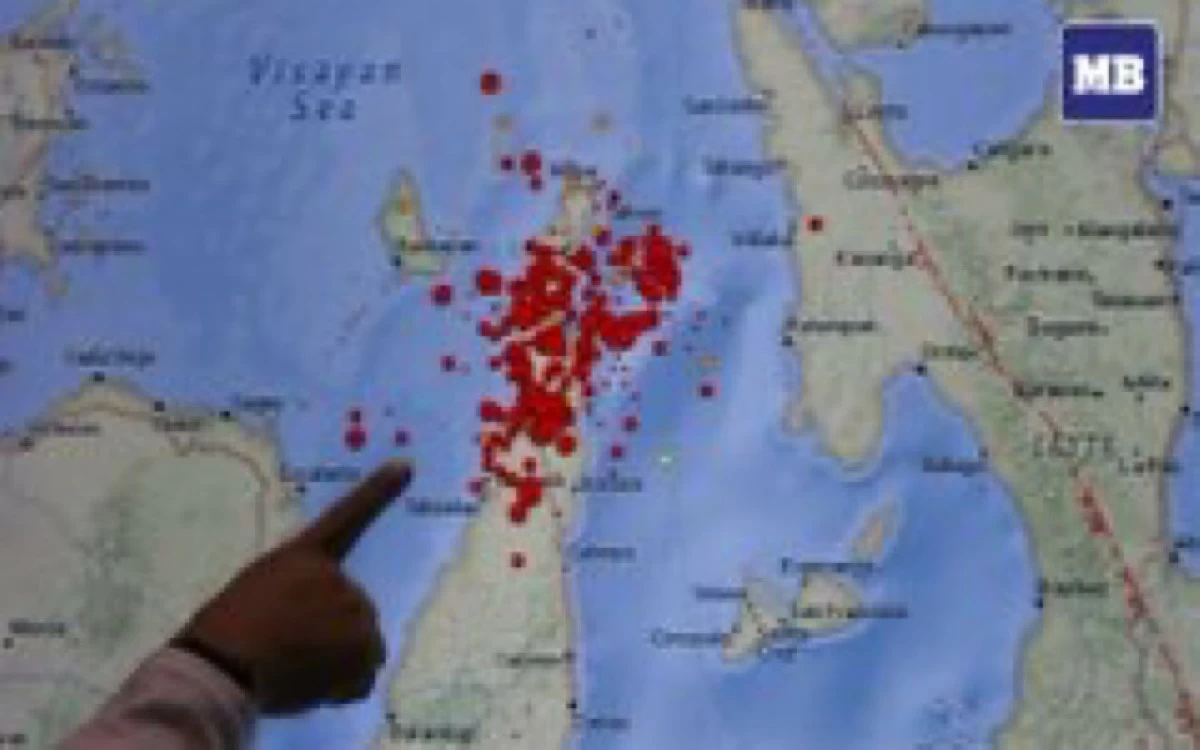
(Santi San Juan/Manila Bulletin)
The magnitude 6.9 earthquake that struck Cebu on Sept. 30 may have been triggered by a fault in the epicentral area that had not generated a strong tremor in the past 400 years, the Philippine Institute of Volcanology and Seismology (Phivolcs) said.
The tremor’s epicenter was traced 19 kilometers northeast of Bogo City, with a shallow depth of five kilometers. It produced a lateral or horizontal movement (side to side shaking).
Phivolcs initially pointed to an offshore active fault northeast of Cebu as the source of the earthquake.
“At least in the last 400 years, yung nag-generate dito ngayon lang ulit siya gumalaw. Kaya medyo malakas (At least in the last 400 years, the generator of this quake has just moved again now. That is why it was quite strong)” said Dr. Winchelle Ian Sevilla, chief of Phivolcs’ Seismological Observation and Earthquake Prediction Division, in a press conference on Wednesday, Oct. 1.
Sevilla noted that while the epicentral area has no traced fault line, its location underwater and history of producing only small earthquakes may have contributed to the long period of inactivity.
“Kung mapapansin niyo sa distribution of active faults and trenches in the Philippines, doon sa epicentral area wala po tayong traced na fault dahil una, nasa ilalim siya ng dagat, pangalawa, maliliit lang yung earthquakes sa epicentral area, ngayon na lang ulit nagkaroon ng isang malakas na lindol (If you look at the distribution of active faults and trenches in the Philippines, there is no traced fault in the epicentral area because it lies under the sea and usually only generates small earthquakes. It is only now that a strong quake has occurred again),” he explained.
However, Phivolcs emphasized that Cebu remains seismically active, as shown in the province’s ground rupture hazard map which indicates the presence of several faults.
To better monitor the seismic activity, Sevilla said Phivolcs has dispatched a quick response team to the epicentral area to install instruments, identify aftershock locations with higher accuracy, and assess structural damage caused by the tremor.
In a primer released on Wednesday, Oct. 1, Phivolcs explained that Cebu and neighboring provinces lie within one of the seismically active regions in the country, with earthquake sources that include the Bogo Fault, Daanbantayan Lineament, and Cebu Fault System.
Local inland and offshore faults, some concealed by young deposits, are also capable of producing strong tremors, it said.
Phivolcs’ historical data show that at least eight major earthquakes ranging from magnitude 5.0 to 7.2 have struck Cebu and nearby provinces since 1885.
The most damaging were the magnitude 6.9 event in Negros Oriental on Feb. 6, 2012, and the magnitude 7.2 Bohol earthquake on Oct. 15, 2013, both of which caused damage in Cebu.

Related Tags

PHIVOLCS 6.9-MAGNITUDE EARTHQUAKE LINDOL CEBU FAULT
ADVERTISEMENT
.most-popular .layout-ratio{ padding-bottom: 79.13%; } @media (min-width: 768px) and (max-width: 1024px) { .widget-title { font-size: 15px !important; } }

{{ articles_filter_1561_widget.title }}

.most-popular .layout-ratio{ padding-bottom: 79.13%; } @media (min-width: 768px) and (max-width: 1024px) { .widget-title { font-size: 15px !important; } }

{{ articles_filter_1562_widget.title }}

.most-popular .layout-ratio{ padding-bottom: 79.13%; } @media (min-width: 768px) and (max-width: 1024px) { .widget-title { font-size: 15px !important; } }

{{ articles_filter_1563_widget.title }}

{{ articles_filter_1564_widget.title }}

.mb-article-details { position: relative; } .mb-article-details .article-body-preview, .mb-article-details .article-body-summary{ font-size: 17px; line-height: 30px; font-family: "Libre Caslon Text", serif; color: #000; } .mb-article-details .article-body-preview iframe , .mb-article-details .article-body-summary iframe{ width: 100%; margin: auto; } .read-more-background { background: linear-gradient(180deg, color(display-p3 1.000 1.000 1.000 / 0) 13.75%, color(display-p3 1.000 1.000 1.000 / 0.8) 30.79%, color(display-p3 1.000 1.000 1.000) 72.5%); position: absolute; height: 200px; width: 100%; bottom: 0; display: flex; justify-content: center; align-items: center; padding: 0; } .read-more-background a{ color: #000; } .read-more-btn { padding: 17px 45px; font-family: Inter; font-weight: 700; font-size: 18px; line-height: 16px; text-align: center; vertical-align: middle; border: 1px solid black; background-color: white; } .hidden { display: none; }
function initializeAllSwipers() { // Get all hidden inputs with cms_article_id document.querySelectorAll('[id^="cms_article_id_"]').forEach(function (input) { const cmsArticleId = input.value; const articleSelector = '#article-' + cmsArticleId + ' .body_images'; const swiperElement = document.querySelector(articleSelector); if (swiperElement && !swiperElement.classList.contains('swiper-initialized')) { new Swiper(articleSelector, { loop: true, pagination: false, navigation: { nextEl: '#article-' + cmsArticleId + ' .swiper-button-next', prevEl: '#article-' + cmsArticleId + ' .swiper-button-prev', }, }); } }); } setTimeout(initializeAllSwipers, 3000); const intersectionObserver = new IntersectionObserver( (entries) => { entries.forEach((entry) => { if (entry.isIntersecting) { const newUrl = entry.target.getAttribute("data-url"); if (newUrl) { history.pushState(null, null, newUrl); let article = entry.target; // Extract metadata const author = article.querySelector('.author-section').textContent.replace('By', '').trim(); const section = article.querySelector('.section-info ').textContent.replace(' ', ' '); const title = article.querySelector('.article-title h1').textContent; // Parse URL for Chartbeat path format const parsedUrl = new URL(newUrl, window.location.origin); const cleanUrl = parsedUrl.host + parsedUrl.pathname; // Update Chartbeat configuration if (typeof window._sf_async_config !== 'undefined') { window._sf_async_config.path = cleanUrl; window._sf_async_config.sections = section; window._sf_async_config.authors = author; } // Track virtual page view with Chartbeat if (typeof pSUPERFLY !== 'undefined' && typeof pSUPERFLY.virtualPage === 'function') { try { pSUPERFLY.virtualPage({ path: cleanUrl, title: title, sections: section, authors: author }); } catch (error) { console.error('ping error', error); } } // Optional: Update document title if (title && title !== document.title) { document.title = title; } } } }); }, { threshold: 0.1 } ); function showArticleBody(button) { const article = button.closest("article"); const summary = article.querySelector(".article-body-summary"); const body = article.querySelector(".article-body-preview"); const readMoreSection = article.querySelector(".read-more-background"); // Hide summary and read-more section summary.style.display = "none"; readMoreSection.style.display = "none"; // Show the full article body body.classList.remove("hidden"); } document.addEventListener("DOMContentLoaded", () => { let loadCount = 0; // Track how many times articles are loaded const offset = [1, 2, 3, 4, 5, 6, 7, 8, 9, 10]; // Offset values const currentUrl = window.location.pathname.substring(1); let isLoading = false; // Prevent multiple calls if (!currentUrl) { console.log("Current URL is invalid."); return; } const sentinel = document.getElementById("load-more-sentinel"); if (!sentinel) { console.log("Sentinel element not found."); return; } function isSentinelVisible() { const rect = sentinel.getBoundingClientRect(); return ( rect.top < window.innerHeight && rect.bottom >= 0 ); } function onScroll() { if (isLoading) return; if (isSentinelVisible()) { if (loadCount >= offset.length) { console.log("Maximum load attempts reached."); window.removeEventListener("scroll", onScroll); return; } isLoading = true; const currentOffset = offset[loadCount]; window.loadMoreItems().then(() => { let article = document.querySelector('#widget_1690 > div:nth-last-of-type(2) article'); intersectionObserver.observe(article) loadCount++; }).catch(error => { console.error("Error loading more items:", error); }).finally(() => { isLoading = false; }); } } window.addEventListener("scroll", onScroll); });

Sign up by email to receive news.