ADVERTISEMENT

Several people feared dead in stampede at Maha Kumbh festival in India

Published Jan 29, 2025 01:55 am
IMG_7119.jpeg
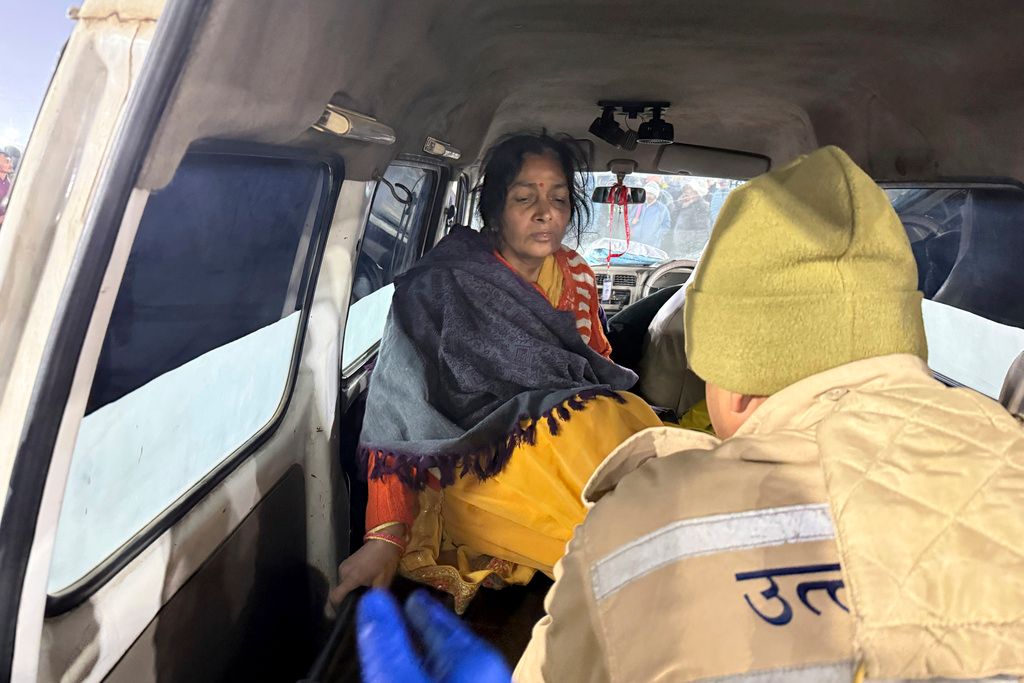
A woman injured in a stampede is helped into an ambulance by the banks of the Sangam, the confluence of the Ganges, the Yamuna and the mythical Saraswati rivers, on Mauni Amavasya' or new moon day during the Maha Kumbh festival, in Prayagraj, Uttar Pradesh, India, Wednesday, Jan. 29, 2025. (AP Photo/Rajesh Kumar Singh)

PRAYAGRAJ, India (AP) — Several people were feared dead and many more injured in a stampede early Wednesday as tens of thousands of Hindus rushed to take a holy bath in the river at the massive Maha Kumbh festival in northern India 's Prayagraj city, local media reported.

Distressed families lined up outside a makeshift hospital inquiring about their missing relatives, rescuers were helping the injured and police tried to manage the crowds.

People's belongings like clothes, blankets and backpacks were strewn around the scene of the stampede. It was not immediately clear what triggered the panic or how many people had been hurt. Some local news websites said 10 people had died.

Wednesday was a sacred day during the six-week festival, and authorities were expecting a record 100 million devotees to engage in a ritual bath at the confluence of the Ganges, the Yamuna and the mythical Saraswati rivers. The ritualistic bathing's main draw are thousands of ash-smeared Hindu ascetics who arrive in massive processions towards the confluence to take a holy dip in the waters.

The incident did not appear to have deterred millions of Hindu pilgrims who continued to throng the site even as police officials urged them over megaphones to keep away from the confluence.

Yogi Adityanath, chief minister of the Uttar Pradesh state, also urged people to not head towards the confluence and instead take baths at other riverbanks. Adityanath, in a post on social platform X, did not make any reference to the stampede but warned people not to "pay attention to any rumors."

The Maha Kumbh festival, held every 12 years, started on Jan. 13 and is the world's largest religious gathering. Authorities expect more than 400 million people to throng the pilgrimage site in total.

Hindus believe that a dip at the confluence of three rivers — two worldly and one mythical — will cleanse them of their past sins and end their process of reincarnation.

Indian authorities have touted the festival as the world's largest religious gathering. Nearly 150 million people have already attended the festival, including the likes of Defense Minister Rajnath Singh and Home Minister Amit Shah and celebrities like Coldplay's Chris Martin.

Authorities built a sprawling tent city on the riverbanks to accommodate visitors. It has 3,000 kitchens and 150,000 toilets, plus roads, electricity and water, communication towers and 11 hospitals.

About 50,000 security personnel are stationed in the city to maintain law and order and manage crowds. Authorities also installed more than 2,500 cameras, some powered by AI, to send crowd movement and density information to four central control rooms, where officials can quickly deploy personnel to avoid stampedes.

In 2013, at least 40 pilgrims who were taking part in the same festival were killed in a stampede at a train station in Prayagraj.

Deadly stampedes are relatively common around Indian religious festivals, where large crowds gather in small areas with shoddy infrastructure and few safety measures. In July at least 116 people died, most of them women and children, when thousands at a religious gathering in northern India stampeded at a tent in Hathras town.


Related Tags

World news
ADVERTISEMENT
.most-popular .layout-ratio{ padding-bottom: 79.13%; } @media (min-width: 768px) and (max-width: 1024px) { .widget-title { font-size: 15px !important; } }

{{ articles_filter_1561_widget.title }}

.most-popular .layout-ratio{ padding-bottom: 79.13%; } @media (min-width: 768px) and (max-width: 1024px) { .widget-title { font-size: 15px !important; } }

{{ articles_filter_1562_widget.title }}

.most-popular .layout-ratio{ padding-bottom: 79.13%; } @media (min-width: 768px) and (max-width: 1024px) { .widget-title { font-size: 15px !important; } }

{{ articles_filter_1563_widget.title }}

{{ articles_filter_1564_widget.title }}

.mb-article-details { position: relative; } .mb-article-details .article-body-preview, .mb-article-details .article-body-summary{ font-size: 17px; line-height: 30px; font-family: "Libre Caslon Text", serif; color: #000; } .mb-article-details .article-body-preview iframe , .mb-article-details .article-body-summary iframe{ width: 100%; margin: auto; } .read-more-background { background: linear-gradient(180deg, color(display-p3 1.000 1.000 1.000 / 0) 13.75%, color(display-p3 1.000 1.000 1.000 / 0.8) 30.79%, color(display-p3 1.000 1.000 1.000) 72.5%); position: absolute; height: 200px; width: 100%; bottom: 0; display: flex; justify-content: center; align-items: center; padding: 0; } .read-more-background a{ color: #000; } .read-more-btn { padding: 17px 45px; font-family: Inter; font-weight: 700; font-size: 18px; line-height: 16px; text-align: center; vertical-align: middle; border: 1px solid black; background-color: white; } .hidden { display: none; }
function initializeAllSwipers() { // Get all hidden inputs with cms_article_id document.querySelectorAll('[id^="cms_article_id_"]').forEach(function (input) { const cmsArticleId = input.value; const articleSelector = '#article-' + cmsArticleId + ' .body_images'; const swiperElement = document.querySelector(articleSelector); if (swiperElement && !swiperElement.classList.contains('swiper-initialized')) { new Swiper(articleSelector, { loop: true, pagination: false, navigation: { nextEl: '#article-' + cmsArticleId + ' .swiper-button-next', prevEl: '#article-' + cmsArticleId + ' .swiper-button-prev', }, }); } }); } setTimeout(initializeAllSwipers, 3000); const intersectionObserver = new IntersectionObserver( (entries) => { entries.forEach((entry) => { if (entry.isIntersecting) { const newUrl = entry.target.getAttribute("data-url"); if (newUrl) { history.pushState(null, null, newUrl); let article = entry.target; // Extract metadata const author = article.querySelector('.author-section').textContent.replace('By', '').trim(); const section = article.querySelector('.section-info ').textContent.replace(' ', ' '); const title = article.querySelector('.article-title h1').textContent; // Parse URL for Chartbeat path format const parsedUrl = new URL(newUrl, window.location.origin); const cleanUrl = parsedUrl.host + parsedUrl.pathname; // Update Chartbeat configuration if (typeof window._sf_async_config !== 'undefined') { window._sf_async_config.path = cleanUrl; window._sf_async_config.sections = section; window._sf_async_config.authors = author; } // Track virtual page view with Chartbeat if (typeof pSUPERFLY !== 'undefined' && typeof pSUPERFLY.virtualPage === 'function') { try { pSUPERFLY.virtualPage({ path: cleanUrl, title: title, sections: section, authors: author }); } catch (error) { console.error('ping error', error); } } // Optional: Update document title if (title && title !== document.title) { document.title = title; } } } }); }, { threshold: 0.1 } ); function showArticleBody(button) { const article = button.closest("article"); const summary = article.querySelector(".article-body-summary"); const body = article.querySelector(".article-body-preview"); const readMoreSection = article.querySelector(".read-more-background"); // Hide summary and read-more section summary.style.display = "none"; readMoreSection.style.display = "none"; // Show the full article body body.classList.remove("hidden"); } document.addEventListener("DOMContentLoaded", () => { let loadCount = 0; // Track how many times articles are loaded const offset = [1, 2, 3, 4, 5, 6, 7, 8, 9, 10]; // Offset values const currentUrl = window.location.pathname.substring(1); let isLoading = false; // Prevent multiple calls if (!currentUrl) { console.log("Current URL is invalid."); return; } const sentinel = document.getElementById("load-more-sentinel"); if (!sentinel) { console.log("Sentinel element not found."); return; } function isSentinelVisible() { const rect = sentinel.getBoundingClientRect(); return ( rect.top < window.innerHeight && rect.bottom >= 0 ); } function onScroll() { if (isLoading) return; if (isSentinelVisible()) { if (loadCount >= offset.length) { console.log("Maximum load attempts reached."); window.removeEventListener("scroll", onScroll); return; } isLoading = true; const currentOffset = offset[loadCount]; window.loadMoreItems().then(() => { let article = document.querySelector('#widget_1690 > div:nth-last-of-type(2) article'); intersectionObserver.observe(article) loadCount++; }).catch(error => { console.error("Error loading more items:", error); }).finally(() => { isLoading = false; }); } } window.addEventListener("scroll", onScroll); });

Sign up by email to receive news.