

ADVERTISEMENT

At 37, Djokovic vows to strive for more after latest injury

Published Jan 25, 2025 07:06 am

At A Glance

  • "I'll keep going. I'll keep striving to win more Slams," Djokovic said. "And as long as I feel that I want to put up with all of this, I'll be around."

MELBOURNE, Australia (AP) — It could be tempting to write off Novak Djokovic at this point, to think he might be closer than ever to being done competing for Grand Slam titles and closer than ever to retirement, where his greatest on-court rivals — Roger Federer, Rafael Nadal and Andy Murray — already reside.
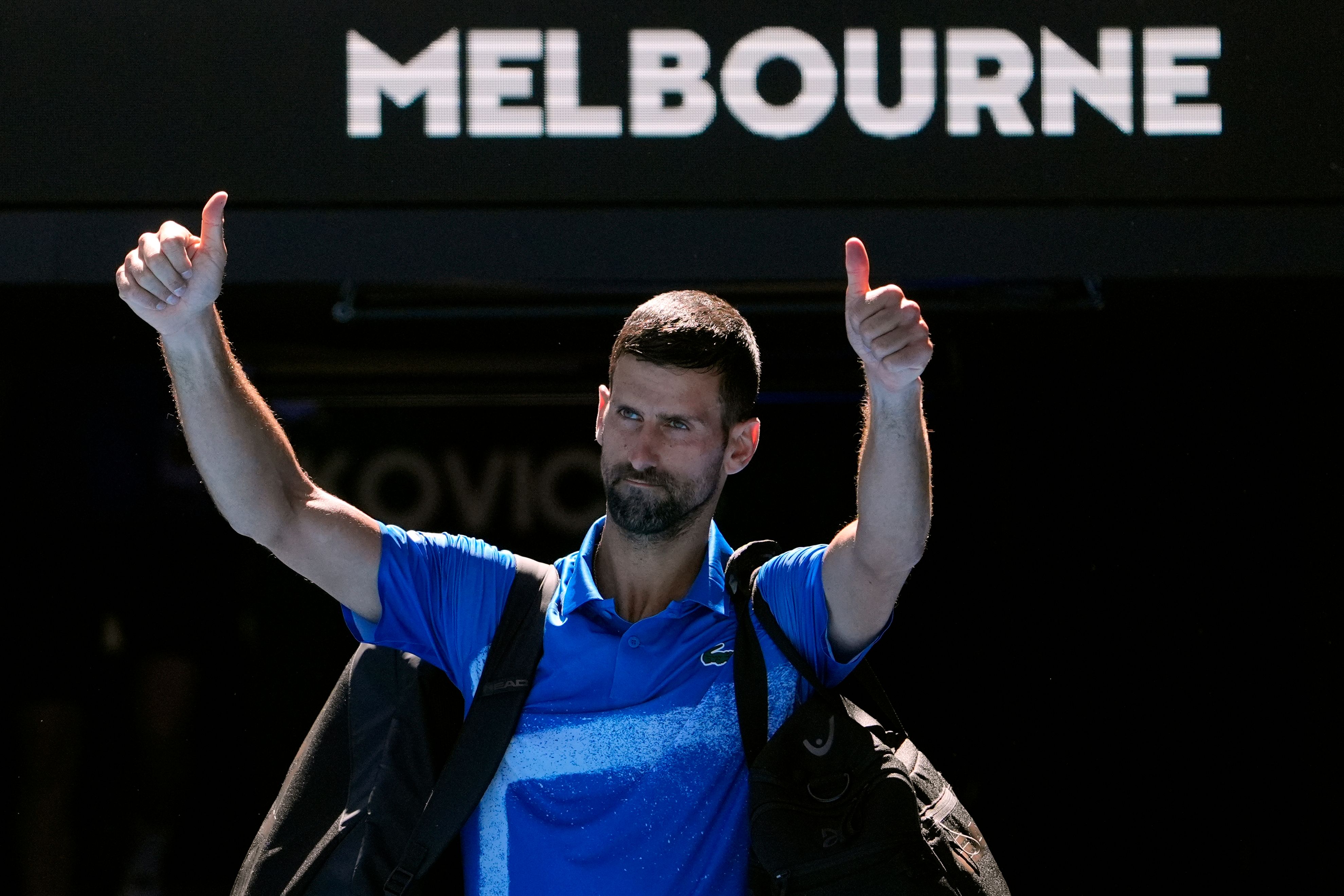
AP25024187578400 (1).jpg
Serbia's Novak Djokovic (AP)

Perhaps those sorts of thoughts are natural in the immediate aftermath of Djokovic's exit from the Australian Open semifinals on Friday, Jan. 24, with a torn leg muscle. He was booed off the court when he quit right after dropping the first set against Alexander Zverev, an abrupt end to Djokovic's pursuit of an 11th trophy at Melbourne Park and an unprecedented 25th major championship overall.

It was the second time in the past four Slams that Djokovic needed to abandon his spot in the latter stages of the bracket. At last year's French Open, he tore the meniscus in his right knee during a fourth-round victory and withdrew before the quarterfinals, then needed surgery.

Also relevant to the conversation: Djokovic will turn 38 before this year's next major, which begins at Roland Garros in late May. That was Nadal's age when he closed his career in November. Murray, a week older than Djokovic, stopped playing last August (and coached Djokovic in Melbourne). Federer's last Grand Slam match came when he was 39, although he didn't announce he was done until the following year.

“How much of a worry is it? I don’t know. It’s not like I’m worrying, (when) approaching every Grand Slam now, whether I’m going to get injured or not. But statistics are against me in a way in the last couple of years,” he acknowledged. "So it is true that (I've been) getting injured quite a bit the last few years. I don’t know what exactly is the reason for that. Maybe several different factors."

What Djokovic said next is sure to make his fans happy and opponents wary.

“I’ll keep going. I’ll keep striving to win more Slams,” Djokovic said. “And as long as I feel that I want to put up with all of this, I’ll be around.”

Keep in mind that Djokovic got hurt late in the first set of his previous match, against 21-year-old Carlos Alcaraz, a four-time major champ who's been ranked No. 1. Despite that, Djokovic played well enough to erase a deficit and overcome Alcaraz in four sets.

Keep this in mind, too: Less than 1 1/2 months after last season's operation on his knee, Djokovic made it all the way to the final at Wimbledon, where he lost to Alcaraz. Three weeks after that, Djokovic made it all the way to the final at the Paris Olympics, where he beat Alcaraz to finally collect the gold medal he'd long wanted to bring home to Serbia.

Djokovic wasn’t able to give a timeline Friday for how long he’ll be sidelined now. He wasn't quite prepared to commit to returning to the Australian Open, either, when asked if this might have been his last appearance, saying: “There is a chance. Who knows? I’ll just have to see how the season goes. ... If I’m fit, healthy, motivated, I don’t see a reason why I wouldn’t come.”

There is plenty of evidence that it is a mistake to consider Djokovic done.

Still, there are going to be those who have doubts about Djokovic's health and longevity.

There already were such questions in some quarters, actually, no matter how nonsensical: On-air remarks by a commentator working for the host broadcaster about Djokovic being overrated and a has-been caused a stir during Week 1 of this Australian Open.

No one who knows anything about Djokovic or tennis would use those terms.

“Novak has done absolutely everything he could on the tennis court in the last 20 years,” said Zverev, who will be seeking his first Grand Slam title when he meets defending champion Jannik Sinner in Sunday's final at Rod Laver Arena.

“He’s won this tournament with an abdominal tear, where most players can’t even continue playing. He’s won this tournament with a hamstring tear,” Zverev said. “He's a 10-time champion. We should all just respect that, in a way, because there’s nobody in this sport’s history who has won, and who has done, as much as him.”

Related Tags

AUSTRALIAN OPEN Novak Djokovic
ADVERTISEMENT
.most-popular .layout-ratio{ padding-bottom: 79.13%; } @media (min-width: 768px) and (max-width: 1024px) { .widget-title { font-size: 15px !important; } }

{{ articles_filter_1561_widget.title }}

.most-popular .layout-ratio{ padding-bottom: 79.13%; } @media (min-width: 768px) and (max-width: 1024px) { .widget-title { font-size: 15px !important; } }

{{ articles_filter_1562_widget.title }}

.most-popular .layout-ratio{ padding-bottom: 79.13%; } @media (min-width: 768px) and (max-width: 1024px) { .widget-title { font-size: 15px !important; } }

{{ articles_filter_1563_widget.title }}

{{ articles_filter_1564_widget.title }}

.mb-article-details { position: relative; } .mb-article-details .article-body-preview, .mb-article-details .article-body-summary{ font-size: 17px; line-height: 30px; font-family: "Libre Caslon Text", serif; color: #000; } .mb-article-details .article-body-preview iframe , .mb-article-details .article-body-summary iframe{ width: 100%; margin: auto; } .read-more-background { background: linear-gradient(180deg, color(display-p3 1.000 1.000 1.000 / 0) 13.75%, color(display-p3 1.000 1.000 1.000 / 0.8) 30.79%, color(display-p3 1.000 1.000 1.000) 72.5%); position: absolute; height: 200px; width: 100%; bottom: 0; display: flex; justify-content: center; align-items: center; padding: 0; } .read-more-background a{ color: #000; } .read-more-btn { padding: 17px 45px; font-family: Inter; font-weight: 700; font-size: 18px; line-height: 16px; text-align: center; vertical-align: middle; border: 1px solid black; background-color: white; } .hidden { display: none; }
function initializeAllSwipers() { // Get all hidden inputs with cms_article_id document.querySelectorAll('[id^="cms_article_id_"]').forEach(function (input) { const cmsArticleId = input.value; const articleSelector = '#article-' + cmsArticleId + ' .body_images'; const swiperElement = document.querySelector(articleSelector); if (swiperElement && !swiperElement.classList.contains('swiper-initialized')) { new Swiper(articleSelector, { loop: true, pagination: false, navigation: { nextEl: '#article-' + cmsArticleId + ' .swiper-button-next', prevEl: '#article-' + cmsArticleId + ' .swiper-button-prev', }, }); } }); } setTimeout(initializeAllSwipers, 3000); const intersectionObserver = new IntersectionObserver( (entries) => { entries.forEach((entry) => { if (entry.isIntersecting) { const newUrl = entry.target.getAttribute("data-url"); if (newUrl) { history.pushState(null, null, newUrl); let article = entry.target; // Extract metadata const author = article.querySelector('.author-section').textContent.replace('By', '').trim(); const section = article.querySelector('.section-info ').textContent.replace(' ', ' '); const title = article.querySelector('.article-title h1').textContent; // Parse URL for Chartbeat path format const parsedUrl = new URL(newUrl, window.location.origin); const cleanUrl = parsedUrl.host + parsedUrl.pathname; // Update Chartbeat configuration if (typeof window._sf_async_config !== 'undefined') { window._sf_async_config.path = cleanUrl; window._sf_async_config.sections = section; window._sf_async_config.authors = author; } // Track virtual page view with Chartbeat if (typeof pSUPERFLY !== 'undefined' && typeof pSUPERFLY.virtualPage === 'function') { try { pSUPERFLY.virtualPage({ path: cleanUrl, title: title, sections: section, authors: author }); } catch (error) { console.error('ping error', error); } } // Optional: Update document title if (title && title !== document.title) { document.title = title; } } } }); }, { threshold: 0.1 } ); function showArticleBody(button) { const article = button.closest("article"); const summary = article.querySelector(".article-body-summary"); const body = article.querySelector(".article-body-preview"); const readMoreSection = article.querySelector(".read-more-background"); // Hide summary and read-more section summary.style.display = "none"; readMoreSection.style.display = "none"; // Show the full article body body.classList.remove("hidden"); } document.addEventListener("DOMContentLoaded", () => { let loadCount = 0; // Track how many times articles are loaded const offset = [1, 2, 3, 4, 5, 6, 7, 8, 9, 10]; // Offset values const currentUrl = window.location.pathname.substring(1); let isLoading = false; // Prevent multiple calls if (!currentUrl) { console.log("Current URL is invalid."); return; } const sentinel = document.getElementById("load-more-sentinel"); if (!sentinel) { console.log("Sentinel element not found."); return; } function isSentinelVisible() { const rect = sentinel.getBoundingClientRect(); return ( rect.top < window.innerHeight && rect.bottom >= 0 ); } function onScroll() { if (isLoading) return; if (isSentinelVisible()) { if (loadCount >= offset.length) { console.log("Maximum load attempts reached."); window.removeEventListener("scroll", onScroll); return; } isLoading = true; const currentOffset = offset[loadCount]; window.loadMoreItems().then(() => { let article = document.querySelector('#widget_1690 > div:nth-last-of-type(2) article'); intersectionObserver.observe(article) loadCount++; }).catch(error => { console.error("Error loading more items:", error); }).finally(() => { isLoading = false; }); } } window.addEventListener("scroll", onScroll); });

Sign up by email to receive news.