ADVERTISEMENT

India's navy launches submarine, warships to guard against China's presence in Indian Ocean

Published Jan 15, 2025 08:53 am

AP25015303445969.jpg

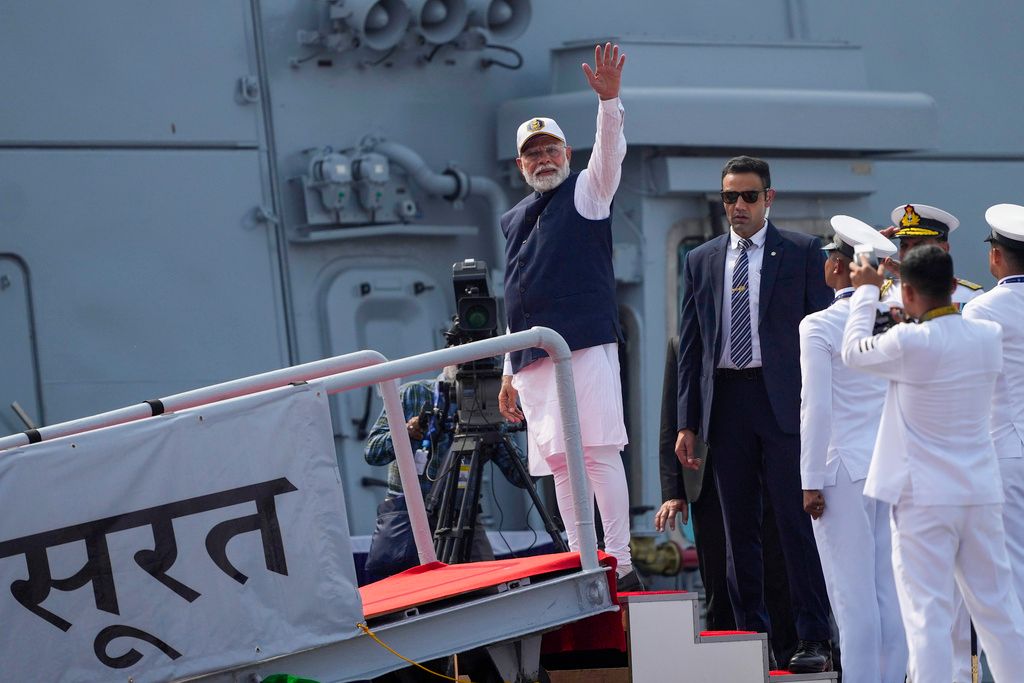
Indian Prime Minister Narendra Modi greets after the commissioning of INS Surat at a naval dockyard in Mumbai,, India, Wednesday, Jan. 15, 2025. (AP Photo/Rafiq Maqbool)


MUMBAI, India (AP) — India's navy on Wednesday simultaneously launched a submarine, a destroyer and a frigate built at a state-run shipyard, underscoring the importance of protecting the Indian Ocean region through which 95% of the country's trade moves amid a strong Chinese presence.

Defense Minister Rajnath Singh said that the Atlantic Ocean’s importance has shifted to the Indian Ocean region, which is becoming a center of international power rivalry.

“India is giving the biggest importance to making its navy powerful to protect its interests,” he said.

“The commissioning of three major naval combatants marks a significant leap forward in realizing India’s vision of becoming a global leader in defense manufacturing and maritime security,” Prime Minister Narendra Modi said while commissioning the vessels at the state-run Mazagon dockyard in Mumbai.

The situation in the Indian Ocean region is challenging with the Chinese navy, India’s main rival, growing exponentially, said Rahul Bedi, a defense analyst.

Bedi said that the INS Vagsheer submarine, the sixth among a French license-built Kalvari (Scorpene)-class conventional diesel-electric submarines, is aimed at replacing aging Indian underwater platforms and plugging serious capability gaps in existing ones. India now has a total of 16 submarines.

The P75 Scorpene submarine project represents India’s growing expertise in submarine construction in collaboration with the Naval Group of France, Bedi said.

India’s defense ministry is expected to conclude a deal for three additional Scorpene submarines to be built in India during Modi’s likely visit to Paris next month to attend the Artificial Intelligence Action Summit hosted by French President Emmanuel Macron.

However, the first of these boats, according to the Indian navy, is only likely to be commissioned by 2031.

India commissioned its first home-built aircraft carrier in 2022 to counter regional rival China’s much more extensive and growing fleet and expand its indigenous shipbuilding capabilities.

The INS Vikrant, whose name is a Sanskrit word for “powerful” or “courageous,” is India’s second operational aircraft carrier. It joins the Soviet-era INS Vikramaditya, which India purchased from Russia in 2004 to defend the Indian Ocean and Bay of Bengal.

Related Tags

WORLDNEWS
ADVERTISEMENT
.most-popular .layout-ratio{ padding-bottom: 79.13%; } @media (min-width: 768px) and (max-width: 1024px) { .widget-title { font-size: 15px !important; } }

{{ articles_filter_1561_widget.title }}

.most-popular .layout-ratio{ padding-bottom: 79.13%; } @media (min-width: 768px) and (max-width: 1024px) { .widget-title { font-size: 15px !important; } }

{{ articles_filter_1562_widget.title }}

.most-popular .layout-ratio{ padding-bottom: 79.13%; } @media (min-width: 768px) and (max-width: 1024px) { .widget-title { font-size: 15px !important; } }

{{ articles_filter_1563_widget.title }}

{{ articles_filter_1564_widget.title }}

.mb-article-details { position: relative; } .mb-article-details .article-body-preview, .mb-article-details .article-body-summary{ font-size: 17px; line-height: 30px; font-family: "Libre Caslon Text", serif; color: #000; } .mb-article-details .article-body-preview iframe , .mb-article-details .article-body-summary iframe{ width: 100%; margin: auto; } .read-more-background { background: linear-gradient(180deg, color(display-p3 1.000 1.000 1.000 / 0) 13.75%, color(display-p3 1.000 1.000 1.000 / 0.8) 30.79%, color(display-p3 1.000 1.000 1.000) 72.5%); position: absolute; height: 200px; width: 100%; bottom: 0; display: flex; justify-content: center; align-items: center; padding: 0; } .read-more-background a{ color: #000; } .read-more-btn { padding: 17px 45px; font-family: Inter; font-weight: 700; font-size: 18px; line-height: 16px; text-align: center; vertical-align: middle; border: 1px solid black; background-color: white; } .hidden { display: none; }
function initializeAllSwipers() { // Get all hidden inputs with cms_article_id document.querySelectorAll('[id^="cms_article_id_"]').forEach(function (input) { const cmsArticleId = input.value; const articleSelector = '#article-' + cmsArticleId + ' .body_images'; const swiperElement = document.querySelector(articleSelector); if (swiperElement && !swiperElement.classList.contains('swiper-initialized')) { new Swiper(articleSelector, { loop: true, pagination: false, navigation: { nextEl: '#article-' + cmsArticleId + ' .swiper-button-next', prevEl: '#article-' + cmsArticleId + ' .swiper-button-prev', }, }); } }); } setTimeout(initializeAllSwipers, 3000); const intersectionObserver = new IntersectionObserver( (entries) => { entries.forEach((entry) => { if (entry.isIntersecting) { const newUrl = entry.target.getAttribute("data-url"); if (newUrl) { history.pushState(null, null, newUrl); let article = entry.target; // Extract metadata const author = article.querySelector('.author-section').textContent.replace('By', '').trim(); const section = article.querySelector('.section-info ').textContent.replace(' ', ' '); const title = article.querySelector('.article-title h1').textContent; // Parse URL for Chartbeat path format const parsedUrl = new URL(newUrl, window.location.origin); const cleanUrl = parsedUrl.host + parsedUrl.pathname; // Update Chartbeat configuration if (typeof window._sf_async_config !== 'undefined') { window._sf_async_config.path = cleanUrl; window._sf_async_config.sections = section; window._sf_async_config.authors = author; } // Track virtual page view with Chartbeat if (typeof pSUPERFLY !== 'undefined' && typeof pSUPERFLY.virtualPage === 'function') { try { pSUPERFLY.virtualPage({ path: cleanUrl, title: title, sections: section, authors: author }); } catch (error) { console.error('ping error', error); } } // Optional: Update document title if (title && title !== document.title) { document.title = title; } } } }); }, { threshold: 0.1 } ); function showArticleBody(button) { const article = button.closest("article"); const summary = article.querySelector(".article-body-summary"); const body = article.querySelector(".article-body-preview"); const readMoreSection = article.querySelector(".read-more-background"); // Hide summary and read-more section summary.style.display = "none"; readMoreSection.style.display = "none"; // Show the full article body body.classList.remove("hidden"); } document.addEventListener("DOMContentLoaded", () => { let loadCount = 0; // Track how many times articles are loaded const offset = [1, 2, 3, 4, 5, 6, 7, 8, 9, 10]; // Offset values const currentUrl = window.location.pathname.substring(1); let isLoading = false; // Prevent multiple calls if (!currentUrl) { console.log("Current URL is invalid."); return; } const sentinel = document.getElementById("load-more-sentinel"); if (!sentinel) { console.log("Sentinel element not found."); return; } function isSentinelVisible() { const rect = sentinel.getBoundingClientRect(); return ( rect.top < window.innerHeight && rect.bottom >= 0 ); } function onScroll() { if (isLoading) return; if (isSentinelVisible()) { if (loadCount >= offset.length) { console.log("Maximum load attempts reached."); window.removeEventListener("scroll", onScroll); return; } isLoading = true; const currentOffset = offset[loadCount]; window.loadMoreItems().then(() => { let article = document.querySelector('#widget_1690 > div:nth-last-of-type(2) article'); intersectionObserver.observe(article) loadCount++; }).catch(error => { console.error("Error loading more items:", error); }).finally(() => { isLoading = false; }); } } window.addEventListener("scroll", onScroll); });

Sign up by email to receive news.