






 World
India kicks off a massive Hindu festival touted as the world's largest religious gathering
World
India kicks off a massive Hindu festival touted as the world's largest religious gathering
India kicks off a massive Hindu festival touted as the world's largest religious gathering


PRAYAGRAJ, India (AP) — Millions of Hindu devotees, mystics and holy men and women from all across India flocked to the northern city of Prayagraj on Monday to kickstart the Maha Kumbh festival, which is being touted as the world's largest religious gathering.
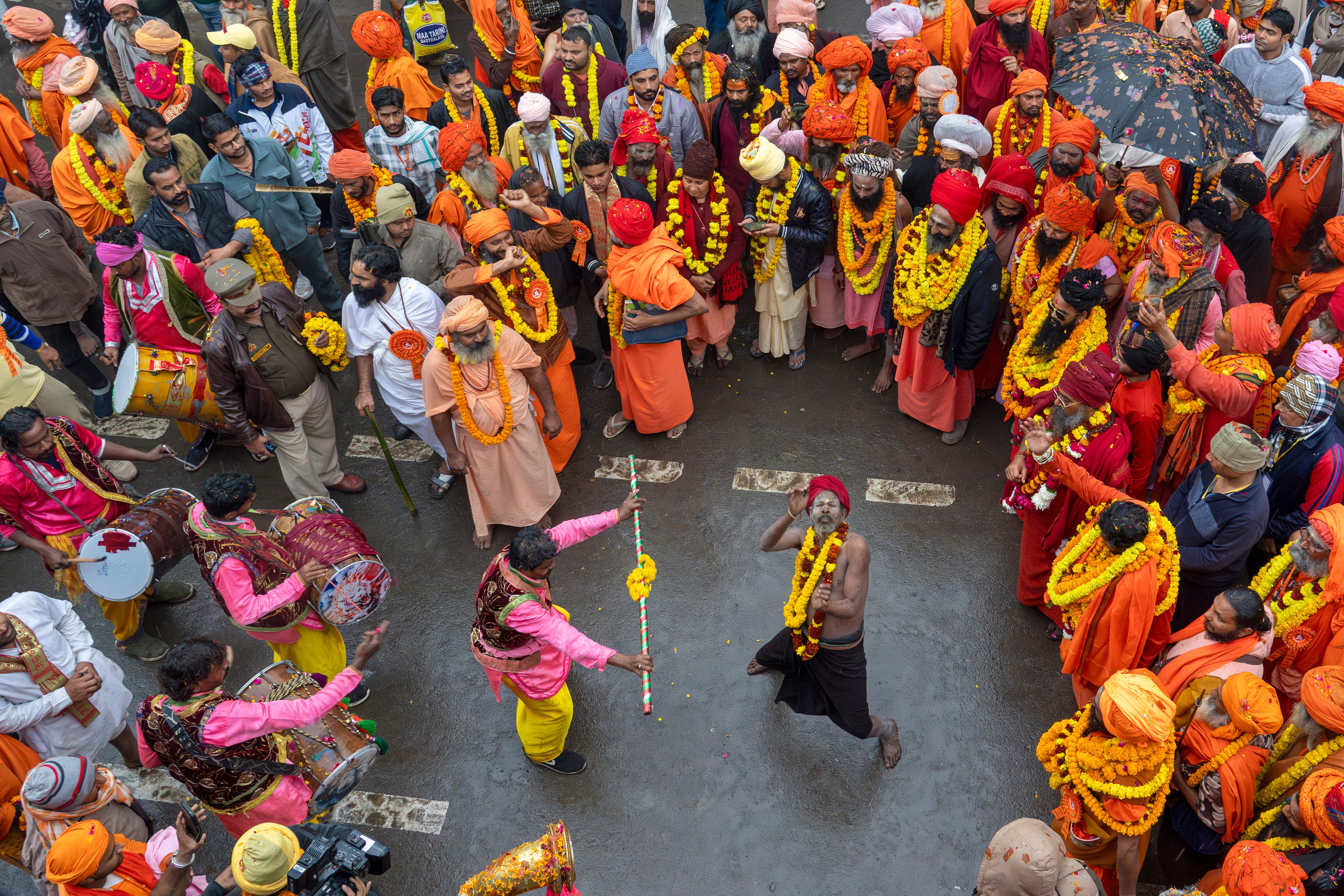
An ascetic dances with another as Hindu holy man walk in a procession, a day before the 45-day-long Maha Kumbh festival, in Prayagraj, India, Sunday, Jan. 12, 2025. (AP Photo/Ashwini Bhatia)
Over about the next six weeks, Hindu pilgrims will gather at the confluence of three sacred rivers — the Ganges, the Yamuna and the mythical Saraswati — where they will take part in elaborate rituals, hoping to begin a journey to achieve Hindu philosophy’s ultimate goal: the release from the cycle of rebirth.
Here’s what to know about the festival:
A religious gathering at the confluence of three sacred rivers
Hindus venerate rivers, and none more so than the Ganges and the Yamuna. The faithful believe that a dip in their waters will cleanse them of their past sins and end their process of reincarnation, particularly on auspicious days. The most propitious of these days occur in cycles of 12 years during a festival called the Maha Kumbh Mela, or pitcher festival.
The festival is a series of ritual baths by Hindu sadhus, or holy men, and other pilgrims at the confluence of three sacred rivers that dates to at least medieval times. Hindus believe that the mythical Saraswati river once flowed from the Himalayas through Prayagraj, meeting there with the Ganges and the Yamuna.
Bathing takes place every day, but on the most auspicious dates, naked, ash-smeared monks charge toward the holy rivers at dawn. Many pilgrims stay for the entire festival, observing austerity, giving alms and bathing at sunrise every day.
“We feel peaceful here and attain salvation from the cycles of life and death,” said Bhagwat Prasad Tiwari, a pilgrim.
The festival has its roots in a Hindu tradition that says the god Vishnu wrested a golden pitcher containing the nectar of immortality from demons. Hindus believe that a few drops fell in the cities of Prayagraj, Nasik, Ujjain and Haridwar — the four places where the Kumbh festival has been held for centuries.
The Kumbh rotates among these four pilgrimage sites about every three years on a date prescribed by astrology. This year’s festival is the biggest and grandest of them all. A smaller version of the festival, called Ardh Kumbh, or Half Kumbh, was organized in 2019, when 240 million visitors were recorded, with about 50 million taking a ritual bath on the busiest day.
Maha Kumb is the world's largest such gathering
At least 400 million people — more than the population of the United States — are expected in Prayagraj over the next 45 days, according to officials. That is around 200 times the 2 million pilgrims that arrived in the Muslim holy cities of Mecca and Medina in Saudi Arabia for the annual Hajj pilgrimage last year.
The festival is a big test for Indian authorities to showcase the Hindu religion, tourism and crowd management.
A vast ground along the banks of the rivers has been converted into a sprawling tent city equipped with more 3,000 kitchens and 150,000 restrooms. Divided into 25 sections and spreading over 40 square kilometers (15 square miles), the tent city also has housing, roads, electricity and water, communication towers and 11 hospitals. Murals depicting stories from Hindu scriptures are painted on the city walls.
Indian Railways has also introduced more than 90 special trains that will make nearly 3,300 trips during the festival to transport devotees, beside regular trains.
About 50,000 security personnel — a 50% increase from 2019 — are also stationed in the city to maintain law and order and crowd management. More than 2,500 cameras, some powered by AI, will send crowd movement and density information to four central control rooms, where officials can quickly deploy personnel to avoid stampedes.
The festival will boost Modi's support base
India’s past leaders have capitalized on the festival to strengthen their relationship with the country’s Hindus, who make up nearly 80% of India’s more than 1.4 billion people. But under Prime Minister Narendra Modi, the festival has become an integral part of its advocacy of Hindu nationalism. For Modi and his party, Indian civilization is inseparable from Hinduism, although critics say the party's philosophy is rooted in Hindu supremacy.
The Uttar Pradesh state, headed by Adityanath — a powerful Hindu monk and a popular hard-line Hindu politician in Modi’s party — has allocated more than $765 million for this year’s event. It has also used the festival to boost his and the prime minister’s image, with giant billboards and posters all over the city showing them both, alongside slogans touting their government welfare policies.
The festival is expected to boost the ruling Hindu nationalist Bharatiya Janata Party’s past record of promoting Hindu cultural symbols for its support base. But recent Kumbh gatherings have also been caught in controversies.
Modi's government changed the city’s Mughal-era name from Allahabad to Prayagraj as part of its Muslim-to-Hindu name-changing effort nationwide ahead of the 2019 festival and the national election that his party won. In 2021, his government refused to call off the festival in Haridwar despite a surge in coronavirus cases, fearing a backlash from religious leaders in the Hindu-majority country.