ADVERTISEMENT

Families in shock begin to visit their charred homes in Los Angeles area

Published Jan 10, 2025 10:29 pm
IMG_6920.jpeg
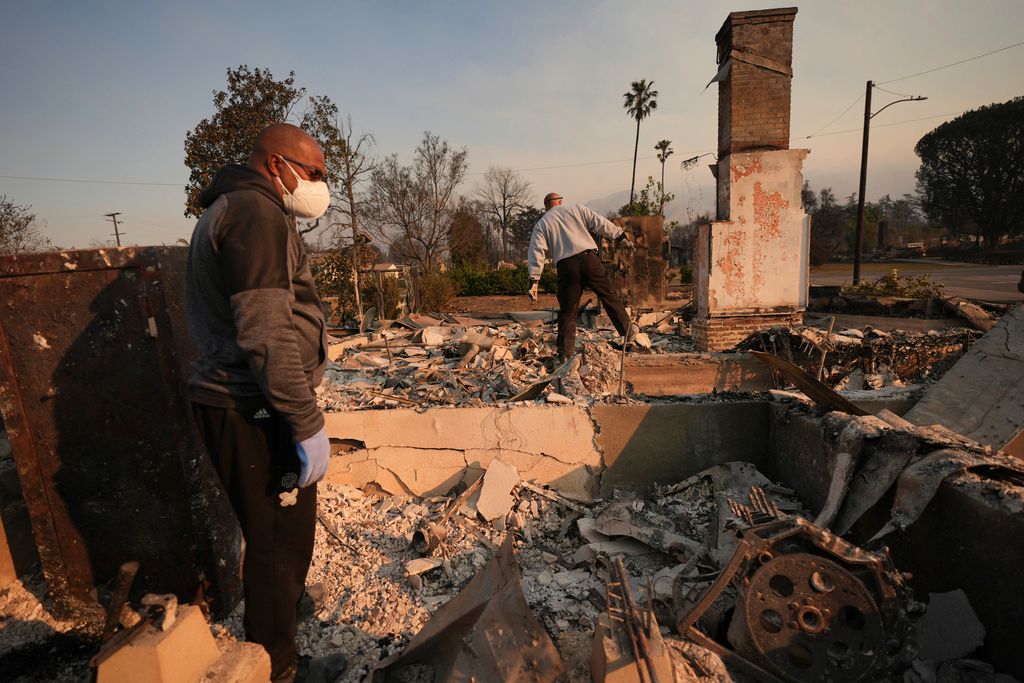
Kenneth Snowden, left, surveys the damage to his fire-ravaged property with his brother Ronnie in the aftermath of the Eaton Fire Friday, Jan. 10, 2025 in Altadena, Calif. (AP Photo/Jae C. Hong)

LOS ANGELES (AP) — Many watched their homes burn on television in a state of shock.

Now four days since the flames erupted in and around Los Angeles, many residents have returned to their still smoldering neighborhoods even as the threat of new fires persisted and the nation's second- largest city remained unsettled. For some it was a first look at the staggering reality of what was lost as the region grapples with the gargantuan challenge of overcoming the disaster and rebuilding.

Metropolitan LA and its 13 million residents, who haven’t seen rain in more than eight months, woke up Friday to another day of strong winds that later eased, enabling firefighters to start gaining some control of the biggest blazes.

Bridget Berg, who was at work when she saw on TV her house in Altadena erupt in flames, came back for the first time with her family on Thursday “just to make it real.”

Their feet crunched across the broken bits covering what had been their home for 16 years.

Her kids sifted through debris on the sidewalk, finding a clay pot and a few keepsakes as they searched for Japanese wood prints they hoped to recover. Her husband pulled his hand out of rubble near the still-standing fireplace, holding up a piece of petrified wood handed down by his grandmother.

“It’s OK. It’s OK,” Berg said as she took stock of the destruction, describing the deck and pool from which her family watched fireworks. “It’s not like we just lost our house — everybody lost their house.”

The fires have burned more than 12,000 homes and other structures since Tuesday, when they first began popping up around a densely populated, 25-mile (40-kilometer) expanse north of downtown Los Angeles. No cause has been identified yet for the largest fires.

At least 10 people have been killed and officials said they expected that number to rise as cadaver dogs go through leveled neighborhoods to assess the devastation to an area larger than San Francisco. Officials on Friday set up a center where people could report those missing. Roughly 150,000 people remained under evacuation orders, and the fires have consumed about 56 square miles (145 square kilometers).

The disaster took homes from everyone — from waiters to movie stars. The government has not yet released figures on the cost of the damage, but private firms have estimated it will climb into the tens of billions.

The flames hit schools, churches, a synagogue, libraries, boutiques, bars, restaurants, banks and local landmarks like the Will Rogers’ Western Ranch House and a Queen Anne-style mansion in Altadena that dated back to 1887 and was commissioned for wealthy map-maker Andrew McNally.

In some neighborhoods, hydrants ran dry and the water system buckled. Gov. Gavin Newsom on Friday ordered an investigation into the loss of water pressure.

Firefighters for the first time made progress containing the Eaton Fire north of Pasadena, officials said Friday. It started Tuesday night and has burned more than 7,000 structures, a term that includes homes, apartment buildings, businesses, outbuildings and vehicles.

To the west, the fire in Pacific Palisades, the largest burning in the LA area, has destroyed over 5,300 structures. The blaze is already the most destructive in Los Angeles’ history.

LA Mayor Karen Bass, who faces a critical test of her leadership as her city endures its greatest crisis in decades, said Friday that firefighters had contained several smaller fires in the past 24 hours.

California National Guard troops arrived on the streets of Altadena before dawn Friday to help protect property in the fire evacuation zone and evening curfews were set to begin in those areas to prevent looting after several earlier arrests.

The level of devastation is jarring even in a state that has grown used to massive wildfires. Dozens of blocks of scenic Pacific Palisades were flattened to smoldering rubble. In neighboring Malibu, where oceanfront homes once stood, all that was left above the debris were blackened palm strands.

Anna Yeager said she and her husband agonized over going back to their beloved Altadena neighborhood near Pasadena after fleeing Tuesday night with their 6-year old daughter and 3-year-old son, their two dogs and a few extra clothes. A neighbor told them their house was gone.

Now she regrets not grabbing her children’s artwork, her husband’s treasured cookbooks, family photos, and jewelry from both her mom who died in 2012 and her husband’s grandmother who survived Auschwitz.

When the couple returned, it was only “chimney after chimney. Power lines everywhere. Fires still going everywhere” she said, adding that when they walked up to their home “it was just dust.”

There were remnants of the front porch where she had photographed her children nearly daily since 2020 and had planned to keep doing that until they reached high school. That gave her hope.

“The porch is still there and it’s to me, it’s a sign to rebuild and not leave,” she said. “You know, it’s like saying, ‘Hey, I’m still here. You can still do this.’”

Yeager’s neighborhood of Tudor homes was planning to celebrate its 100th anniversary in May.

“You build a world for yourself and your family, and you feel safe in that world and things like this happen that you cannot control,” she said. “And that’s the way it goes. It’s devastating.

Related Tags

World news
ADVERTISEMENT
.most-popular .layout-ratio{ padding-bottom: 79.13%; } @media (min-width: 768px) and (max-width: 1024px) { .widget-title { font-size: 15px !important; } }

{{ articles_filter_1561_widget.title }}

.most-popular .layout-ratio{ padding-bottom: 79.13%; } @media (min-width: 768px) and (max-width: 1024px) { .widget-title { font-size: 15px !important; } }

{{ articles_filter_1562_widget.title }}

.most-popular .layout-ratio{ padding-bottom: 79.13%; } @media (min-width: 768px) and (max-width: 1024px) { .widget-title { font-size: 15px !important; } }

{{ articles_filter_1563_widget.title }}

{{ articles_filter_1564_widget.title }}

.mb-article-details { position: relative; } .mb-article-details .article-body-preview, .mb-article-details .article-body-summary{ font-size: 17px; line-height: 30px; font-family: "Libre Caslon Text", serif; color: #000; } .mb-article-details .article-body-preview iframe , .mb-article-details .article-body-summary iframe{ width: 100%; margin: auto; } .read-more-background { background: linear-gradient(180deg, color(display-p3 1.000 1.000 1.000 / 0) 13.75%, color(display-p3 1.000 1.000 1.000 / 0.8) 30.79%, color(display-p3 1.000 1.000 1.000) 72.5%); position: absolute; height: 200px; width: 100%; bottom: 0; display: flex; justify-content: center; align-items: center; padding: 0; } .read-more-background a{ color: #000; } .read-more-btn { padding: 17px 45px; font-family: Inter; font-weight: 700; font-size: 18px; line-height: 16px; text-align: center; vertical-align: middle; border: 1px solid black; background-color: white; } .hidden { display: none; }
function initializeAllSwipers() { // Get all hidden inputs with cms_article_id document.querySelectorAll('[id^="cms_article_id_"]').forEach(function (input) { const cmsArticleId = input.value; const articleSelector = '#article-' + cmsArticleId + ' .body_images'; const swiperElement = document.querySelector(articleSelector); if (swiperElement && !swiperElement.classList.contains('swiper-initialized')) { new Swiper(articleSelector, { loop: true, pagination: false, navigation: { nextEl: '#article-' + cmsArticleId + ' .swiper-button-next', prevEl: '#article-' + cmsArticleId + ' .swiper-button-prev', }, }); } }); } setTimeout(initializeAllSwipers, 3000); const intersectionObserver = new IntersectionObserver( (entries) => { entries.forEach((entry) => { if (entry.isIntersecting) { const newUrl = entry.target.getAttribute("data-url"); if (newUrl) { history.pushState(null, null, newUrl); let article = entry.target; // Extract metadata const author = article.querySelector('.author-section').textContent.replace('By', '').trim(); const section = article.querySelector('.section-info ').textContent.replace(' ', ' '); const title = article.querySelector('.article-title h1').textContent; // Parse URL for Chartbeat path format const parsedUrl = new URL(newUrl, window.location.origin); const cleanUrl = parsedUrl.host + parsedUrl.pathname; // Update Chartbeat configuration if (typeof window._sf_async_config !== 'undefined') { window._sf_async_config.path = cleanUrl; window._sf_async_config.sections = section; window._sf_async_config.authors = author; } // Track virtual page view with Chartbeat if (typeof pSUPERFLY !== 'undefined' && typeof pSUPERFLY.virtualPage === 'function') { try { pSUPERFLY.virtualPage({ path: cleanUrl, title: title, sections: section, authors: author }); } catch (error) { console.error('ping error', error); } } // Optional: Update document title if (title && title !== document.title) { document.title = title; } } } }); }, { threshold: 0.1 } ); function showArticleBody(button) { const article = button.closest("article"); const summary = article.querySelector(".article-body-summary"); const body = article.querySelector(".article-body-preview"); const readMoreSection = article.querySelector(".read-more-background"); // Hide summary and read-more section summary.style.display = "none"; readMoreSection.style.display = "none"; // Show the full article body body.classList.remove("hidden"); } document.addEventListener("DOMContentLoaded", () => { let loadCount = 0; // Track how many times articles are loaded const offset = [1, 2, 3, 4, 5, 6, 7, 8, 9, 10]; // Offset values const currentUrl = window.location.pathname.substring(1); let isLoading = false; // Prevent multiple calls if (!currentUrl) { console.log("Current URL is invalid."); return; } const sentinel = document.getElementById("load-more-sentinel"); if (!sentinel) { console.log("Sentinel element not found."); return; } function isSentinelVisible() { const rect = sentinel.getBoundingClientRect(); return ( rect.top < window.innerHeight && rect.bottom >= 0 ); } function onScroll() { if (isLoading) return; if (isSentinelVisible()) { if (loadCount >= offset.length) { console.log("Maximum load attempts reached."); window.removeEventListener("scroll", onScroll); return; } isLoading = true; const currentOffset = offset[loadCount]; window.loadMoreItems().then(() => { let article = document.querySelector('#widget_1690 > div:nth-last-of-type(2) article'); intersectionObserver.observe(article) loadCount++; }).catch(error => { console.error("Error loading more items:", error); }).finally(() => { isLoading = false; }); } } window.addEventListener("scroll", onScroll); });

Sign up by email to receive news.