







Davao Occidental town suffering from substandard road projects
Published Sep 30, 2025 02:41 pm


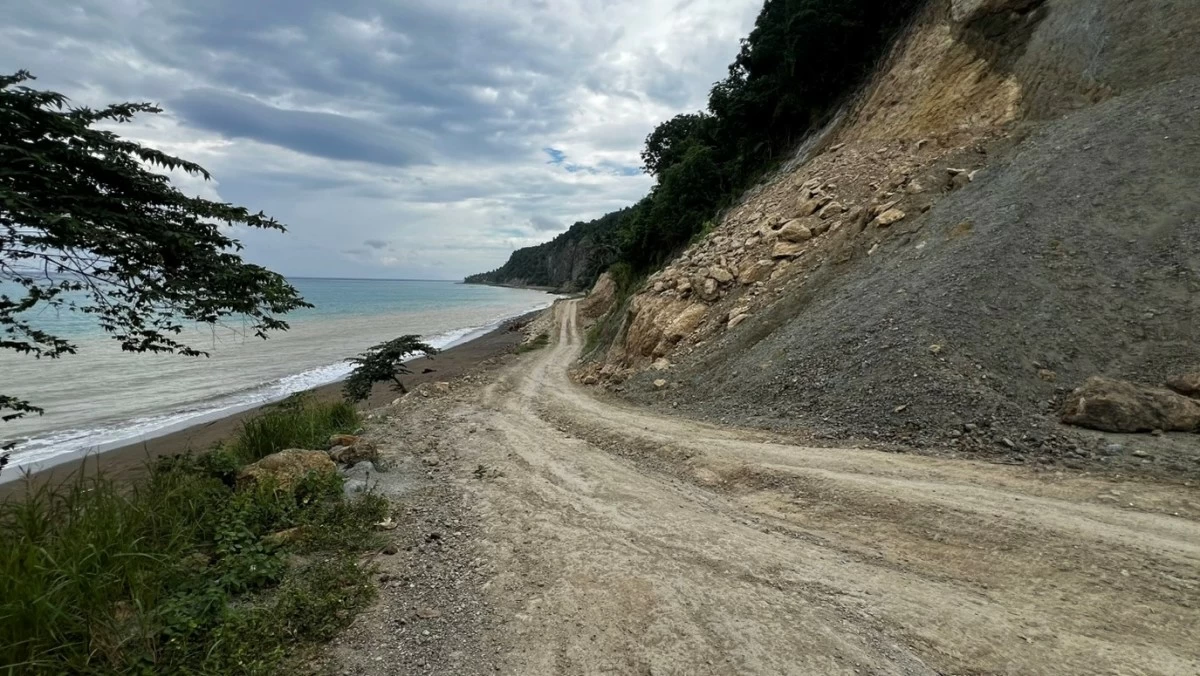
CAYAPONGA-Malalan Bypass Road in Jose Abad Santos, Davao Occidental photo taken on July 22, 2025. (Photo courtesy of NEDA RDC-11)
DAVAO CITY – The mayor of Jose Abad Santos town, Davao Occidental province where a ghost flood control project was discovered last week has lamented that alleged substandard road projects have contributed to the sluggish progress of the coastal municipality.
These had an adverse impact on the local government’s delivery of basic services, education and economy of the remote town locally known by its acronym JAS.
On Sept. 25, Department of Public Works and Highways Secretary Vince Dizon and then Independent Commission for Infrastructure (ICI) Special Adviser Baguio City Mayor Benjamin Magalong discovered an alleged P96-million ghost flood control project in Barangay Culaman implemented by controversial Discaya-owned Saint Timothy Construction Corp.
On the same day, Mayor Jason John Joyce hinted in his Facebook page that there are still some ghost projects and substandard road projects in his municipality.
Joyce lamented that poor road conditions have a domino effect in the local economy and daily life of the people in the coastal town.
“The poor road conditions have affected our freedom of movement,” he told Manila Bulletin in an interview on Monday, Sept. 29.
The mayor added that many of his constituents who are studying or working in other places would only come home once a year because of the expensive fares and bad road conditions.
He said the most common mode of public transportation going to JAS is a pickup truck with a fare of P1,500 per person.
“It’s expensive but the people have no choice because 4x4 pick-up vehicles are the fastest means to navigate through the steep and winding roads going to JAS,” he said.
Joyce lamented that there are some portions of the national highway linking JAS to neighboring towns of Don Marcelino (Davao Occidental) and Glan in Sarangani province that are either unfinished or need repairs.
Some of these were reportedly marked as completed, he added.
“The local government does not have enough resources to do repairs or fund the incomplete projects. But we don’t have a choice but to help repair the national highway since we are the ones who are using it everyday,” Joyce explained.
He disclosed that some portions of the coastal highway have been scoured by floodwaters or seawaters and pose a grave danger among motorists.
In a press statement on July 23, 2025, the Regional Project Monitoring Committee (RPMC) confirmed that “a number of road sections of the Davao-Sarangani Road remain unpaved, limiting accessibility to remote communities in the province.”
Impact on education, economy
Located at least 200 kilometers south of this city, JAS shares its boundary with Sarangani.
Joyce lamented that the road condition has affected the literacy of his municipality, adding that many of the older generations were not able to enrol to college.
“When I was in elementary up to high school, our only means of going to Malita was by boat.Then from Malita, then we will travel to Davao City by land,” he recalled, adding that he had also experienced riding a boat side-by-side with sacks of copra meat.
Residents in the southern part of JAS prefer to send their children to college in General Santos City, which is about 100 kilometers from Kitayo, the southernmost barangay of JAS.
“Aside from distance, the road is difficult too between the town proper going to the southern part of JAS,” the mayor said. “There are portions that are one lane, some are still unpaved by few meters.”
While the Southern Philippines Agribusiness and Marine and Aquatic School of Technology (SPAMAST) opened an extension campus in JAS last year, some of the residents in the northern part of JAS still prefer to enrol to colleges in in Malita, Digos City ( Davao del Sur) or in this city.
A 24-year-old working student from JAS told Manila Bulletin that about 30 percent of their batch in high school have finished college or are still studying in college.
She added that in the generation of her parents, who are now in their mid-50s, only a handful of them were able to go to college.
Many of those in their teens and early 20s had to work in this city, most of them as house helpers, to be able to support their studies, she added.
The mayor said that the local government is supporting at least 1,200 students, mostly working students, in nearby cities and provinces.
Aside from the impact of bad road conditions to the education of the his constituents, the mayor bemoaned that the local government could hardly convince potential investors.
He recalled that there was a trader who signified an interest to invest in coconut business but did not push through due to lack of a seaport and poor road conditions.
A first-class town with about 73,000 people, about 90 percent of its economy depends on coconut farming.
Joyce pointed out that his town has the potential for further development if the road conditions would be improved.
He added that the bad road conditions also made it harder for the traders to haul goods in and out of JAS.
“Imagine, we were very happy that a Minute Burger franchise opened in my town last year. That was the first famous food brand in JAS. How much more if we have a better roads?”
Moreover, Joyce also boasted that they have pristine shorelines that could be developed as a tourist destination.
“It’s not as beautiful as the beaches in Samal Island but I can say that these are also potential tourist spots. But with the bad road conditions, we could hardly invite tourists. Except for the motorcycle enthusiasts, especially the big bikes, they love the challenge of riding to our municipality,” he said.
But last year, mayor added that they were very happy that a bus firn finally linked JAS to this city with a fare of P500 per person.
“While in many parts of the country are now happy that electric vehicles are running on their roads, we were very happy when a bus arrived in our municipality last year,” Joyce said.
Should the road conditions improve, the mayor believes that the travel time would be cut to half.
Even as the town was scrutinized due to the alleged ghost flood projects, the mayor was grateful that his town was given attention with a hope to improve the vital infrastructures in the municipality.
“Hindi lang po nakaw na pera, pero ninakawan din po kami ng mga kababayan ko ng disenteng buhay.”
(Not only money was stolen but also a decent life for people)