







The Philippines called on United Nations member-states to urge the remaining Annex II states to sign and ratify the Nuclear-Test-Ban Treaty for its entry into force 30 years after it was first introduced.
PH pushes anew for entry into force of nuclear test ban treaty
Published Sep 29, 2025 06:44 pm


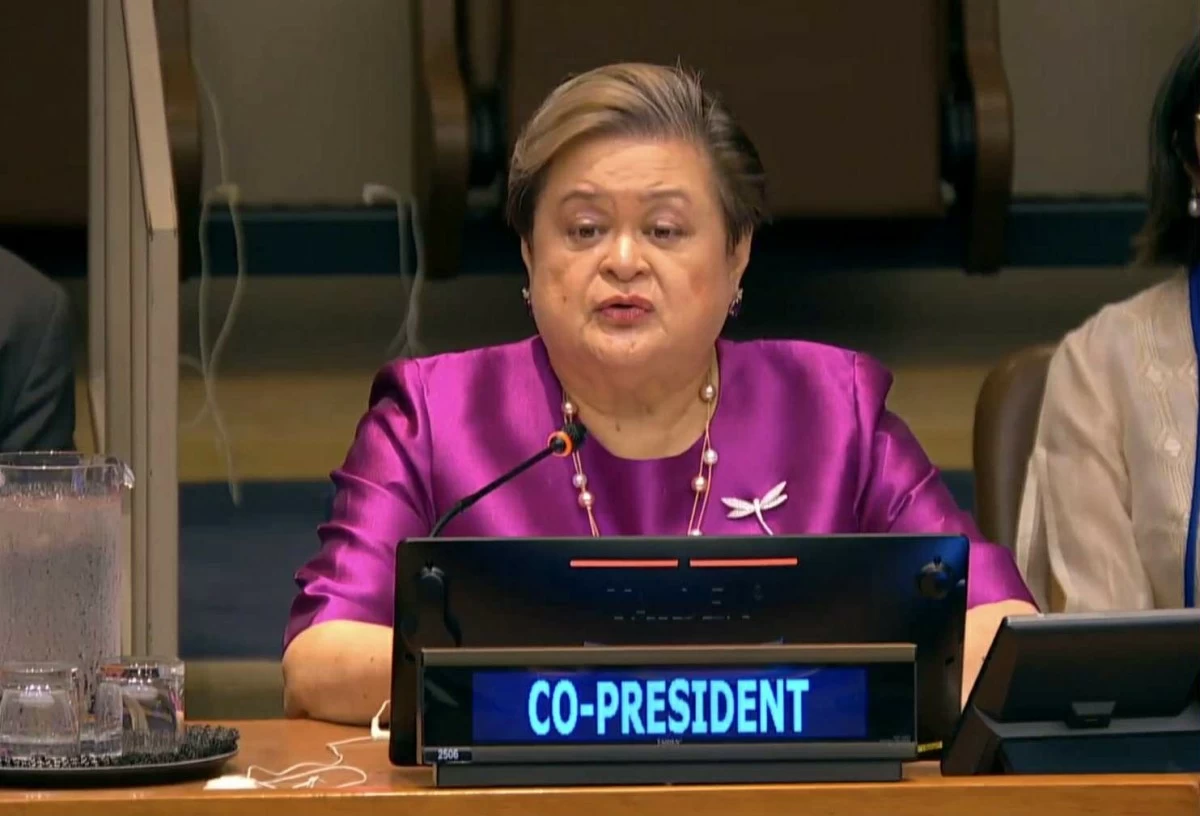
DFA Secretary Ma. Theresa Lazaro co-chairs the Article XIV Conference of the Comprehensive Nuclear-Test-Ban Treaty at the UN General Assembly in New York. (CTBTO Photo)
Department of Foreign Affairs (DFA) Secretary Ma. Theresa Lazaro made the call in her statement as co-chair during the 2025 Conference on Facilitating Entry Into Force of the Comprehensive Nuclear-Test-Ban Treaty (CTBT) at the United Nations General Assembly (UNGA) on Sept. 26.
“The Article XIV Conference is mandated to find effective measures to accelerate the entry into force of the CTBT,” she said. “We therefore reiterate our call for the remaining Annex II States to sign and ratify the treaty without delay and preconditions.”
“In the face of simmering geopolitical dynamics and intensifying nuclear rhetoric, our efforts should even be more unrelenting and united towards this goal,” she added.
As co-president with Sweden, Lazaro vowed that the Philippines “will work tirelessly in the next two years to promote the entry into force and universalization of the CTBT.”
According to an archived content of the United States’ Department of State’s website, the Annex II states are those that must ratify and deposit their instrument of ratification in the UN for the entry into force of the CTBT.
The 44 States under Annex II are those that participated in the negotiation of the CTBT from 1994 to 1996 and possessed nuclear power or research reactors at that time.
The latest chart found on CTBTO.org showed that out of the 44 states, 41 states have signed, 35 have ratified, three have not signed, and nine have not ratified.
Those that have not signed and ratified are the Democratic People’s Republic of Korea, India, and Pakistan. States that have signed but have yet to ratify are China, Egypt, Iran, Russia, and the United States.
“It is regrettable though that three decades hence, the Treaty has not yet entered into force,” Lazaro said.
“These anniversaries must drive States Signatories to act in concert and allow this Treaty to enter into force, one more crucial step towards a world without nuclear weapons,” the official added.
The Philippines, she stressed, was one of the first countries to sign and ratify the CTBT.
“Our co-presidency of this Conference is a manifestation of our unremitting commitment. A consistent champion of nuclear disarmament and non-proliferation, the Philippines’ commitment to a nuclear-free world is enshrined in our country’s basic law,” Lazaro said.