ADVERTISEMENT

PH vows larger role in global peace push under UN security body

Published Sep 28, 2025 10:16 am
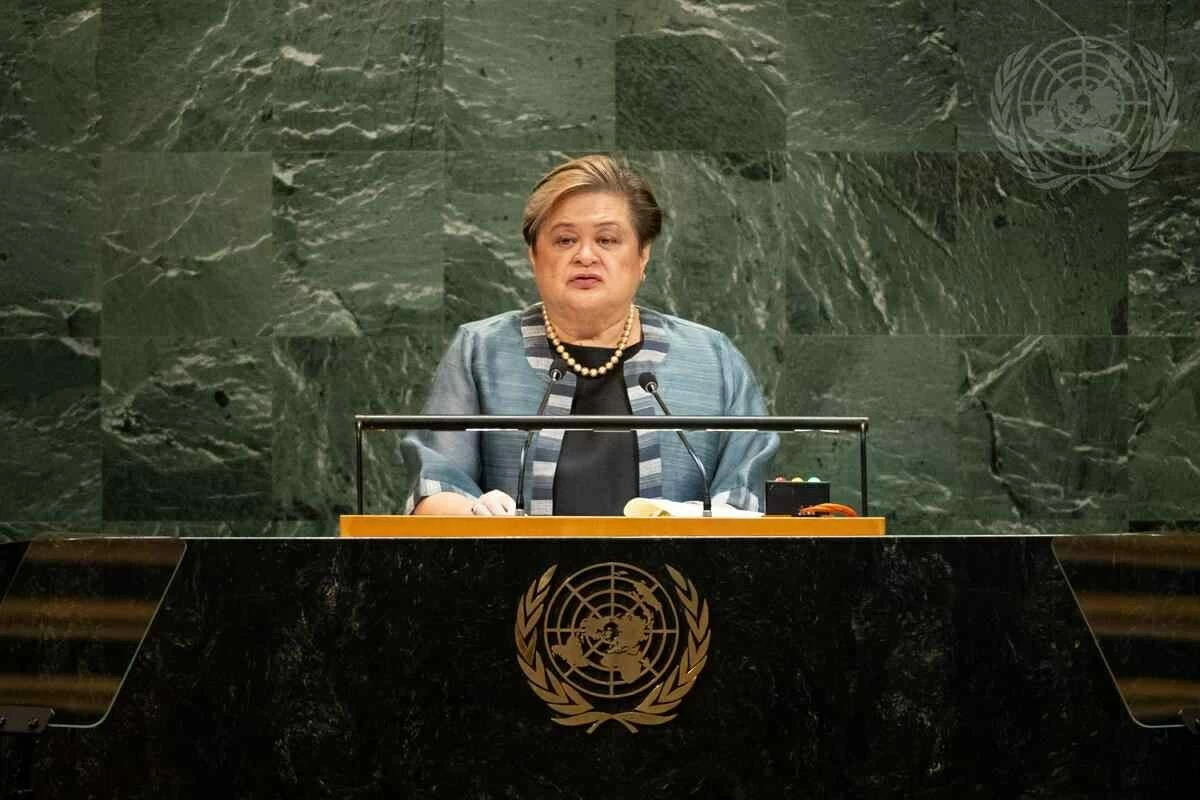
Foreign Affairs Secretary Ma. Theresa Lazaro delivers the Philippines' statement at the High-Level General Debate of the United Nations General Assembly in New York. (UN/Rick Bajornas)
Recognizing the challenges in peace and security, Department of Foreign Affairs (DFA) Secretary Ma. Theresa Lazaro on Saturday, Sept. 27 (New York time), once more pushed for the inclusion of the Philippines in the United Nations Security Council (UNSC) for a non-permanent seat, underscoring the country’s commitment and readiness to pursue global peace.

In a speech delivered during the General Debate at the 80th Session of the United Nations General Assembly (UNGA), the DFA chief expressed the Philippines’ preparedness to rise to the challenge the world faces today, particularly in advancing justice, equality, peace, and progress.

“This is a challenge that the Philippines is ready to rise up to, as we seek a non-permanent seat in the Security Council for the term 2027 to 2028. We look ahead to the solemn honor of serving this body. The Philippines is committed to contribute to the Security Council in a manner that takes into account the views and concerns of the general UN membership and other principal organs of the United Nations,” she said.

“We recognize the weight of the responsibility of the Security Council. When it acts for the interest of humanity, it is a fulcrum of change, a force for good, and a bastion of hope for populations trapped in hopeless situations. We seek to be part of it to help advance the cause of global peace with the depth of experience earned from our struggles for peace,” she added.

Lazaro shared the struggles in achieving peace in southern Philippines, noting that the “success story” of the Bangsamoro Autonomous Region in Muslim Mindanao (BARMM) “tells us that peace-building, though sometimes arduous and long, endows communities their rightful future.”

Even in its own seas, the Philippines continues to protect its peace and security, as the DFA secretary underscored the country’s commitment to international law and rules-based order, particularly to the 1982 Unted Nations Convention on the Law of the Sea (UNCLOS) and the 2016 Arbitral Award on the South China Sea.

“There is no alternative to the United Nations. There is no good global order other than one based on international law and the principle of the sovereign equality of states. A rules-based order is indispensable. To maritime nations such as the Philippines, international law, particularly the 1982 Law of the Sea, is fundamental to our future,” she said.

“While our government vessels and fisherfolk continue to be harassed in our own waters, and as we remain on the receiving end of illegal, coercive, aggressive, and dangerous actions in the South China Sea, we abide by the UNCLOS as reinforced by the binding 2016 Arbitral Award on the South China Sea. We are committed to diplomacy and other peaceful means to settle disputes,” she added.

The Philippines is currently seeking a non-permanent seat in the UNSC for 2027-2028.

Meanwhile, Lazaro also acknowledged the bigger roles being played by developing nations and middle-income economies amid cuts in development financing because of “politics and the demands of war.”

“Amidst current funding shortfalls, we must support reforms to help it deliver value to UN Member States, in tight accord with national priorities, with less bureaucracy and fragmentation...This has shifted the focus to the roles of developing and middle-income countries as shapers of development solutions. And why not?,” she asked.

“Together, we are the fastest-growing economies, the largest consumer markets, and the top sources of human capital. Even as we manage our share of economic vulnerabilities within our borders, developing nations are assuming greater responsibility as agents of transformative and inclusive cooperation. We are actively reshaping the global development agenda in the 21st century,” the secretary added.

But she pointed out that developed nations still have their roles to play, saying that they should “fulfill their financial obligation” while developing countries “must be co-architects of systems that determine allocation, eligibility, and accountability.”

Related Tags

DFA Ma. Theresa Lazaro UN General Assembly New York global peace
ADVERTISEMENT
.most-popular .layout-ratio{ padding-bottom: 79.13%; } @media (min-width: 768px) and (max-width: 1024px) { .widget-title { font-size: 15px !important; } }

{{ articles_filter_1561_widget.title }}

.most-popular .layout-ratio{ padding-bottom: 79.13%; } @media (min-width: 768px) and (max-width: 1024px) { .widget-title { font-size: 15px !important; } }

{{ articles_filter_1562_widget.title }}

.most-popular .layout-ratio{ padding-bottom: 79.13%; } @media (min-width: 768px) and (max-width: 1024px) { .widget-title { font-size: 15px !important; } }

{{ articles_filter_1563_widget.title }}

{{ articles_filter_1564_widget.title }}

.mb-article-details { position: relative; } .mb-article-details .article-body-preview, .mb-article-details .article-body-summary{ font-size: 17px; line-height: 30px; font-family: "Libre Caslon Text", serif; color: #000; } .mb-article-details .article-body-preview iframe , .mb-article-details .article-body-summary iframe{ width: 100%; margin: auto; } .read-more-background { background: linear-gradient(180deg, color(display-p3 1.000 1.000 1.000 / 0) 13.75%, color(display-p3 1.000 1.000 1.000 / 0.8) 30.79%, color(display-p3 1.000 1.000 1.000) 72.5%); position: absolute; height: 200px; width: 100%; bottom: 0; display: flex; justify-content: center; align-items: center; padding: 0; } .read-more-background a{ color: #000; } .read-more-btn { padding: 17px 45px; font-family: Inter; font-weight: 700; font-size: 18px; line-height: 16px; text-align: center; vertical-align: middle; border: 1px solid black; background-color: white; } .hidden { display: none; }
function initializeAllSwipers() { // Get all hidden inputs with cms_article_id document.querySelectorAll('[id^="cms_article_id_"]').forEach(function (input) { const cmsArticleId = input.value; const articleSelector = '#article-' + cmsArticleId + ' .body_images'; const swiperElement = document.querySelector(articleSelector); if (swiperElement && !swiperElement.classList.contains('swiper-initialized')) { new Swiper(articleSelector, { loop: true, pagination: false, navigation: { nextEl: '#article-' + cmsArticleId + ' .swiper-button-next', prevEl: '#article-' + cmsArticleId + ' .swiper-button-prev', }, }); } }); } setTimeout(initializeAllSwipers, 3000); const intersectionObserver = new IntersectionObserver( (entries) => { entries.forEach((entry) => { if (entry.isIntersecting) { const newUrl = entry.target.getAttribute("data-url"); if (newUrl) { history.pushState(null, null, newUrl); let article = entry.target; // Extract metadata const author = article.querySelector('.author-section').textContent.replace('By', '').trim(); const section = article.querySelector('.section-info ').textContent.replace(' ', ' '); const title = article.querySelector('.article-title h1').textContent; // Parse URL for Chartbeat path format const parsedUrl = new URL(newUrl, window.location.origin); const cleanUrl = parsedUrl.host + parsedUrl.pathname; // Update Chartbeat configuration if (typeof window._sf_async_config !== 'undefined') { window._sf_async_config.path = cleanUrl; window._sf_async_config.sections = section; window._sf_async_config.authors = author; } // Track virtual page view with Chartbeat if (typeof pSUPERFLY !== 'undefined' && typeof pSUPERFLY.virtualPage === 'function') { try { pSUPERFLY.virtualPage({ path: cleanUrl, title: title, sections: section, authors: author }); } catch (error) { console.error('ping error', error); } } // Optional: Update document title if (title && title !== document.title) { document.title = title; } } } }); }, { threshold: 0.1 } ); function showArticleBody(button) { const article = button.closest("article"); const summary = article.querySelector(".article-body-summary"); const body = article.querySelector(".article-body-preview"); const readMoreSection = article.querySelector(".read-more-background"); // Hide summary and read-more section summary.style.display = "none"; readMoreSection.style.display = "none"; // Show the full article body body.classList.remove("hidden"); } document.addEventListener("DOMContentLoaded", () => { let loadCount = 0; // Track how many times articles are loaded const offset = [1, 2, 3, 4, 5, 6, 7, 8, 9, 10]; // Offset values const currentUrl = window.location.pathname.substring(1); let isLoading = false; // Prevent multiple calls if (!currentUrl) { console.log("Current URL is invalid."); return; } const sentinel = document.getElementById("load-more-sentinel"); if (!sentinel) { console.log("Sentinel element not found."); return; } function isSentinelVisible() { const rect = sentinel.getBoundingClientRect(); return ( rect.top < window.innerHeight && rect.bottom >= 0 ); } function onScroll() { if (isLoading) return; if (isSentinelVisible()) { if (loadCount >= offset.length) { console.log("Maximum load attempts reached."); window.removeEventListener("scroll", onScroll); return; } isLoading = true; const currentOffset = offset[loadCount]; window.loadMoreItems().then(() => { let article = document.querySelector('#widget_1690 > div:nth-last-of-type(2) article'); intersectionObserver.observe(article) loadCount++; }).catch(error => { console.error("Error loading more items:", error); }).finally(() => { isLoading = false; }); } } window.addEventListener("scroll", onScroll); });

Sign up by email to receive news.