






Manila Bulletin
 Philippines
National
'Opong' downgraded to severe tropical storm as it crosses Masbate
Philippines
National
'Opong' downgraded to severe tropical storm as it crosses Masbate
Philippines
National
'Opong' downgraded to severe tropical storm as it crosses Masbate
'Opong' downgraded to severe tropical storm as it crosses Masbate
Published Sep 26, 2025 06:41 am


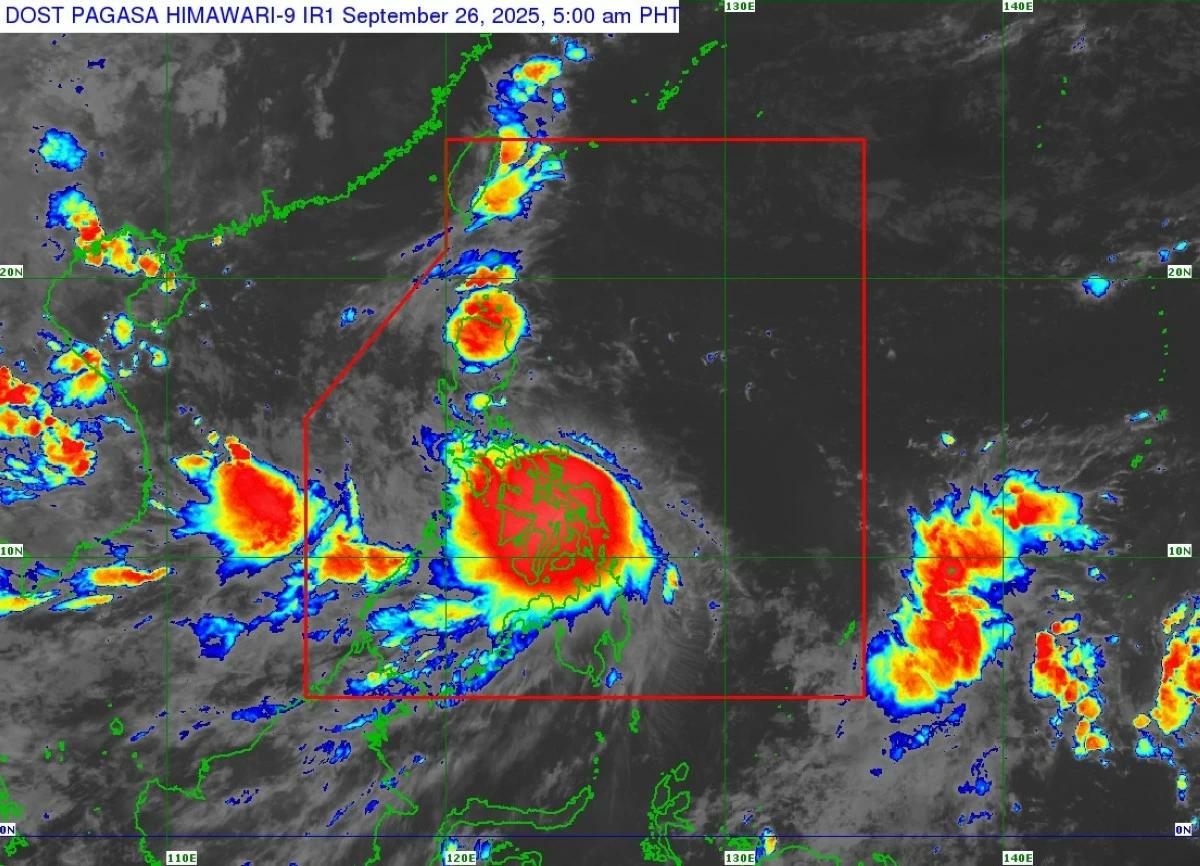
PAGASA
Severe Tropical Storm Opong (international name: Bualoi) has weakened from a typhoon after its second landfall over Palanas, Masbate at 4 a.m. on Friday, Sept. 26, the Philippine Atmospheric, Geophysical and Astronomical Services Administration (PAGASA) said.
In its 5 a.m. bulletin, PAGASA said Opong was traversing Masbate while moving west-northwestward at 30 kilometers per hour (kph).
The severe tropical storm was packing maximum sustained winds of 110 kph near the center and gustiness of up to 150 kph.
Opong is expected to continue crossing Masbate before moving over the Sibuyan Sea, southern Calabarzon, and northern Mimaropa.
It will emerge over the West Philippine Sea late Friday evening or early Saturday morning, Sept. 27.
Opong made its first landfall in San Policarpo, Eastern Samar at 11:30 p.m. Thursday, Sept. 25, before crossing inland and weakening.
At the time of landfall, Opong had maximum sustained winds of 120 kph near the center and gustiness of up to 165 kph.
PAGASA weather specialist Loriedin de la Cruz-Galicia said that if the storm continues to shift southward, the stronger gusts of Opong’s winds may no longer be felt in Metro Manila, Rizal, and nearby provinces including Bulacan, Pampanga, and Tarlac, since the area of intense winds remains relatively compact.
As of Friday morning, Wind Signal No. 3 was hoisted over Sorsogon, Masbate, including Ticao and Burias Islands, Albay, western and southern portions of Camarines Sur, southern portion of Quezon, Marinduque, Romblon, Oriental Mindoro, Occidental Mindoro, including Lubang Islands, Batangas, southern portion of Laguna, Northern Samar, northern and central portions of Eastern Samar, northern and central portions of Samar, Biliran, and northern portion of Leyte.
Meanwhile, Signal No. 2 was in effect in Catanduanes, the rest of Camarines Sur, Camarines Norte, the rest of Quezon, the rest of Laguna, Rizal, Cavite, Metro Manila, Bulacan, Pampanga, Bataan, the southern portion of Zambales, Calamian Islands, the rest of Eastern Samar, the rest of Samar, northern and central portions of Leyte, northern portion of Cebu, including Camotes and Bantayan Islands, extreme northern portion of Negros Occidental, northern portion of Iloilo, Capiz, Aklan, and northwestern portion of Antique.
Signal No. 1 remains raised over the central and southern portions of Isabela, Quirino, Nueva Vizcaya, Ifugao, southwestern portion of Mountain Province, Benguet, southern portion of Ilocos Sur, La Union, Pangasinan, Aurora, Nueva Ecija, Tarlac, the rest of Zambales, Cuyo Islands, northern portion of mainland Palawan, Southern Leyte, the rest of Leyte, eastern and central portions of Bohol, central portion of Cebu, northern portion of Negros Oriental, northern and central portions of Negros Occidental, central portion of Iloilo, central portion of Antique, Dinagat Islands, and Surigao del Norte, including Siargao Island and Bucas Grande Islands.
PAGASA said that as Opong crosses the archipelago, it will likely remain a severe tropical storm.
Re-intensification is highly likely once it emerges over the West Philippine Sea.