






Manila Bulletin
 Philippines
National
OCD: 18 dead due to 'Opong', 'Nando', other weather disturbances
Philippines
National
OCD: 18 dead due to 'Opong', 'Nando', other weather disturbances
Philippines
National
OCD: 18 dead due to 'Opong', 'Nando', other weather disturbances
OCD: 18 dead due to 'Opong', 'Nando', other weather disturbances
Government pushes early recovery in Northern Luzon as Visayas, Southern Luzon endure effects of successive storms
Published Sep 26, 2025 11:52 am
|
Updated Sep 26, 2025 01:23 pm


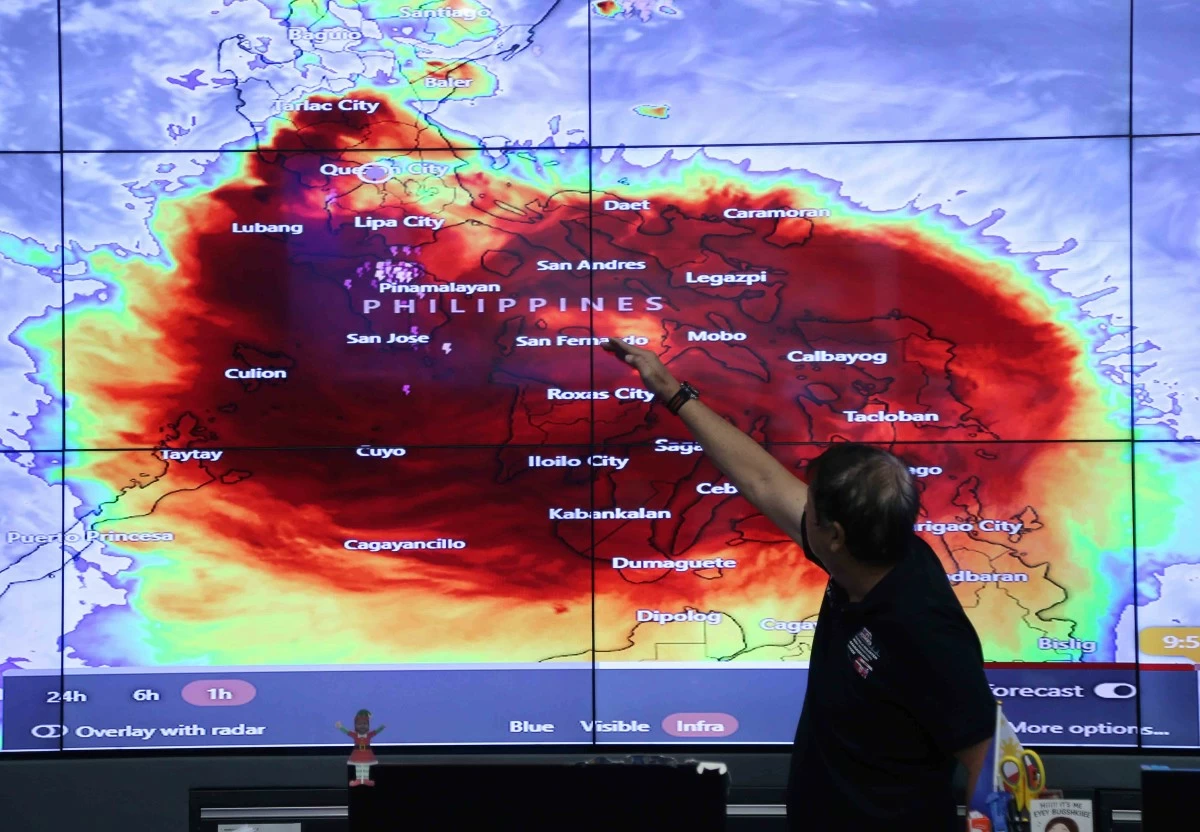
Manila Disaster Risk Reduction and Management Office (MDRRMO) Director Arnel Angeles keeps a close watch on the movement of Severe Tropical Storm “Opong” at the MDRRMO Command, Communication and Control Center in Manila City Hall on September 26, 2025. “Opong,” which has intensified while moving northwest, is expected to bring heavy rains and possible flooding to parts of Metro Manila and nearby provinces. (Mark Balmores / MANILA BULLETIN)
At least 18 people have died as Visayas and Southern Luzon weathered the impact of Severe Tropical Storm “Opong” while Northern Luzon is pushing for early recovery due to Super Typhoon “Nando”, Tropical Depression “Mirasol”, and southwest monsoon (habagat), the Office of Civil Defense (OCD) disclosed Friday, Sept. 26.
OCD Deputy Administrator Asst. Sec. Bernardo Rafaelito Alejandro IV said eight people died in Cagayan, including seven fishermen who drowned when their boat capsized and another one struck by fallen debris.
Three people also died in Cordillera Administrative Region (CAR) due to landslide and drowning, while three died in Central Luzon (Region 3).
In a virtual press briefing, the Bicol Regional Disaster Risk Reduction and Management Council (RDRRMC) Director Claudio Yucot also reported four fatalities in Region 5: three were hit by fallen debris, uprooted tree, and collapsed wall in Masbate; and one was struck by lightning in Camarines Norte.
“Most of the fatalities are still for validation. We also have 17 injured and two missing that we are searching for already,” Alejandro said. “We will be closely monitoring the impact of Typhoon Opong as we also recover in Northern Luzon from the effects of Typhoon Nando.”
3 successive storms and habagat's impact
In a span of 10 days or since Sept. 16, Opong, Nando, Mirasol, and the enhanced habagat caused widespread destruction that affected 303,537 families composed of 1,212,712 individuals in Ilocos (Region 1), Cagayan Valley (Region 2), CAR, Central Luzon (Region 3), National Capital Region (NCR), Calabarzon (Region 4A), Mimaropa (Region 4B), Bicol (Region 5), Western Visayas (Region 6), Zamboanga Peninsula (Region 9), and Bangsamoro Autonomous Region in Muslim Mindanao (BARMM).
Of this, more than 16,000 families or 50,000 individuals were displaced and either sheltered in 389 evacuation centers or stayed with other people’s houses. There were 120,000 families or 433,000 individuals that were also preemptively evacuated.
“Many of those preemptively evacuated are in Region 5, reaching around 93,000 families, followed by Region 8 with 14,945 families, and Region 4B with 4,676 families. These are the regions that the typhoon will pass through or has already passed, such as Samar, which has already been struck by Typhoon Opong and where a second landfall occurred in Palanas, Masbate,” Alejandro said.
“As we speak, the typhoon is currently over Masbate, so response operations continue in Regions 8, 5, and 4B. Our island provinces in Region 4B—Romblon, Marinduque, and even Mindoro—are also preparing for its arrival,” he added.
Damage
The OCD said 214 road sections and 35 bridges were affected due to bad weather. There were 113 areas that also experienced power interruption, 12 areas that had water interruption, and six areas that had their communication lines affected.
The initial damage to agriculture was pegged at P38.57 million, with majority of it recorded in Region 4A at P23 million, followed by Region 1 at P13.99 million, and Region 6 at P860,000.
Meanwhile, damage to infrastructure was estimated at P794.81 million. Most of the damage was reported in Region 1 at P773.25 million, followed by Region 2 at P21 million, and Region 4B at P500,000.
Assistance
The OCD said it has extended P21 million worth of relief assistance to 31,000 families who were affected by the bad weather.
“For food and non-food items, according to the Department of Social Welfare and Development, our stockpile of food items is more than sufficient, and we have around P3 billion in standby funds that can be immediately utilized. For telecommunications, available resources are also ready, with almost 833 teams or equipment units from the Department of Information and Communications Technology and other agencies,” Alejandro said.
“The Health Cluster is also ready as we have adequate medical supplies. Our logistics are prepared as well and we have several airplanes in use, ships on standby. Our Search, Rescue, and Retrieval (SRR) Cluster is ready with nearly 1,000 personnel either on standby or already deployed due to Typhoon Nando. We also have more or less 52,000 personnel on standby who can be mobilized or augment local government units at a given notice,” he added.