ADVERTISEMENT

Marcos signs law creating nuclear regulatory body, bans non-peaceful use of atomic energy

Published Sep 25, 2025 01:01 pm
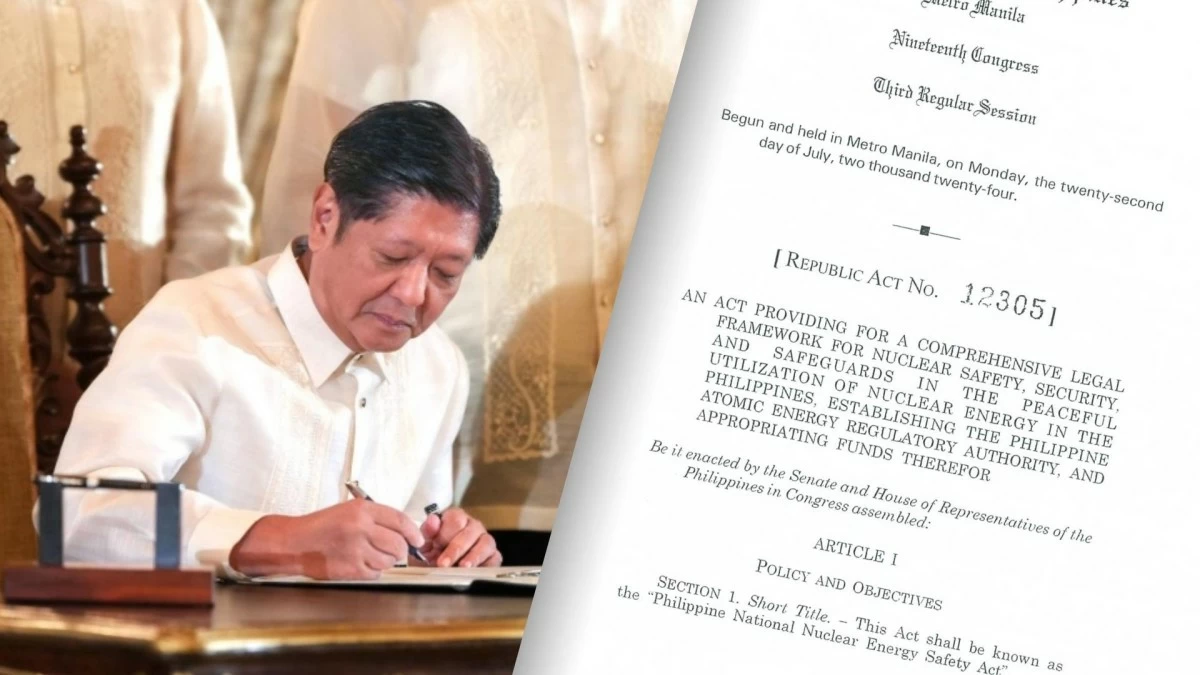
File photos
File photos
President Marcos has signed Republic Act (RA) No. 12305, or the Philippine National Nuclear Energy Safety Act, establishing a national framework for the peaceful and secure use of nuclear energy in the country.
The new law, signed on Sept. 18, creates the Philippine Atomic Energy Regulatory Authority (PhilATOM), an independent and quasi-judicial body tasked to oversee all nuclear and radiation activities nationwide.
The measure underscores the government’s policy to “harness the peaceful, safe, and secure use of atomic energy to provide benefits to the Philippines in the fields of energy production, health and medicine, scientific research, agriculture, industry, education, and others.”
At the same time, it strictly bans military or non-civilian applications, stating that the nuclear energy shall only be used for peaceful purposes, and that all facilities and activities related to the acquisition or development of nuclear explosives, radiological dispersal devices and other non-peaceful uses are strictly prohibited.

PhilATOM as sole regulator

Under the law, PhilATOM will have “sole and exclusive jurisdiction to exercise regulatory control… for the peaceful, safe, and secure uses of nuclear energy and radiation sources in the Philippines.”
The new authority will absorb regulatory powers from all other agencies and act as the national counterpart to the International Atomic Energy Agency (IAEA).
Its head will be a Director General appointed by the President for a five-year term, assisted by four deputy directors general, also presidential appointees.
PhilATOM is empowered to issue implementing rules, safety standards, and guidelines, and to enforce compliance through inspections, notices of violation, and penalties.
It may also “suspend, modify, or revoke authorizations, after due notice and hearing, which fail to comply with the provisions” of the law and its regulations.

Authorization and inspections

RA 12305 requires authorization for all nuclear-related activities, such as siting, construction, operation, commissioning, and decommissioning of a nuclear or radiation facility and its associated activities.
Applicants must demonstrate safety and security before approval, while the authorized party bears prime responsibility for operations.
Inspectors shall have access at any time to all parts of the facility for the purpose of verifying compliance with the provisions of the new law.

Emergency and security measures

To prepare for nuclear or radiological incidents, a national plan shall be established “to mitigate the consequences of an incident within or outside the territory… integrated in the National Disaster Risk Reduction and Management Council framework.”
PhilATOM will set requirements for the physical protection and transport of nuclear material, as well as categorize nuclear substances by risk level.
The law also mandates oversight of all nuclear activities consistent with “the Philippines’ obligations under the Safeguards Agreements and Additional Protocol” with the IAEA.

Radioactive waste management

The Act directs PhilATOM to establish a national registry of radioactive waste and spent fuel inventory. This includes regulation, documentation, and long-term control of disposal sites.
The registry is intended to ensure accountability for spent fuel and waste throughout their lifecycle.

Offenses and penalties

Violations of the Act include unauthorized operation of nuclear facilities, improper handling of radioactive material, or willfully causing a release of nuclear energy.
Penalties range from administrative fines and license revocations to imprisonment of up to five years and fines of at least P10 million, depending on the severity of the offense.
Criminal liability also covers those who conspire to initiate nuclear chain reactions that could cause death, injury, or environmental damage.
Providing false or misleading information to PhilATOM will likewise be penalized.
More severe offenses include willfully causing nuclear reactions or radiation releases that endanger life, property, or the environment.
Those found guilty of such acts may face imprisonment and higher penalties, “considering the grave nature of those offenses.”

Related Tags

President Marcos Bongbong Marcos nuclear energy PhilAtom
ADVERTISEMENT
.most-popular .layout-ratio{ padding-bottom: 79.13%; } @media (min-width: 768px) and (max-width: 1024px) { .widget-title { font-size: 15px !important; } }

{{ articles_filter_1561_widget.title }}

.most-popular .layout-ratio{ padding-bottom: 79.13%; } @media (min-width: 768px) and (max-width: 1024px) { .widget-title { font-size: 15px !important; } }

{{ articles_filter_1562_widget.title }}

.most-popular .layout-ratio{ padding-bottom: 79.13%; } @media (min-width: 768px) and (max-width: 1024px) { .widget-title { font-size: 15px !important; } }

{{ articles_filter_1563_widget.title }}

{{ articles_filter_1564_widget.title }}

.mb-article-details { position: relative; } .mb-article-details .article-body-preview, .mb-article-details .article-body-summary{ font-size: 17px; line-height: 30px; font-family: "Libre Caslon Text", serif; color: #000; } .mb-article-details .article-body-preview iframe , .mb-article-details .article-body-summary iframe{ width: 100%; margin: auto; } .read-more-background { background: linear-gradient(180deg, color(display-p3 1.000 1.000 1.000 / 0) 13.75%, color(display-p3 1.000 1.000 1.000 / 0.8) 30.79%, color(display-p3 1.000 1.000 1.000) 72.5%); position: absolute; height: 200px; width: 100%; bottom: 0; display: flex; justify-content: center; align-items: center; padding: 0; } .read-more-background a{ color: #000; } .read-more-btn { padding: 17px 45px; font-family: Inter; font-weight: 700; font-size: 18px; line-height: 16px; text-align: center; vertical-align: middle; border: 1px solid black; background-color: white; } .hidden { display: none; }
function initializeAllSwipers() { // Get all hidden inputs with cms_article_id document.querySelectorAll('[id^="cms_article_id_"]').forEach(function (input) { const cmsArticleId = input.value; const articleSelector = '#article-' + cmsArticleId + ' .body_images'; const swiperElement = document.querySelector(articleSelector); if (swiperElement && !swiperElement.classList.contains('swiper-initialized')) { new Swiper(articleSelector, { loop: true, pagination: false, navigation: { nextEl: '#article-' + cmsArticleId + ' .swiper-button-next', prevEl: '#article-' + cmsArticleId + ' .swiper-button-prev', }, }); } }); } setTimeout(initializeAllSwipers, 3000); const intersectionObserver = new IntersectionObserver( (entries) => { entries.forEach((entry) => { if (entry.isIntersecting) { const newUrl = entry.target.getAttribute("data-url"); if (newUrl) { history.pushState(null, null, newUrl); let article = entry.target; // Extract metadata const author = article.querySelector('.author-section').textContent.replace('By', '').trim(); const section = article.querySelector('.section-info ').textContent.replace(' ', ' '); const title = article.querySelector('.article-title h1').textContent; // Parse URL for Chartbeat path format const parsedUrl = new URL(newUrl, window.location.origin); const cleanUrl = parsedUrl.host + parsedUrl.pathname; // Update Chartbeat configuration if (typeof window._sf_async_config !== 'undefined') { window._sf_async_config.path = cleanUrl; window._sf_async_config.sections = section; window._sf_async_config.authors = author; } // Track virtual page view with Chartbeat if (typeof pSUPERFLY !== 'undefined' && typeof pSUPERFLY.virtualPage === 'function') { try { pSUPERFLY.virtualPage({ path: cleanUrl, title: title, sections: section, authors: author }); } catch (error) { console.error('ping error', error); } } // Optional: Update document title if (title && title !== document.title) { document.title = title; } } } }); }, { threshold: 0.1 } ); function showArticleBody(button) { const article = button.closest("article"); const summary = article.querySelector(".article-body-summary"); const body = article.querySelector(".article-body-preview"); const readMoreSection = article.querySelector(".read-more-background"); // Hide summary and read-more section summary.style.display = "none"; readMoreSection.style.display = "none"; // Show the full article body body.classList.remove("hidden"); } document.addEventListener("DOMContentLoaded", () => { let loadCount = 0; // Track how many times articles are loaded const offset = [1, 2, 3, 4, 5, 6, 7, 8, 9, 10]; // Offset values const currentUrl = window.location.pathname.substring(1); let isLoading = false; // Prevent multiple calls if (!currentUrl) { console.log("Current URL is invalid."); return; } const sentinel = document.getElementById("load-more-sentinel"); if (!sentinel) { console.log("Sentinel element not found."); return; } function isSentinelVisible() { const rect = sentinel.getBoundingClientRect(); return ( rect.top < window.innerHeight && rect.bottom >= 0 ); } function onScroll() { if (isLoading) return; if (isSentinelVisible()) { if (loadCount >= offset.length) { console.log("Maximum load attempts reached."); window.removeEventListener("scroll", onScroll); return; } isLoading = true; const currentOffset = offset[loadCount]; window.loadMoreItems().then(() => { let article = document.querySelector('#widget_1690 > div:nth-last-of-type(2) article'); intersectionObserver.observe(article) loadCount++; }).catch(error => { console.error("Error loading more items:", error); }).finally(() => { isLoading = false; }); } } window.addEventListener("scroll", onScroll); });

Sign up by email to receive news.