






Manila Bulletin
 Business
The Economy
Budget chief Pangandaman maintains: DBM not involved in insertions
Business
The Economy
Budget chief Pangandaman maintains: DBM not involved in insertions
Business
The Economy
Budget chief Pangandaman maintains: DBM not involved in insertions
Budget chief Pangandaman maintains: DBM not involved in insertions
Education, social services get boost in 2026 national budget proposal as DPWH loses ₱255 billion
Published Sep 25, 2025 11:13 am
|
Updated Sep 25, 2025 06:45 pm


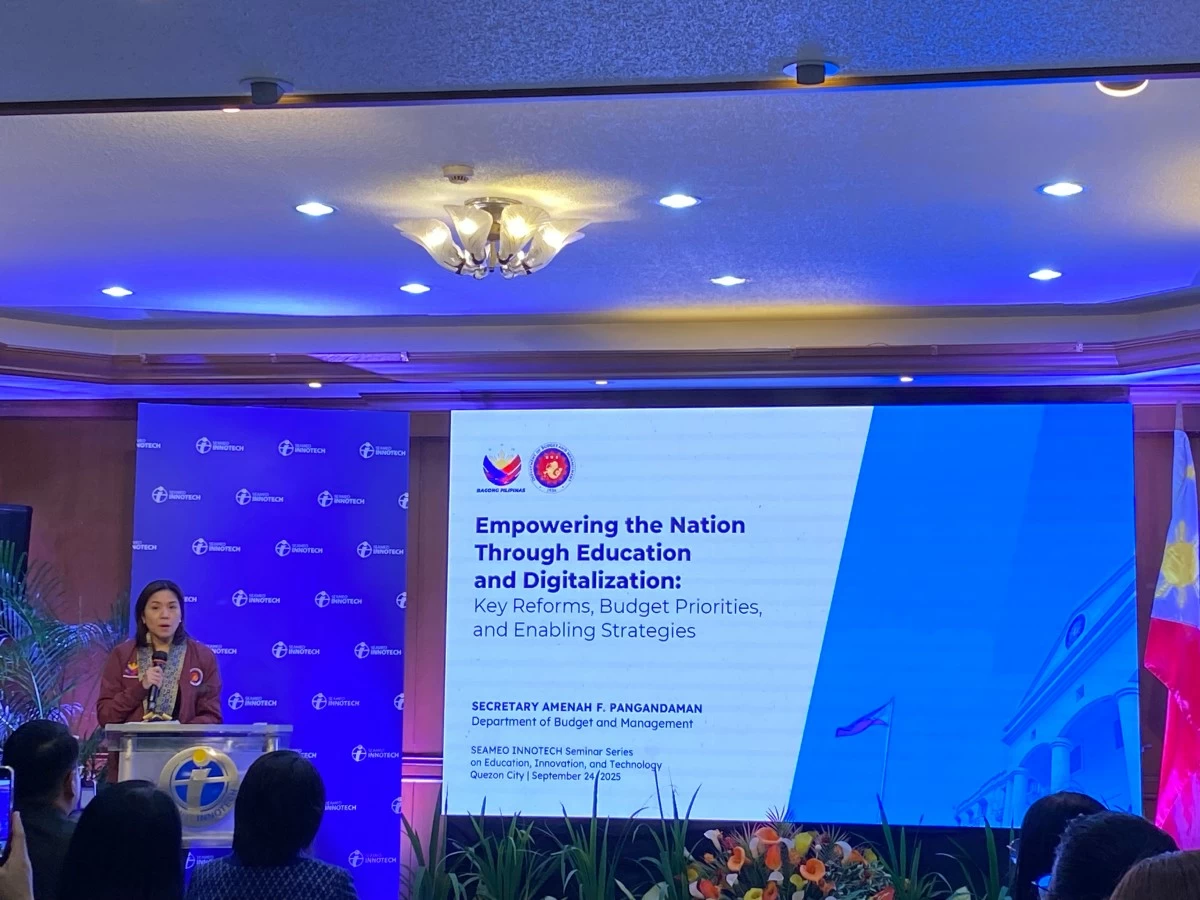
In the aftermath of the scandal involving “ghost” and substandard flood control projects, Budget Secretary Amenah F. Pangandaman maintained that the Department of Budget and Management (DBM) is not involved in controversial budget insertions, wherein corruption of public funds allegedly emanate.
On the sidelines of an INNOTECH seminar on Wednesday, Sept. 24, Pangandaman explained that the executive, in particular the DBM, is not involved in budget insertions, explaining that the agency’s role is simply to receive requests and proposals from departments and agencies, and then evaluate them against the annual budget ceiling set by the Cabinet-level Development Budget Coordination Committee (DBCC), which groups the economic team.
The Budget chief added that insertions are not possible within the DBM since it has no role in project implementation.
Pangandaman said that despite a hefty cut in the proposed 2026 budget of the embattled Department of Public Works and Highways (DPWH), the national spending plan for next year stays at a record ₱6.793 trillion, with larger allocations for education and social services instead.
To recall, the House of Representatives slashed the DPWH’s budget for next year to ₱625.78 billion from the original ₱881 billion.
The DBM chief said that this was done so that legislators could supposedly use the “reprioritized” funding for other necessary and priority projects under the menu presented by President Ferdinand R. Marcos Jr. in the proposed 2026 General Appropriations Act (GAA) that the executive submitted to Congress for consideration.
“A large portion of the funds was allocated to education, electrification, social protection, hospitals and medical assistance, as well as the ₱60 billion for PhilHealth,” she added, referring to the return of unutilized funds of the state-run Philippine Health Insurance Corp. ordered by Marcos over the weekend.
Despite the controversy in the DPWH, she expressed confidence in the on-time approval of the 2026 national budget amid ongoing Congressional hearings scrutinizing the proposal.
Pangandaman stressed that budget requests are evaluated based on the over ₱6.7-trillion spending cap set by the DBCC. “It has to be allocated according to the needs of the agencies,” she said. “Once it is given to them, we follow the budget process, and each Cabinet secretary defends their proposed budget.”
“It’s not a quick process,” she added.
The Budget chief further emphasized the importance of the post-budget phase, particularly proper implementation by each department to ensure that projects are carried out as planned. She also highlighted the need to make the national ID system interoperable, so government benefits reach the rightful recipients.
Pangandaman also acknowledged concerns about potential underspending by the DPWH in the coming months due to several factors: the election-related ban earlier this year, an ongoing investigation, and the decision of new DPWH Secretary Vince Dizon to suspend all project bidding to review the budget line by line.
She likewise clarified that the return of ₱100 billion to the Philippine Deposit Insurance Corp. (PDIC), if also ordered by the President or ruled by the Supreme Court (SC), would not affect fiscal consolidation or the plan to narrow the budget deficit, as it simply represents a reprioritization of funds within the overall budget.
Meanwhile, following the President’s directive, Pangandaman said during the INNOTECH seminar that the allocation for basic and higher education has been significantly increased to ₱1.224 trillion, marking the first time the Philippines will meet the United Nations Educational, Scientific, and Cultural Organization’s (UNESCO) recommended four percent of gross domestic product (GDP) spending on education.
The Department of Education (DepEd) has been allocated ₱928.52 billion to ensure the provision of quality basic education. Of this, ₱11.8 billion is earmarked for the expanded school feeding program to help ensure that no learner’s education is affected by undernutrition or hunger.
The proposed 2026 national budget has also allocated ₱3 billion for last mile schools in geographically isolated and disadvantaged areas (GIDAs), nearly ₱700 million for alternative learning systems, and ₱28.1 billion for the construction and rehabilitation of classrooms, water supply, sanitation facilities, and other essential improvements.
The DepEd computerization program will receive ₱16.45 billion, a 576-percent increase, to support e-classroom and e-learning packages. Another ₱15.39 billion has been allocated to create over 65,000 teaching and non-teaching positions to reduce teachers’ administrative workload.
For tertiary education, state universities and colleges (SUCs) will receive around ₱134.99 billion, while the Commission on Higher Education (CHED) will be allocated ₱34 billion to support its “ACHIEVE” agenda. Of this, ₱27.41 billion will go to the universal access to quality tertiary education program to cover tuition and other school fees for students.
In addition, about ₱2.15 billion will be set aside for student financial assistance programs to ensure that learners from poor to lower-middle-income households are not left behind.
Pangandaman also announced the launch of the Bagong Pilipinas merit scholars program, with an initial ₱630 million allocation. The program targets incoming college students from low-income households who graduated with the highest honors in senior high school, giving them the opportunity to pursue degrees, including master’s programs.
“We are equally committed to closing the gap in our education workforce and enhancing the welfare of our education,” Pangandaman said.
She also highlighted that the Philippines is among the first countries in Asia to adopt blockchain infrastructure for monitoring government spending, welcoming congressional support to institutionalize the technology through legislation.
At the same time, she cautioned that project figures on paper do not always align with on-ground progress. This, she said, is why the government launched Project DIME, a geotagging and satellite-based platform that enables citizens to track major infrastructure projects online. The platform provides information on budget utilization, implementing agencies, contractors, contract details, timelines, and project status, and has been in use since 2022.
(Ricardo M. Austria)