







Beyond Seoul, Korean universities vie for global standing
Traditional top-tier universities show global edge, Kyungpook National University leads regional flagships at 14th place
Published Sep 25, 2025 01:51 pm


Graphic by Bae So-young, Cho Sang-won
By JUNG DA-HYUN
Korea’s long-standing top-tier universities maintained their dominance in the first-ever K-universities Global Excellence Rankings 2026 (KGER), yet the Top 30 revealed a new wave of contenders.
Regional national universities and mid-sized institutions are increasingly staking their claim, signaling a shift in the landscape of Korean higher education and highlighting the rise of alternative centers of excellence.
The results point to a more diverse and competitive landscape, with universities beyond Seoul and outside the traditional hierarchy proving their global potential. Amid a demographic crisis and intensifying competition for foreign experts, regional, mid-sized and smaller universities are racing to globalize — a push driven as much by survival as by prestige.
KGER aims to serve as a reliable guide for international students choosing to study in Korea, while strengthening the global competitiveness of Korean universities.
The evaluation consists of 190 points across four categories: 60 for education, 50 for research, 40 for student support and 40 for graduate outcomes.
It was developed by The Korea Times’ evaluation team in cooperation with six external experts in university globalization, to ensure both credibility and transparency. The evaluation also drew on publicly available and verifiable data, including data from the Ministry of Education and Naver Scholytics.
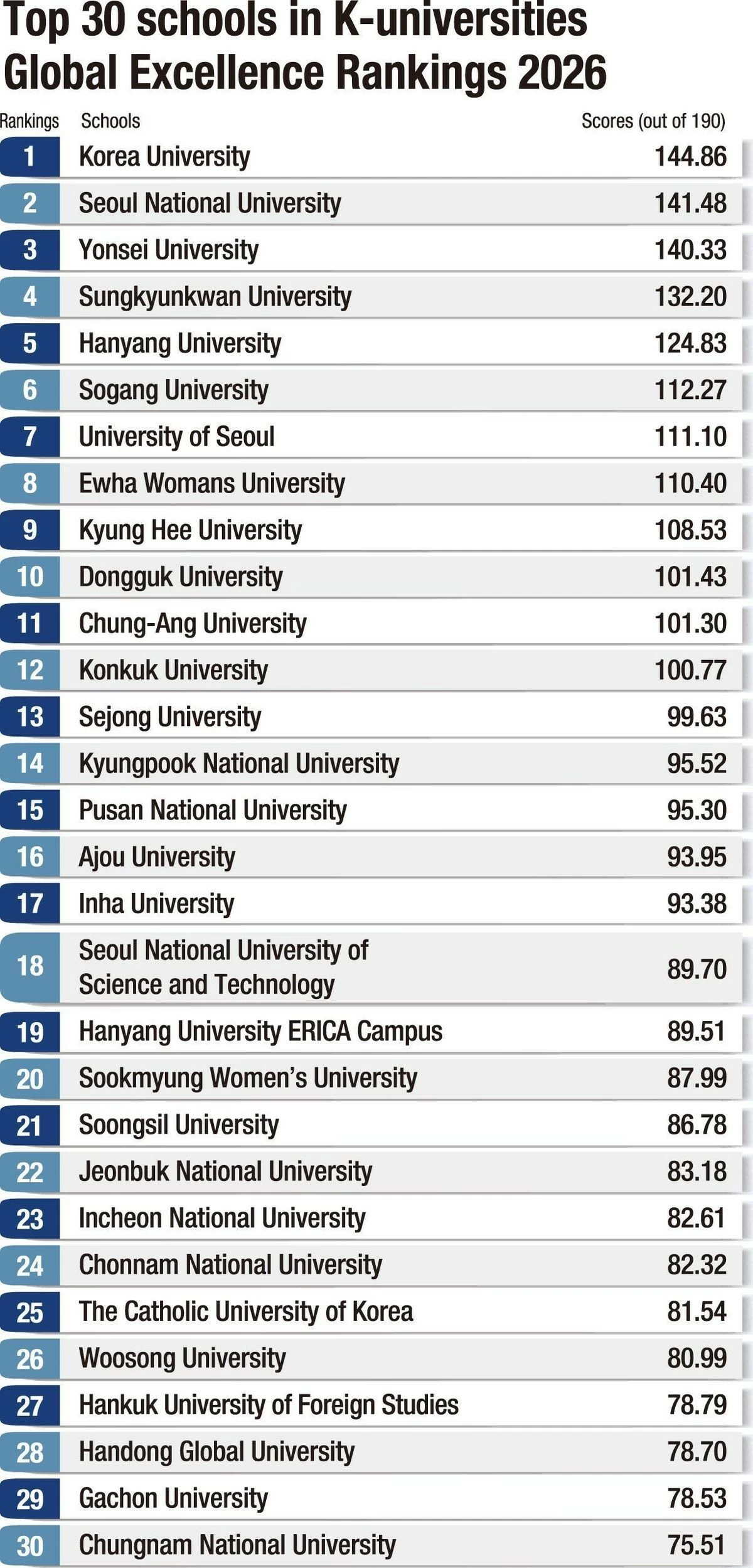
Korea University topped the overall ranking with 144.86 points, ahead of Seoul National University with 141.48 and Yonsei University with 140.33. The three so-called “SKY” universities reiterated their dominance, driven by strengths in research, global partnerships and sustained appeal to international students.
The overall list combines results from four key areas: education, research, student support, and graduate outcomes and social impact.
While the top three schools were separated by fewer than five points, a clear gap followed before Sungkyunkwan University in fourth with 132.2.
Rounding out the Top 10 were Hanyang University in fifth, Sogang University in sixth, University of Seoul in seventh, Ewha Womans University in eighth, Kyung Hee University in ninth and Dongguk University in 10th.
Traditionally strong performers in domestic rankings for Korean students, these universities also demonstrated their competitiveness in globalization, attracting large numbers of international students while building active global networks and joint research programs.
National universities outside Seoul made a strong showing in KGER, with five regional flagship universities placing in the Top 30.
Kyungpook National University led the group at 14th, followed by Pusan National University in 15th, Jeonbuk National University at 22nd, Chonnam National University at 24th and Chungnam National University at 30th, underscoring the rising profile of regional institutions in Korea’s push for global competitiveness.
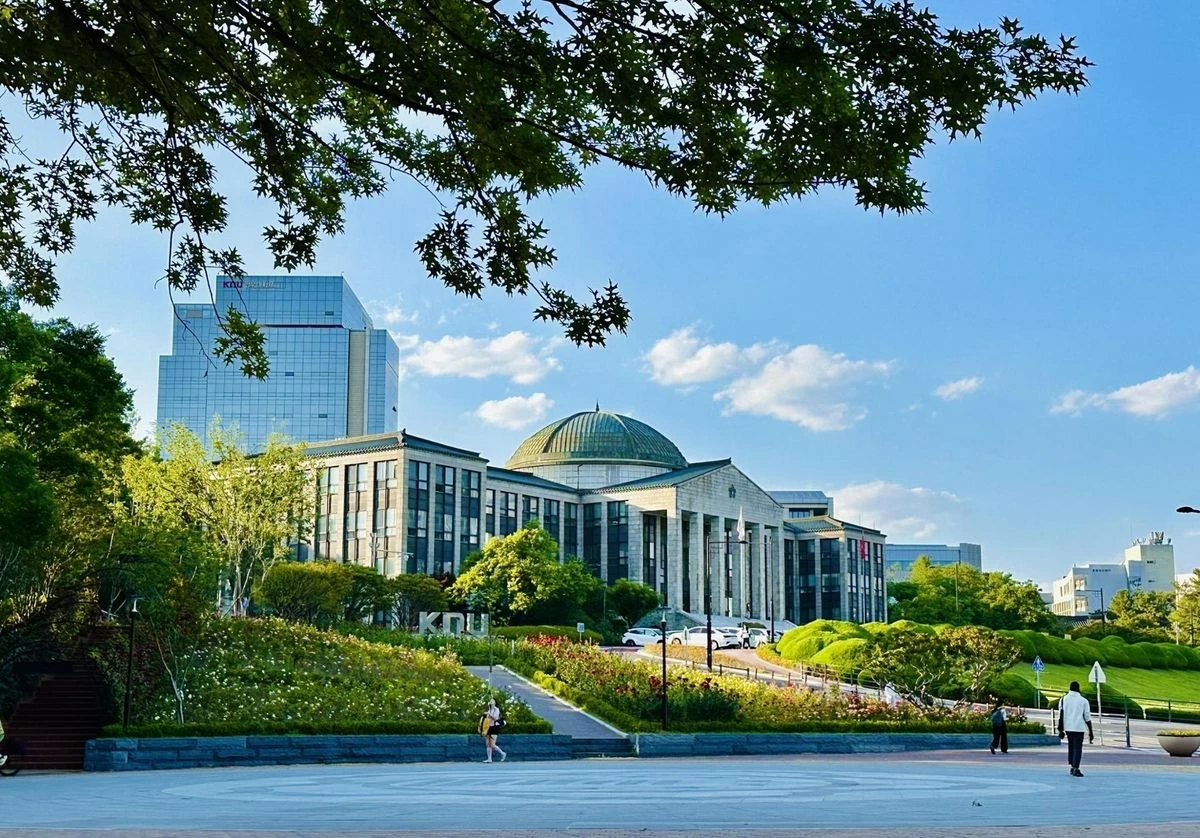
Kyungpook National University campus in Daegu (Photo courtesy of Kyungpook National University)
This stands in sharp contrast to the common perception in Korea that universities outside Seoul are secondary options. The rankings show that, even with Seoul’s dominance, regional institutions are carving out their place through specialized exchange programs and tailored support policies. Their rising visibility underscores the role of local hubs in dispersing international talent and easing Korea’s chronic “Seoul-centrism.”
For regional flagship universities, the demographic crisis is even more severe, emphasizing the need to shift from short-term recruitment to drawing international students who can stay on after graduation by securing jobs in the region.
Many of these universities are highlighting their research strengths, forging partnerships with local institutes in fields such as artificial intelligence and biotechnology.
The push also aligns with the government’s initiative to “create 10 Seoul National Universities,” which aims to bolster higher education outside the capital and promote more balanced national development by essentially replicating the reputation of the prestigious university.
Beyond the Top 10, the rankings delivered some surprises, spotlighting universities that typically rank lower in domestic evaluations yet have demonstrated significant strengths in globalization.
Sejong University ranked 13th overall, driven by a standout performance in research, while Woosong University came in 26th with strong scores in education and student support. Though less prominent in domestic rankings, Woosong has pushed its way into the Top 30 by sharpening its focus on globalization.
Handong Global University also made the Top 30 despite its relatively low profile in domestic rankings. Founded on a Christian ethos, the university has built its reputation on globalization, living up to its name. With a dormitory accommodation rate of about 90 percent, most students live on campus, where the university fosters community through organized activities and events. The university also offers a wide range of English-taught courses, reinforcing its global orientation.
Meanwhile, Hankuk University of Foreign Studies, known for its diverse international student body and dedicated foreign student council, placed 27th. Strong results in education and graduate outcomes were offset by weaker performances in research and student support, lowering its total score.
https://www.koreatimes.co.kr/southkorea/university-rankings/20250924/beyond-seoul-korean-universities-vie-for-global-standing