ADVERTISEMENT

Art depicting anomalous flood control projects gets a thumbs up

Published Sep 25, 2025 05:20 pm
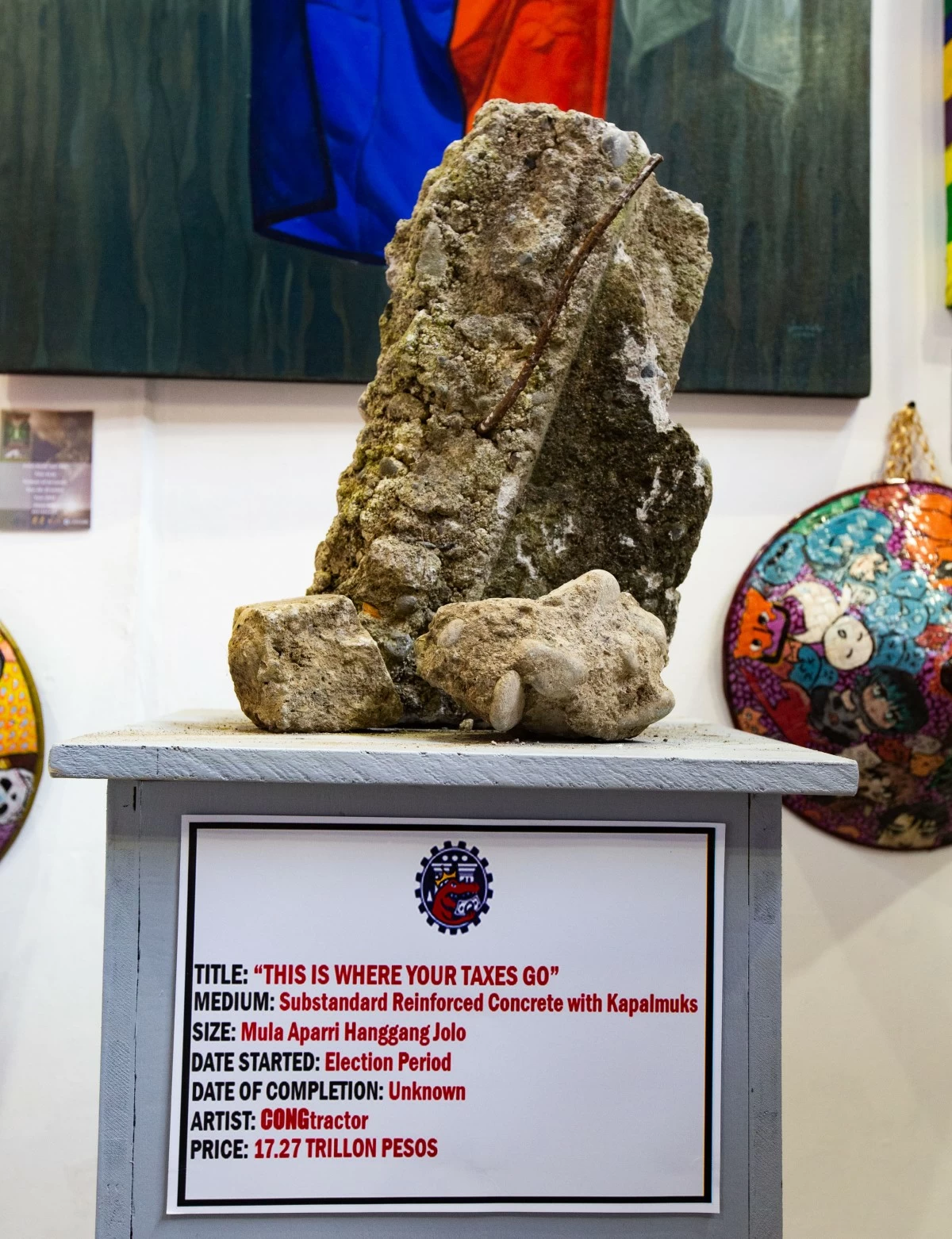
THE art installation ‘This is Where Your Taxes Go.’ (Keith Bacongco)
DAVAO CITY – A collaborative work of three artists from the Caraga region that depicts the anomalous flood control projects is now one of the head turners in the ongoing Mindanao Art Festival.
The art installation – a chunk of salvaged concrete with protruding reinforcement steel bars – has been drawing attention at the exhibition area in SM Lanang.
While Mindanao Art showcases art works coming from different galleries across the country, this particular art installation stands unique among over 1,000 pieces.
With the title “This is Where Your Taxes Go,” artist Gualberto Licong explained that the art installation tells a sad story of corruption-laden society.
“It’s like an Exhibit A, a physical evidence of the corruption,” said Licong, who collaborated with fellow artists Alwin Musa and Ariel Sitoy to come up with the bold idea.
The artists belong to Likha-Karaga Gallery based in Butuan City in Agusan del Norte in the Caraga region (Region 13).
Licong recalled that they agreed to produce an artwork that would surely captivate the attention of the audience, more particularly related to the issues that the country is facing today.
“We want to expose corruption through art. To challenge the people and government officials to take action for a genuine change for the benefit of the Filipinos,” he said.
The art installation originally weighs about 20 kilos and was taken from one of the government projects in an undisclosed location. It represents all anomalous government project in the Philippines.
Its label emulates the standard signage of the program of work in all government projects.
The label also bears a parody logo of the Department of Public Works and Highways with the country’s P17.27-trillion debt as the price of the project.
It also stated that its date started in an election period with unknown date of completion. “Mula Aparri hanggang Jolo (From Aparri to Jolo),” the project size stated.
A spectator from Southern Luzon reacted that the art installation depicts the real state of the government projects in many parts of the country. "Kahit doon sa amin, meron din mga ganyan na substandard at ghost projects. Lahat kasabwat pati mayor namin (There are ghost and substandard projects even in our place. Everybody is involved, even out mayor)," he said.
Aside from the art installation, Likha-Karaga also featured some art pieces that depict social commentaries on prevailing issues in the country.
Musa said the artwork is not just a display of artistry but also a social commentary that demands attention from the public.
He added that the art pieces are a bold reaction to betrayal, injustice, and greed.
Musa admitted that they came up with the idea out of dismay over the flood control issue. “Then we realized that most of the infrastructure projects, ang semento ang laging nakukurakot (cement is involved in corruption).”
Mindanao Art curator Karlo Antonio David said that the art installation by Likha-Karaga is just one of the few art pieces in the exhibition that depict social commentaries on the prevailing controversies in the country.
David said that they were expecting something bold from the artists prior to the opening of the exhibition.
Now on its seventh year, Mindanao Art is the biggest art festival in the region that showcases over 1,000 artworks coming from about 30 galleries from Visayas and Luzon.

Related Tags

Davao City Mindanao Art Festival
ADVERTISEMENT
.most-popular .layout-ratio{ padding-bottom: 79.13%; } @media (min-width: 768px) and (max-width: 1024px) { .widget-title { font-size: 15px !important; } }

{{ articles_filter_1561_widget.title }}

.most-popular .layout-ratio{ padding-bottom: 79.13%; } @media (min-width: 768px) and (max-width: 1024px) { .widget-title { font-size: 15px !important; } }

{{ articles_filter_1562_widget.title }}

.most-popular .layout-ratio{ padding-bottom: 79.13%; } @media (min-width: 768px) and (max-width: 1024px) { .widget-title { font-size: 15px !important; } }

{{ articles_filter_1563_widget.title }}

{{ articles_filter_1564_widget.title }}

.mb-article-details { position: relative; } .mb-article-details .article-body-preview, .mb-article-details .article-body-summary{ font-size: 17px; line-height: 30px; font-family: "Libre Caslon Text", serif; color: #000; } .mb-article-details .article-body-preview iframe , .mb-article-details .article-body-summary iframe{ width: 100%; margin: auto; } .read-more-background { background: linear-gradient(180deg, color(display-p3 1.000 1.000 1.000 / 0) 13.75%, color(display-p3 1.000 1.000 1.000 / 0.8) 30.79%, color(display-p3 1.000 1.000 1.000) 72.5%); position: absolute; height: 200px; width: 100%; bottom: 0; display: flex; justify-content: center; align-items: center; padding: 0; } .read-more-background a{ color: #000; } .read-more-btn { padding: 17px 45px; font-family: Inter; font-weight: 700; font-size: 18px; line-height: 16px; text-align: center; vertical-align: middle; border: 1px solid black; background-color: white; } .hidden { display: none; }
function initializeAllSwipers() { // Get all hidden inputs with cms_article_id document.querySelectorAll('[id^="cms_article_id_"]').forEach(function (input) { const cmsArticleId = input.value; const articleSelector = '#article-' + cmsArticleId + ' .body_images'; const swiperElement = document.querySelector(articleSelector); if (swiperElement && !swiperElement.classList.contains('swiper-initialized')) { new Swiper(articleSelector, { loop: true, pagination: false, navigation: { nextEl: '#article-' + cmsArticleId + ' .swiper-button-next', prevEl: '#article-' + cmsArticleId + ' .swiper-button-prev', }, }); } }); } setTimeout(initializeAllSwipers, 3000); const intersectionObserver = new IntersectionObserver( (entries) => { entries.forEach((entry) => { if (entry.isIntersecting) { const newUrl = entry.target.getAttribute("data-url"); if (newUrl) { history.pushState(null, null, newUrl); let article = entry.target; // Extract metadata const author = article.querySelector('.author-section').textContent.replace('By', '').trim(); const section = article.querySelector('.section-info ').textContent.replace(' ', ' '); const title = article.querySelector('.article-title h1').textContent; // Parse URL for Chartbeat path format const parsedUrl = new URL(newUrl, window.location.origin); const cleanUrl = parsedUrl.host + parsedUrl.pathname; // Update Chartbeat configuration if (typeof window._sf_async_config !== 'undefined') { window._sf_async_config.path = cleanUrl; window._sf_async_config.sections = section; window._sf_async_config.authors = author; } // Track virtual page view with Chartbeat if (typeof pSUPERFLY !== 'undefined' && typeof pSUPERFLY.virtualPage === 'function') { try { pSUPERFLY.virtualPage({ path: cleanUrl, title: title, sections: section, authors: author }); } catch (error) { console.error('ping error', error); } } // Optional: Update document title if (title && title !== document.title) { document.title = title; } } } }); }, { threshold: 0.1 } ); function showArticleBody(button) { const article = button.closest("article"); const summary = article.querySelector(".article-body-summary"); const body = article.querySelector(".article-body-preview"); const readMoreSection = article.querySelector(".read-more-background"); // Hide summary and read-more section summary.style.display = "none"; readMoreSection.style.display = "none"; // Show the full article body body.classList.remove("hidden"); } document.addEventListener("DOMContentLoaded", () => { let loadCount = 0; // Track how many times articles are loaded const offset = [1, 2, 3, 4, 5, 6, 7, 8, 9, 10]; // Offset values const currentUrl = window.location.pathname.substring(1); let isLoading = false; // Prevent multiple calls if (!currentUrl) { console.log("Current URL is invalid."); return; } const sentinel = document.getElementById("load-more-sentinel"); if (!sentinel) { console.log("Sentinel element not found."); return; } function isSentinelVisible() { const rect = sentinel.getBoundingClientRect(); return ( rect.top < window.innerHeight && rect.bottom >= 0 ); } function onScroll() { if (isLoading) return; if (isSentinelVisible()) { if (loadCount >= offset.length) { console.log("Maximum load attempts reached."); window.removeEventListener("scroll", onScroll); return; } isLoading = true; const currentOffset = offset[loadCount]; window.loadMoreItems().then(() => { let article = document.querySelector('#widget_1690 > div:nth-last-of-type(2) article'); intersectionObserver.observe(article) loadCount++; }).catch(error => { console.error("Error loading more items:", error); }).finally(() => { isLoading = false; }); } } window.addEventListener("scroll", onScroll); });

Sign up by email to receive news.