ADVERTISEMENT

PH formally submits ratification documents of High Seas Treaty at UNGA

Published Sep 24, 2025 01:51 pm
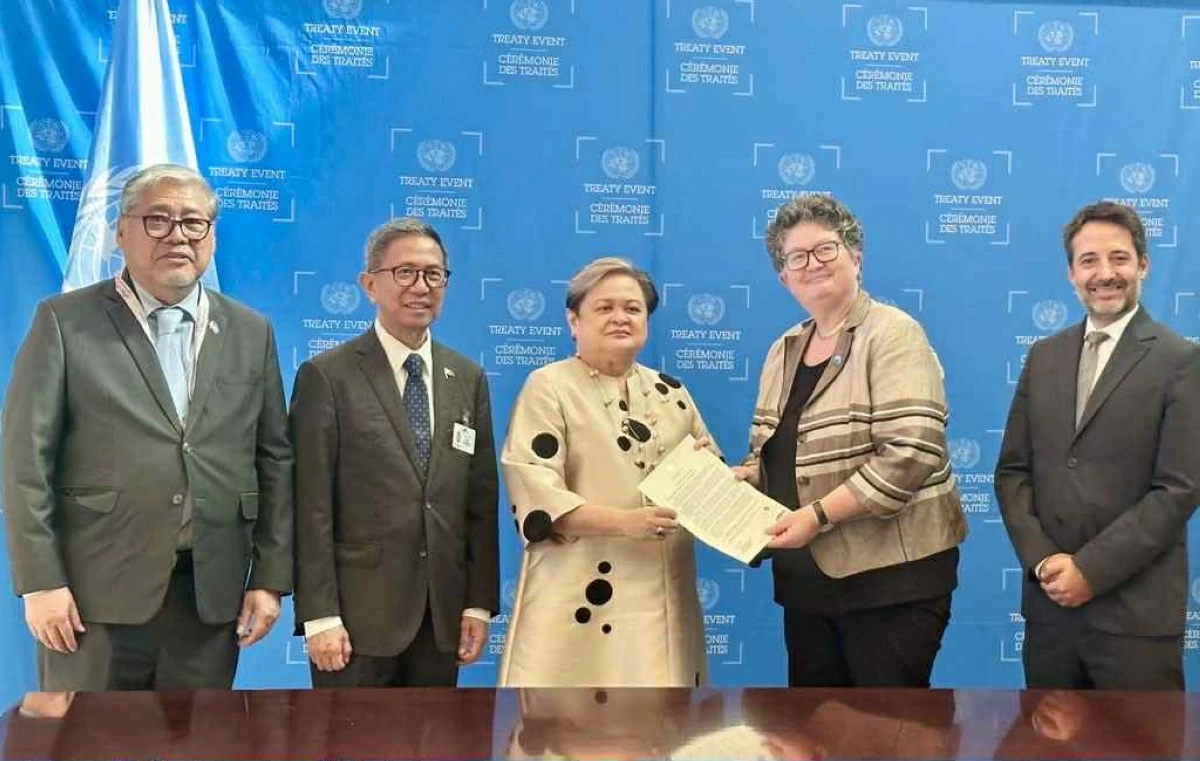
The Philippines deposits the ratification instrument for the BBNJ Agreement at the Treaty event of the UN General Assembly in New York. (DFA Photo)
Proving its leadership in marine ecology and the sustainable use of maritime resources, the Philippines—through Department of Foreign Affairs (DFA) Secretary Ma. Theresa Lazaro—formally deposited the instrument of ratification of the Agreement on the Conservation and Sustainable Use of Marine Biological Diversity of Areas Beyond National Jurisdiction (BBNJ) at the United Nations General Assembly (UNGA).

The turnover of the documents was done during the Treaty Event held at the UNGA headquarters in New York City on Wednesday, Sept. 24 (Manila time).

“This is a testament to the Philippines' leadership in efforts to advance global ocean governance, as a maritime and archipelagic nation,” Lazaro, who was together with Environment Secretary Raphael Lotilla, said in an X (formerly Twitter) post.

The BBNJ, also called the High Seas Treaty, is the third implementing agreement of the 1982 United Nations Convention on the Law of the Sea (UNCLOS).

It seeks to ensure the conservation and sustainable use of marine biological diversity of areas beyond national jurisdiction.

“We are proud to take this next step to be part of the growing family of States Parties the BBNJ Agreement. The Agreement is a milestone in addressing biological diversity loss and the degradation of ocean ecosystems,” Lazaro said.

“It is a crucial multilateral framework for an archipelagic state like the Philippines that is located in the world’s center of marine biodiversity, and bounded by the high seas in the Pacific and in the South China Sea. It further implements and reinforces the UNCLOS,” she added.

According to the secretary, the Philippines played an active role in the two-decade process that led to the BBNJ Agreement.

She said that throughout the process, the Philippines “advocated for the special recognition for archipelagic states – and together with other states, the common heritage of humankind, the fair and equitable sharing of benefits, as well as capacity building and marine technology transfer, particularly for developing states.”

This new agreement will deliver “tangible benefits” to the country as it ensures the health of the ocean and sustain fisheries, which will secure food and livelihood for millions of coastal families.

The DFA said it will also provide “area-based protections” in the high seas that could enhance fish stocks and it will provide capacity-building and marine technology transfer opportunities for Filipino scientists.

“The Philippines’ ratification of the BBNJ Agreement solidifies its commitment to uphold the rules-based order underpinned by international law, particularly by UNCLOS,” a statement from the DFA read.

“It also affirms the country’s responsibility to protect and preserve the marine environment, including in the high seas,” it added, pointing out the Philippines’ geographical proximity to resource-rich maritime features.

The BBNJ Agreement is the third implementing agreement to the UNCLOS.

President Marcos ratified it on June 18, 2024, while Senate’s concurrence followed on Sept. 17 this year.

Related Tags

UN General Assembly Ma. Theresa Lazaro DFA High Seas Treaty
ADVERTISEMENT
.most-popular .layout-ratio{ padding-bottom: 79.13%; } @media (min-width: 768px) and (max-width: 1024px) { .widget-title { font-size: 15px !important; } }

{{ articles_filter_1561_widget.title }}

.most-popular .layout-ratio{ padding-bottom: 79.13%; } @media (min-width: 768px) and (max-width: 1024px) { .widget-title { font-size: 15px !important; } }

{{ articles_filter_1562_widget.title }}

.most-popular .layout-ratio{ padding-bottom: 79.13%; } @media (min-width: 768px) and (max-width: 1024px) { .widget-title { font-size: 15px !important; } }

{{ articles_filter_1563_widget.title }}

{{ articles_filter_1564_widget.title }}

.mb-article-details { position: relative; } .mb-article-details .article-body-preview, .mb-article-details .article-body-summary{ font-size: 17px; line-height: 30px; font-family: "Libre Caslon Text", serif; color: #000; } .mb-article-details .article-body-preview iframe , .mb-article-details .article-body-summary iframe{ width: 100%; margin: auto; } .read-more-background { background: linear-gradient(180deg, color(display-p3 1.000 1.000 1.000 / 0) 13.75%, color(display-p3 1.000 1.000 1.000 / 0.8) 30.79%, color(display-p3 1.000 1.000 1.000) 72.5%); position: absolute; height: 200px; width: 100%; bottom: 0; display: flex; justify-content: center; align-items: center; padding: 0; } .read-more-background a{ color: #000; } .read-more-btn { padding: 17px 45px; font-family: Inter; font-weight: 700; font-size: 18px; line-height: 16px; text-align: center; vertical-align: middle; border: 1px solid black; background-color: white; } .hidden { display: none; }
function initializeAllSwipers() { // Get all hidden inputs with cms_article_id document.querySelectorAll('[id^="cms_article_id_"]').forEach(function (input) { const cmsArticleId = input.value; const articleSelector = '#article-' + cmsArticleId + ' .body_images'; const swiperElement = document.querySelector(articleSelector); if (swiperElement && !swiperElement.classList.contains('swiper-initialized')) { new Swiper(articleSelector, { loop: true, pagination: false, navigation: { nextEl: '#article-' + cmsArticleId + ' .swiper-button-next', prevEl: '#article-' + cmsArticleId + ' .swiper-button-prev', }, }); } }); } setTimeout(initializeAllSwipers, 3000); const intersectionObserver = new IntersectionObserver( (entries) => { entries.forEach((entry) => { if (entry.isIntersecting) { const newUrl = entry.target.getAttribute("data-url"); if (newUrl) { history.pushState(null, null, newUrl); let article = entry.target; // Extract metadata const author = article.querySelector('.author-section').textContent.replace('By', '').trim(); const section = article.querySelector('.section-info ').textContent.replace(' ', ' '); const title = article.querySelector('.article-title h1').textContent; // Parse URL for Chartbeat path format const parsedUrl = new URL(newUrl, window.location.origin); const cleanUrl = parsedUrl.host + parsedUrl.pathname; // Update Chartbeat configuration if (typeof window._sf_async_config !== 'undefined') { window._sf_async_config.path = cleanUrl; window._sf_async_config.sections = section; window._sf_async_config.authors = author; } // Track virtual page view with Chartbeat if (typeof pSUPERFLY !== 'undefined' && typeof pSUPERFLY.virtualPage === 'function') { try { pSUPERFLY.virtualPage({ path: cleanUrl, title: title, sections: section, authors: author }); } catch (error) { console.error('ping error', error); } } // Optional: Update document title if (title && title !== document.title) { document.title = title; } } } }); }, { threshold: 0.1 } ); function showArticleBody(button) { const article = button.closest("article"); const summary = article.querySelector(".article-body-summary"); const body = article.querySelector(".article-body-preview"); const readMoreSection = article.querySelector(".read-more-background"); // Hide summary and read-more section summary.style.display = "none"; readMoreSection.style.display = "none"; // Show the full article body body.classList.remove("hidden"); } document.addEventListener("DOMContentLoaded", () => { let loadCount = 0; // Track how many times articles are loaded const offset = [1, 2, 3, 4, 5, 6, 7, 8, 9, 10]; // Offset values const currentUrl = window.location.pathname.substring(1); let isLoading = false; // Prevent multiple calls if (!currentUrl) { console.log("Current URL is invalid."); return; } const sentinel = document.getElementById("load-more-sentinel"); if (!sentinel) { console.log("Sentinel element not found."); return; } function isSentinelVisible() { const rect = sentinel.getBoundingClientRect(); return ( rect.top < window.innerHeight && rect.bottom >= 0 ); } function onScroll() { if (isLoading) return; if (isSentinelVisible()) { if (loadCount >= offset.length) { console.log("Maximum load attempts reached."); window.removeEventListener("scroll", onScroll); return; } isLoading = true; const currentOffset = offset[loadCount]; window.loadMoreItems().then(() => { let article = document.querySelector('#widget_1690 > div:nth-last-of-type(2) article'); intersectionObserver.observe(article) loadCount++; }).catch(error => { console.error("Error loading more items:", error); }).finally(() => { isLoading = false; }); } } window.addEventListener("scroll", onScroll); });

Sign up by email to receive news.